


The most common literary allusion to US President George W. Bush is William Shakespeare's Prince Hal, the hard-drinking, wild-living young man who sobers up and emerges as the great English warrior King Henry V.
So, as the Republicans once again crown Bush as their nominee, I decided to seek lessons from an expert on King Henry, who is also one of the shrewdest analysts of current American politics and international affairs. That's right: Shakespeare. I went to Ashland for my annual pilgrimage to the Oregon Shake-speare Festival, then started thinking about what Shake-speare might say.
The paramount lesson in Shakespeare's plays is that the world is full of nuances and uncertainties, and that leaders self-destruct when they are too rigid, too sure of themselves or too intoxicated by moral clarity.
You see Shakespeare's passion for nuance in the way he portrays Henry V himself (you also see his prurience, for Henry V is Shake-speare's most obscene play, laced with X-rated double-entendres that make it a fine introduction to the Bard for teens).
Shakespeare admires Henry, who, like Bush, is strong, decisive and funny to be around, as well as a victor in overseas battles that help soothe doubts about his legitimacy. Thus for several hundred years, the play Henry V was regarded as a celebration of Henry's invasions of France, and for that reason George Bernard Shaw and other liberal critics recoiled from it.
Yet critics began to see another subtext -- an unblinking examination of the brutality and excesses of war, even depicting the Abu Ghraib scandal of the 15th century: Henry's order to murder French prisoners at Agincourt. Shakespeare's play can be seen as scorning the empty-headed jingoism that inflicts so much suffering as the ruler wraps himself in the flag. As Shakespeare writes about wars of choice:
"But if the cause be not good, the king himself hath a heavy reckoning to make when all those legs and arms and heads chopped off in a battle shall join together at the latter day and cry all `We died at such and such a place,' some swearing, some crying for a surgeon, some upon their wives left poor behind them, some upon the debts they owe, some upon their children rawly left. I am afeared there are few die well that die in a battle."
A related lesson for Bush is the inevitability of intelligence failures. In many plays, characters believe information that turns out to be untrue. Lear believes his elder daughters; Romeo believes that Juliet is dead; Othello believes Iago's lies.
Shakespeare begins Henry IV, Part 2, with the character of Rumor (who could be played by Ahmad Chalabi) and shows how kings get in trouble by relying on partial truths or flattery spun by sycophants like Goneril Tenet and Regan Wolfowitz.
"All these figures in Shake-speare suffer from hubris, and that's what Bush is suffering from," says Kenneth Albers, a veteran Shakespearean actor who is playing Lear in Ashland.
Indeed, the only person who seems to provide Shakespeare's kings with sound advice is the court fool, who cannot be punished for saying unpalatable truths. I urge Bush to appoint a White House fool.
Shakespeare is warning us against rash actions on the basis of flawed intelligence. Hamlet is sometimes seen as an indictment of indecision, but his "to be or not to be" soliloquy is a careful examination of the pros and cons of immediate action -- a measured approach that Bush might have emulated before the Iraq war.
Instead, Bush emulates Coriolanus, who proves so inflexible and intemperate that tragedy befalls his people.
Unless Bush learns to see nuance and act less rashly, he will be the Coriolanus of our age: a strong and decisive leader, initially celebrated for his leadership in a crisis, who ultimately fails himself and his nation because of his rigidity, superficiality and arrogance.
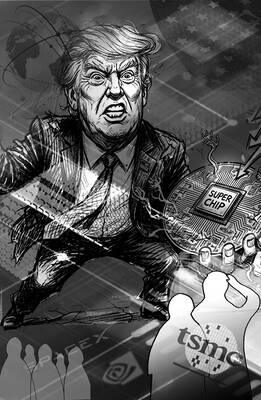
The White House’s decision to take a 9.9 percent stake in Intel Corp is looking like very shrewd business indeed. Since the government bought in at US$20.47 a share last August, the US chipmaker’s surging stock price has delivered the US a US$43 billion return. One of the reasons the investment has so far proved so sound is that the White House has made sure of it. According to The Wall Street Journal, Howard personally pushed deals on Intel’s behalf with some of the most lucrative clients imaginable. They include Nvidia Corp, the company at the heart of the AI
A single photograph can cut through a lot of noise, but it can also be used to misrepresent the truth. At the very least, it can concentrate the mind on something that requires further investigation. On Monday last week, Ma Ying-jeou Foundation CEO Tai Hsia-ling (戴遐齡) and former National Security Council secretary-general King Pu-tsung (金溥聰) held a news conference in which they showed a photograph of former foundation CEO Hsiao Hsu-tsen (蕭旭岑), now Chinese Nationalist Party (KMT) deputy chairman. In the image Hsiao is seated next to Xiamen Taiwan Businessmen Association chairman Han Ying-huan (韓螢煥). The two men were holding
I first met Professor Ray Jiing (井迎瑞) as a film and documentary student at Shih Hsin University’s (SHU) Department of Radio Television and Film in 1988. The following year, he went on to become the director of the Chinese Taipei Film Archive — forerunner of the Taiwan Film and Audiovisual Institute (TFAI). Over his eight-year tenure, Jiing rescued and restored over 200 classic Taiwanese films. In 1997, he established the Graduate Institute of Studies in Documentary and Film Archiving at Tainan National University of the Arts (TNNUA), and I joined the program in his third cohort of students. Beyond a
A recent report concerning a student who is suing his teacher posed the question in its headline: Does failing a student in two subjects constitute bullying? The college student in Chiayi County apparently sought NT$2 million (US$63,603) in state compensation, but a court dismissed the case. The first reaction of many might have been to ask: What has happened to students nowadays? Some say that teachers have lost their authority, while others say students are overindulged. Some even start reminiscing over the days when “whatever the teacher says goes.” However, the real issue might be overlooked if emotional reactions like that are the


 RSS
RSS