


On March 15, former president Lee Teng-hui (李登輝) formally proposed recognition of Taiwanese nationhood at a meeting of the World Federation of Taiwanese Associations (世界台灣人大會). He also laid down the main guidelines for a new Constitution establishing the nation Taiwan.
Constitutional reform is the kind of healthy thinking the people of any sovereign and independent state should entertain, but it was criticized by PFP Chairman James Soong (宋楚瑜). He believes it would anger "Communist China" (中共), and that most nations "would not accept Taiwan independence." Such statements once again throw Soong's and Lien Chan's (連戰) slogan "the Republic of China is a sovereign and independent state" into a state of extreme political confusion.
Taiwan is deceiving the world by using the name Republic of China. The world is abundantly clear on the fact that Taiwan is the factual entity and that the Republic of China is a political corpse expelled from the international community. Taiwan still clings to this false status, living out a life in degradation. Soong's logic is the laughing stock of today's society and its only market is the unificationist camp.
To put down the Taiwanese people's hope of independence and sovereignty, Soong even suggested that other nations would not accept Taiwan independence. We want to ask Soong if China, a constant threat to Taiwan, would ask the US, Japan or Europe for permission to invade Taiwan. But when Taiwan wants to build a peaceful, democratic and free country called Taiwan, he wants to ask whether other nations agree. What kind of logic is that? It's ridiculous.
POLITICAL RESPONSIBILITY
The people of Taiwan should ask Soong, who talks loudly of his love for Taiwan, whether he accepts that Taiwan is a sovereign and independent state. We should ask him to be unambiguously clear.
Someone intending to run for president should possess political intelligence and a sense of mission, and call for the people to protect their own nation. Soong, however, scorns the moral courage and political responsibility such a political leader should possess and threatens the people of Taiwan with the enemy. If we really needed such politicians, wouldn't it be faster simply to surrender?
When faced with invasion and an anti-humanitarian dictatorship, a self-respecting people should stand up and protect itself. If the leaders of Vietnam constantly had told their people not to anger China, would it still exist?
Soong's threats about what will happen if we anger China are only meant to consolidate the political thinking and interests of his China-friendly political clique. He doesn't consider the fate and future of the people of Taiwan, and is exchanging the lives of the whole people for his own personal interests.
The KMT has lived through 50 years of colonialist thinking of a united greater China. This is still poisoning the spirit of the Taiwanese people, and many Taiwanese must have been seriously affected by this China poison to be taken in by Soong's and Lien's coarse political lies.
Protecting Taiwan and not angering China are mutually exclusive concepts. Someone who wants to protect Taiwan without angering China only pretends to love Taiwan and does not intend to protect it. How come the Taiwanese people still haven't seen through this kind of politician?
Tzeng Kuei-hai is chairman of the Southern Taiwan Society.
Translated by Perry Svensson
On March 22, 2023, at the close of their meeting in Moscow, media microphones were allowed to record Chinese Communist Party (CCP) dictator Xi Jinping (習近平) telling Russia’s dictator Vladimir Putin, “Right now there are changes — the likes of which we haven’t seen for 100 years — and we are the ones driving these changes together.” Widely read as Xi’s oath to create a China-Russia-dominated world order, it can be considered a high point for the China-Russia-Iran-North Korea (CRINK) informal alliance, which also included the dictatorships of Venezuela and Cuba. China enables and assists Russia’s war against Ukraine and North Korea’s
After thousands of Taiwanese fans poured into the Tokyo Dome to cheer for Taiwan’s national team in the World Baseball Classic’s (WBC) Pool C games, an image of food and drink waste left at the stadium said to have been left by Taiwanese fans began spreading on social media. The image sparked wide debate, only later to be revealed as an artificially generated image. The image caption claimed that “Taiwanese left trash everywhere after watching the game in Tokyo Dome,” and said that one of the “three bad habits” of Taiwanese is littering. However, a reporter from a Japanese media outlet
Taiwanese pragmatism has long been praised when it comes to addressing Chinese attempts to erase Taiwan from the international stage. “Taipei” and the even more inaccurate and degrading “Chinese Taipei,” imposed titles required to participate in international events, are loathed by Taiwanese. That is why there was huge applause in Taiwan when Japanese public broadcaster NHK referred to the Taiwanese Olympic team as “Taiwan,” instead of “Chinese Taipei” during the opening ceremony of the Tokyo Olympics. What is standard protocol for most nations — calling a national team by the name their country is commonly known by — is impossible for
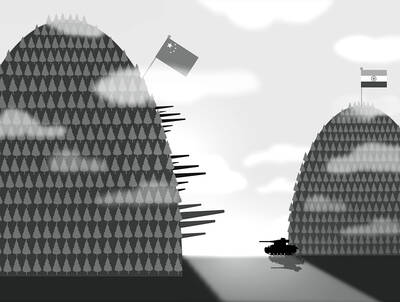
India is not China, and many of its residents fear it never will be. It is hard to imagine a future in which the subcontinent’s manufacturing dominates the world, its foreign investment shapes nations’ destinies, and the challenge of its economic system forces the West to reshape its own policies and principles. However, that is, apparently, what the US administration fears. Speaking in New Delhi last week, US Deputy Secretary of State Christopher Landau warned that “we will not make the same mistakes with India that we did with China 20 years ago.” Although he claimed the recently agreed framework


 RSS
RSS