


You can blame part of it on Margaret Thatcher. It was she who brought some of the worst characteristics of the British temper to the surface and made them respectable: parochialism, petty nationalism, distrust of strangers (the Americans excepted), dog eat dog, and that long tradition of petty-bourgeois stoicism, tolerating the second rate from government and the public sector -- hospitals, trains, schools and so on.
Her originality was to shake the moribund British economic tree until its leaves fell off, revealing a new hard working, thrifty, go-for-it populace -- only 20-30 percent of the population, but that was enough -- that would, by earning more, be able to buy privately what it did not really like in the public sector. All this still lives on after four years of Labour government and will be, doubtless, alive and healthy at the end of another five-year term, unless Prime Minister Tony Blair is suddenly struck by lightening on the way to Buckingham Palace.
You can blame some of it too on John Major, Thatcher's successor. It wasn't so much that he carried on the Thatcherite revolution of privatisation with an earnestness that led to the terrible mistakes of the rail system, it was the way he resigned immediately on losing the election. If he had hung on for six months as leader of the opposition, Chris Patten would have had time to finish his term of office as governor of Hong Kong, return to Britain, win a seat at Westminster in a by-election and then assume the leadership of the Conservative Party.
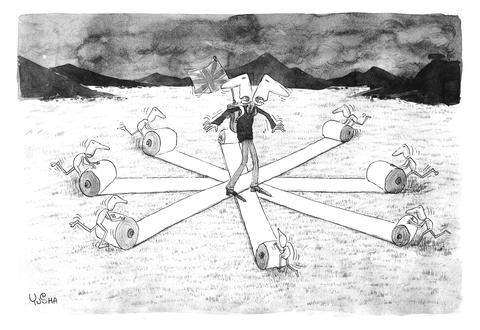
ILLUSTRATION: YU SHA
It was both an act of betrayal and an act of small mindedness. The former because it was Patten who, as chairman of the party, had won Major his second term in office against all predictions and the latter because it threw the Conservatives into the hands of the narrowest of ideologues, led by little Englanders who seemed totally out of touch with the realities of an emerging Europe that celebrates both its strengths and diversity through its unity, and who hark back to some bygone age when closeness to Washington was Britain's only political option.
If Patten had led the Conservatives then a referendum on Europe would have been, by now, long over and done with, and Britain a signed up member of the euro-currency club from the onset, taking its place as one of the major creative forces in building a war-free Europe, which is what all this binding and building is ultimately about.
As it was, Blair, despite an enormous majority that should have enabled him, as far as the electorate was concerned, to walk on water, became frightened at the prospect of calling a referendum with the Conservatives against him and, more importantly, the conservative press, owned by North Americans -- itself a quite ludicrous state of affairs since neither Rupert Murdoch nor Conrad Black have any compunction about using supposedly impartial media outlets to tell the government and a good slice of the electorate what to do over Europe.
This tells us a lot about Blair, a "nice guy" as Polly Toynbee, the shrewd commentator of The Guardian tells us. "Not cynical, not world-weary, his easy sincerity is entirely convincing: he plainly wants to do good. But at each meeting the puzzle is always the same: what holds him back from a great leap forward?" Blair does not set out to challenge long held British attitudes, now alive and well again after the renovation work done on them by Margaret Thatcher.
As Toynbee says, "A bolder leader might challenge popular apathy, ignorance, indifference, unambition and intellectual idleness by offering something more than amelioration."
An attitude of caution perhaps more understandable from Bill Clinton who, for most of his time in office, had a hostile Congress arrayed against him, but less explicable for Blair who commanded an enormous majority and who has never seemed in doubt of winning another one.
I have watched this election from the home of my dying mother-in-law in Sweden, at peace that my vote won't count and knowing that, for the first time in my 40 years of voting, there is no party on offer I really want to vote for.
But Sweden sparks another thought as yet one more time family events lead me to observe close up how another nation runs its public services. How, for example, Swedish retirement homes and hospitals manage to maintain such high levels of medical excellence, the kindest of nursing care for the dying, coupled with very pleasant surroundings that would shame even the toppest notch of America's private sector.
I have long wondered why Blair doesn't hop on a plane for a 90-minute journey here, followed by the press pack, while he spends two weeks educating himself and the media behind him on what can work in the public sector, how it works and why it works. Blair could do anything he wants and get away with it. He could put Britain at the centre of Europe. He could challenge -- and change -- the British tolerance for the second-rate. He could give the country something to aim for and, as Toynbee says, "seize the imagination of a phlegmatic population [because] out there is still an outdated, unmodernized, semi-static nation, encrusted with phoney traditions, resistant to change, even in the face of glaring social and economic lassitude."
Good natured as he is, Blair is probably too young and too inexperienced to be prime minister. He came to office not having travelled much except on holiday, with few encounters with life outside his studies as a student and later as a parliamentarian. If he knew how Britain could be, he surely wouldn't be quite so complacent, unassuming and diffident about his country's future.

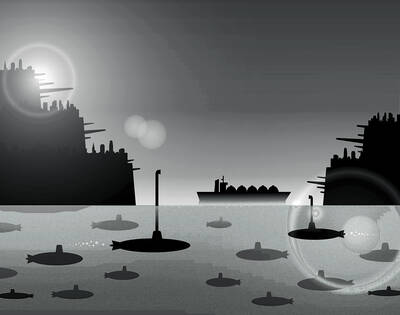
In the event of a war with China, Taiwan has some surprisingly tough defenses that could make it as difficult to tackle as a porcupine: A shoreline dotted with swamps, rocks and concrete barriers; conscription for all adult men; highways and airports that are built to double as hardened combat facilities. This porcupine has a soft underbelly, though, and the war in Iran is exposing it: energy. About 39,000 ships dock at Taiwan’s ports each year, more than the 30,000 that transit the Strait of Hormuz. About one-fifth of their inbound tonnage is coal, oil, refined fuels and liquefied natural gas (LNG),
On Monday, the day before Chinese Nationalist Party (KMT) Chairwoman Cheng Li-wun (鄭麗文) departed on her visit to China, the party released a promotional video titled “Only with peace can we ‘lie flat’” to highlight its desire to have peace across the Taiwan Strait. However, its use of the expression “lie flat” (tang ping, 躺平) drew sarcastic comments, with critics saying it sounded as if the party was “bowing down” to the Chinese Communist Party (CCP). Amid the controversy over the opposition parties blocking proposed defense budgets, Cheng departed for China after receiving an invitation from the CCP, with a meeting with
Chinese Nationalist Party (KMT) Chairwoman Cheng Li-wun (鄭麗文) is leading a delegation to China through Sunday. She is expected to meet with Chinese President Xi Jinping (習近平) in Beijing tomorrow. That date coincides with the anniversary of the signing of the Taiwan Relations Act (TRA), which marked a cornerstone of Taiwan-US relations. Staging their meeting on this date makes it clear that the Chinese Communist Party (CCP) intends to challenge the US and demonstrate its “authority” over Taiwan. Since the US severed official diplomatic relations with Taiwan in 1979, it has relied on the TRA as a legal basis for all
To counter the CCP’s escalating threats, Taiwan must build a national consensus and demonstrate the capability and the will to fight. The Chinese Communist Party (CCP) often leans on a seductive mantra to soften its threats, such as “Chinese do not kill Chinese.” The slogan is designed to frame territorial conquest (annexation) as a domestic family matter. A look at the historical ledger reveals a different truth. For the CCP, being labeled “family” has never been a guarantee of safety; it has been the primary prerequisite for state-sanctioned slaughter. From the forced starvation of 150,000 civilians at the Siege of Changchun


 RSS
RSS