


There has been considerable interest in Tibetan Buddhism here in Taiwan over the past few years. A large number of books have been published, Tibetan Buddhist groups have been organized, Tibetan masters have been come to visit and teach and, of course, there was the visit of the Dalai Lama himself.
This interest in Tibetan Buddhism could reflect one of two trends. On the less positive side, the interest could merely reflect an unhealthy interest in acquiring occult or supernatural powers. The blunt reality is that much of Tibetan Buddhism's "fame" is owing to its reputed ability to harness supernatural powers. This, combined with the superstitious tendency in Taiwanese culture, makes for an unhealthy combination.
But on a far more positive note, the interest in Tibetan Buddhism may reflect a desire to create a more compassionate society and more compassionate individuals. In my opinion, many of Taiwan's fundamental problems stem from a lack of genuine compassion in society. As a human rights advocate and an attorney, I am often struck by the lack of compassion here.
I don't say this to be insulting, nor to be racist, nor ethnocen-tric. I quickly admit that the US is not a bastion of compassion either. And I realize that it is a generalization and all generalizations have exceptions, but I think it is fair to say, that as a society, Taiwan lacks true compassion.
Compassion is central to Tibetan Buddhism. The Dalai Lama stresses the fundamental place of compassion and its relationship to human rights.
"Although it is important to respect others' natural rights, we tend to lead our lives in the opposite way," he has written. "This is because we lack love and compassion. Therefore, even in relation to the question of human rights violations and concern for human rights, the key point is the practice of compassion, love and forgiveness. Very often, when people hear about love and compassion, they have a sense that these are related to religious practices. It is not necessarily so. It is very important to recognize instead that compassion and love are fundamental to relations between sentient beings in general and human beings in particular."
I agree with the Dalai Lama's assertion that the key factor in any society, which will tend to foster support for human rights and individual dignity, is compassion. Absent a strong basis of compassion, individuals and societies tend to have a very apathetic approach to basic human rights and civil liberties. Much of the Taiwanese public's disinterest in human rights and civil liberties is a result of a lack of genuine compassion towards others. Of course there are other factors at work: historical, sociological and others, but a lack of social and individual compassion is perhaps the core problem.
The question is what exactly is this quality that is so important to both human rights and Tibetan Buddhism?
The Dalai Lama says: "I would like to explain the meaning of compassion, which is often misunderstood. Genuine compassion is based not on our own projections and expectations, but rather on the rights of the other: Irrespective of whether another person is a close friend or an enemy, as long as that person wishes for peace and happiness and wishes to overcome suffering, then on that basis we develop genuine concern for his or her problem. This is genuine compassion."
I would hope that the widespread interest in Tibetan Buddhism leads Taiwanese to appreciate and value compassion.
If this happens, both on an individual and societal level, then the values of human rights and civil liberties will naturally have a stronger, more stable basis. And that will be very good for Taiwan in the year 2000.
Brian Kennedy is a member of the boards of Amnesty International Taiwan and the Taiwan Association for Human Rights.
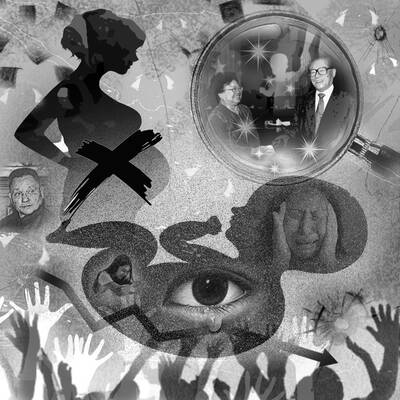
Jan. 1 marks a decade since China repealed its one-child policy. Just 10 days before, Peng Peiyun (彭珮雲), who long oversaw the often-brutal enforcement of China’s family-planning rules, died at the age of 96, having never been held accountable for her actions. Obituaries praised Peng for being “reform-minded,” even though, in practice, she only perpetuated an utterly inhumane policy, whose consequences have barely begun to materialize. It was Vice Premier Chen Muhua (陳慕華) who first proposed the one-child policy in 1979, with the endorsement of China’s then-top leaders, Chen Yun (陳雲) and Deng Xiaoping (鄧小平), as a means of avoiding the
As the Chinese People’s Liberation Army (PLA) races toward its 2027 modernization goals, most analysts fixate on ship counts, missile ranges and artificial intelligence. Those metrics matter — but they obscure a deeper vulnerability. The true future of the PLA, and by extension Taiwan’s security, might hinge less on hardware than on whether the Chinese Communist Party (CCP) can preserve ideological loyalty inside its own armed forces. Iran’s 1979 revolution demonstrated how even a technologically advanced military can collapse when the social environment surrounding it shifts. That lesson has renewed relevance as fresh unrest shakes Iran today — and it should

The last foreign delegation Nicolas Maduro met before he went to bed Friday night (January 2) was led by China’s top Latin America diplomat. “I had a pleasant meeting with Qiu Xiaoqi (邱小琪), Special Envoy of President Xi Jinping (習近平),” Venezuela’s soon-to-be ex-president tweeted on Telegram, “and we reaffirmed our commitment to the strategic relationship that is progressing and strengthening in various areas for building a multipolar world of development and peace.” Judging by how minutely the Central Intelligence Agency was monitoring Maduro’s every move on Friday, President Trump himself was certainly aware of Maduro’s felicitations to his Chinese guest. Just
On today’s page, Masahiro Matsumura, a professor of international politics and national security at St Andrew’s University in Osaka, questions the viability and advisability of the government’s proposed “T-Dome” missile defense system. Matsumura writes that Taiwan’s military budget would be better allocated elsewhere, and cautions against the temptation to allow politics to trump strategic sense. What he does not do is question whether Taiwan needs to increase its defense capabilities. “Given the accelerating pace of Beijing’s military buildup and political coercion ... [Taiwan] cannot afford inaction,” he writes. A rational, robust debate over the specifics, not the scale or the necessity,


 RSS
RSS