


After the sack of Nanjing in 1841, then imperial capital of China, the British secured what the Chinese still call the unequal treaty; Britain won control of Hong Kong and the right to trade freely in opium; the Chinese got nothing. And it was at Nanjing in 1937 that the Chinese were again and more bloodily humiliated by foreigners.
The Japanese murdered an estimated 300,000 civilians and soldiers in an atrocity whose calculated, indifferent cruelty rivalled a Nazi death camp, but to which the world has been curiously indifferent.
Yet today this once decaying symbol of China's century-long weakness is at one end of a booming 320km long corridor of factories and worker flats; at the other end sits the throbbing mega-sprawl of Shanghai.
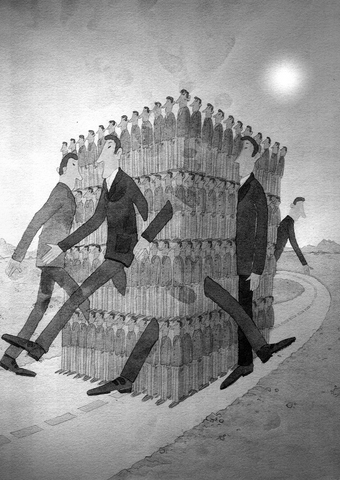
ILLUSTRATION: YU SHA
China is beginning to meet the economic expectation that it has long promised but never delivered, due to a phenomenon that dare not openly speak its name. Capitalism, a distinctive and more socially minded Chinese capitalism but capitalism none the less, is irreversibly taking root in the world's most populous, and communist, country. Nothing is likely to be the same again. Nanjing's ambitions, and its capacity to meet them, is tribute to that. As the deputy director of the city's economic commission explained to me, it aims to become China's No. 1 knowledge city. It has 37 universities.
A state-of-the-art metro system with bullet trains begins operation this autumn. The plan is to combine this extraordinary infrastructure with the opportunities of globalization to make the city's three core industries -- automobiles, petrochemicals, and information and communication technoloy (ICT) -- super-competitive.
I asked him and a group of businessmen he had arranged for me to meet if there was any going back. None, they nodded in unison. Nobody in China had any other prospectus than more of what was so evidently working.
Openness to inward investment is galvanizing Nanjing's industrial base. Ford and Fiat have given the local car and truck industry, and its supply chain, critical mass and international quality standards.
The latest addition is Rover, for Nanjing is where Rover's new manufacturing capacity is to be located after its Chinese takeover.
The plan is that Rover's research capacity and high value-added production in the UK are to be maintained while volume car production takes off in the Nanjing-Shanghai corridor, taking advantage of new access to the European market.
The Rover bet may even come off. Part of the current economic alchemy is that Chinese wage costs are up to a 30th of those in the West for workers whose skill levels and productivity, with the same equipment, are equal to their Western counterparts. Every worker who leaves the land for the factory thus contributes to the boom. The other part is rising demand, fueled by increasingly affluent Chinese consumers in their hundreds of millions, together with a protracted Keynesian stimulus on infrastructure spending on an unparalleled scale. The resulting growth, if it continues, will turn China into the world's second biggest economy within 20 years.
The change-makers on the ground are an increasingly confident Chinese private business sector and a tidal wave of foreign inward investment, all aware that this is the 21st-century Klondike. Even some of the wholly nationalized, inefficient, state-owned enterprises burdened by having to provide cheap houses and pensions for every worker are getting in on the act.
But maintaining the pace of growth is not guaranteed, a potential disaster for an economy that needs to find 10 million new jobs a year to hold off massive social unrest. Hudong-Zhonghua is the exception rather than the rule. Most managers of Chinese state-owned enterprise are communist administrators with no idea about business practice.
Paying interest on bank loans, for example, is an alien concept; if the big four Chinese banks, despite massive infusions of capital, ever had to accept the resulting loan write-offs, they would go broke. But it's a contagion that affects the private sector. Half the shares quoted on the Shanghai stock market have never paid a dividend. Too many Chinese businessmen think that money comes free; if the attitude doesn't change, ultimately the money tap will have to shut, bringing the growth engine to a halt.
It is issues like these that are now preoccupying the party leadership, as this month's annual party conference showed. The first phase of China's growth -- opening up to globalization, permitting a limited degree of market freedoms and launching a wave of massive infrastructure spending -- has been the easiest.
The "soft" infrastructure of a market economy -- accounting practice, credit appraisal, allocating resources to companies that need it, trustworthy and predictable law, professional, uncorrupt business ethics, worker representation and voice, free information flows and a critical media -- has to be both permitted and then developed to sustain growth. Businesses, for example, have to pay interest on their loans and dividends on their shares and to be held to account if they do not.
Last week marked a turning point; the leadership openly recognized that addressing these issues was to define the next phase of Chinese development, along with a redoubling of efforts to lower the stunning disparities in wealth between the booming east coast and the desperately poor west. But the prerequisite is to maintain the growth momentum and that, in turn, is now dependent upon a robust soft infrastructure. Which, in turn, means completing the transition not just to the form of capitalism but to its content.
The Communist Party doesn't call it that; it prefers "harmonious economic development" or the "socialist market economy." But this is capitalism by any other name. It is certainly not red-blooded, hire-and-fire American capitalism, nor ever will be. "Confucian" capitalism will join European capitalism as another economic and social model with which to challenge the US variant.
But it will be impossible to develop a soft economic infrastructure without political ramifications; a soft political infrastructure that embodies more transparency, pluralism and accountability is part of the same process.
In short, a form of democracy is on the agenda; the question is not if but how and what. It will have to respect China's particularities. There is acute awareness about how easy it is for a country of 1.3 billion people to split, but it must happen none the less. The genie is out of the bottle and the future of the world hangs on the outcome.
The saga of Sarah Dzafce, the disgraced former Miss Finland, is far more significant than a mere beauty pageant controversy. It serves as a potent and painful contemporary lesson in global cultural ethics and the absolute necessity of racial respect. Her public career was instantly pulverized not by a lapse in judgement, but by a deliberate act of racial hostility, the flames of which swiftly encircled the globe. The offensive action was simple, yet profoundly provocative: a 15-second video in which Dzafce performed the infamous “slanted eyes” gesture — a crude, historically loaded caricature of East Asian features used in Western
Is a new foreign partner for Taiwan emerging in the Middle East? Last week, Taiwanese media reported that Deputy Minister of Foreign Affairs Francois Wu (吳志中) secretly visited Israel, a country with whom Taiwan has long shared unofficial relations but which has approached those relations cautiously. In the wake of China’s implicit but clear support for Hamas and Iran in the wake of the October 2023 assault on Israel, Jerusalem’s calculus may be changing. Both small countries facing literal existential threats, Israel and Taiwan have much to gain from closer ties. In his recent op-ed for the Washington Post, President William
A stabbing attack inside and near two busy Taipei MRT stations on Friday evening shocked the nation and made headlines in many foreign and local news media, as such indiscriminate attacks are rare in Taiwan. Four people died, including the 27-year-old suspect, and 11 people sustained injuries. At Taipei Main Station, the suspect threw smoke grenades near two exits and fatally stabbed one person who tried to stop him. He later made his way to Eslite Spectrum Nanxi department store near Zhongshan MRT Station, where he threw more smoke grenades and fatally stabbed a person on a scooter by the roadside.
Taiwan-India relations appear to have been put on the back burner this year, including on Taiwan’s side. Geopolitical pressures have compelled both countries to recalibrate their priorities, even as their core security challenges remain unchanged. However, what is striking is the visible decline in the attention India once received from Taiwan. The absence of the annual Diwali celebrations for the Indian community and the lack of a commemoration marking the 30-year anniversary of the representative offices, the India Taipei Association and the Taipei Economic and Cultural Center, speak volumes and raise serious questions about whether Taiwan still has a coherent India


 RSS
RSS