


Sometimes it takes so long to figure out what's wrong with a question that you never quite get to the answer. At the forum on being British and Muslim organized by the Guardian last week, participants argued that some of the questions and issues being raised would never be put to white Christians, for example. These included: "do you have a duty to vote and/or participate in British political life?"; "do you have a responsibility to inform on political or religious groups who use violence to achieve political ends?"; and "do you want integration into British society or parallel lives? Why?"
The reluctance to confront these particular questions didn't stifle debate, but it raises broader issue of how and when to withdraw from problematic dialogues.
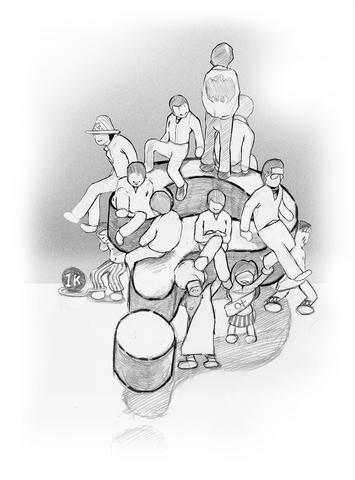
ILLUSTRATION: ZEKE LIN
Sometimes, though not in this forum, questions can be so pregnant with assumptions that they are, arguably, better left unanswered. Not because they do not relate to important issues, but because they are so loaded with prejudice and crippled by ignorance, thoughtless in tone and reckless in content, that the manner in which they are put renders them incapable of addressing important issues. To engage with them would be to legitimize their bias.
Terms of reference
This is not an issue confined to race or religion. The victors in every battle do not just write history (and then rewrite it continually until the vanquished have either been disappeared or demonized beyond all recognition), they also frame the terms of reference for the present. Questions, and those who pose them, are never neutral, but are both informed and misinformed by the received wisdom of place and time.
Nobody ever asks: "when did you first realize you were straight?" or "how do you balance fatherhood and work?" One day, hopefully, they might. But in the meantime some identities will be subject to relentless examination, while others coast by with eternal presumption. Those who ask the questions of others without interrogating themselves are effectively saying: this is our world, you're just living in it.
So we inquire in our own image with all the limitations and prejudices implied. The point is not that we should ask tough questions of others -- our best and only hope is that we all keep talking. But if you want a substantial answer, you must ask a substantial question. The respondent may meet you half way, but if the person asking the questions hasn't moved an inch, half of nothing will not take either of them very far.
One of the most distinguished members of the panel at the Guardian forum, academic Tariq Ramadan, argued that turning their backs on the court of British public opinion, like a republican detainee before a Diplock judge, was not an option for British Muslims.
Not an answer
"Just because they are not asking others does not mean that the question is not legitimate," he said. "You cannot get rid of perceptions by saying that your question is wrong. It's like saying to someone who says to you `I'm scared. I feel that you are a threat to this society'. And you say `No, It's not good to be scared.' If I am scared, I am scared. Now try to help me to put it in another way."
Mr Ramadan has a point. If you are interested in conversing with the world around you, then you cannot simply ask people to change the subject every time a subject you do not like comes up. Such pre-emptive defensiveness stands little chance of winning over potential support and shows every sign of a lack of confidence in your ability to make yourself understood. We cannot choose the terrain on which these battles are fought; nor can we dictate the rules. These are subject to negotiation.
But the reason some people get defensive is because they feel that they are forever being attacked. It's true that we have to work with what we've got. But sometimes the material we are given to work with seems so lame that I am tempted to take a day off. Before there can be negotiation there must first be goodwill -- the desire to fill in the gaps of knowledge and perspective. A good question does not seek agreement but engagement; a point of contact; the recognition of at least the shred of commonality with the questioned.
Without that, all we are left with is full-scale interrogation -- the hostile questioning of the prosecution counsel: less of a conversation than a trial by presumption.
It's time to flip the script, to lay bare just a hint of the assuming subconscious that infects the most common questions I have either been asked or heard. To ask the kind of questions of white, British people (some are just for Christians) that they often pose to "others" but are never asked themselves. I didn't make these up because I wouldn't know where to start. This is my world. For the next 500 words, you're just living in it.
Tough questions
Do you think of yourself as white or British or both? Does it worry you that you got your job just because of your race? Where are you from? No, but really? Since this is where you live, don't you think you should try and integrate with other races more? Is your first loyalty to your God, or to your country? Is it true what they say about white guys? Given the genocide, slavery and colonialism unleashed in the name of Christianity over the last two centuries, do you feel your religion is compatible with democracy? Mr. Grant, do you think of yourself as a white actor or an actor who happens to be white? I don't mind white people, but if they want to live here then why shouldn't they have to fit in with our traditions? Shouldn't the police be doing more to tackle white-on-white crime? Given the objectification of women in your culture and the rise in teenage pregnancies, don't you think it's time to ban young girls wearing make up? What do you make of the tribal conflict in Ukraine? I thought you asked for flesh-colored tights? Don't you feel that this politically correct belief that we have to respect white people's feelings has stifled honest discussion and debate? Isn't it a shame that white people cannot pick more responsible leaders? What do you mean, you can't Morris dance? Don't you ever worry about being pigeonholed as a white person? Why aren't you doing more to check the rise in Christian fundamentalism? Who are your community leaders? Why should we balance our belief in human rights with our tolerance for Christians? What do white people think about Jews? How would you define "white" style? Mr. Amis, why do you write about white people all the time? Don't you find that limiting? What are you doing for your people? Have you seen what the Bible says about women? Are you the token white guy? Don't take this personally, but why are white men so aggressive? Now the Olympics are over, can we finally admit that white people are genetically equipped to excel in archery and rowing? What is it with white people and homophobia? You know what white women are like, don't you? I understand that as a white person you come at this from a particular place, but can't you try to look at it objectively for a moment? Why do you people have such a chip on your shoulder? Don't get offended, I was only asking.
Gary Younge chaired last week's Young, Muslim and British debate organized by The Guardian
There is a modern roadway stretching from central Hargeisa, the capital of Somaliland in the Horn of Africa, to the partially recognized state’s Egal International Airport. Emblazoned on a gold plaque marking the road’s inauguration in July last year, just below the flags of Somaliland and the Republic of China (ROC), is the road’s official name: “Taiwan Avenue.” The first phase of construction of the upgraded road, with new sidewalks and a modern drainage system to reduce flooding, was 70 percent funded by Taipei, which contributed US$1.85 million. That is a relatively modest sum for the effect on international perception, and
At the end of last year, a diplomatic development with consequences reaching well beyond the regional level emerged. Israeli Prime Minister Benjamin Netanyahu declared Israel’s recognition of Somaliland as a sovereign state, paving the way for political, economic and strategic cooperation with the African nation. The diplomatic breakthrough yields, above all, substantial and tangible benefits for the two countries, enhancing Somaliland’s international posture, with a state prepared to champion its bid for broader legitimacy. With Israel’s support, Somaliland might also benefit from the expertise of Israeli companies in fields such as mineral exploration and water management, as underscored by Israeli Minister of
Chile has elected a new government that has the opportunity to take a fresh look at some key aspects of foreign economic policy, mainly a greater focus on Asia, including Taiwan. Still, in the great scheme of things, Chile is a small nation in Latin America, compared with giants such as Brazil and Mexico, or other major markets such as Colombia and Argentina. So why should Taiwan pay much attention to the new administration? Because the victory of Chilean president-elect Jose Antonio Kast, a right-of-center politician, can be seen as confirming that the continent is undergoing one of its periodic political shifts,

The Chinese Communist Party (CCP) challenges and ignores the international rules-based order by violating Taiwanese airspace using a high-flying drone: This incident is a multi-layered challenge, including a lawfare challenge against the First Island Chain, the US, and the world. The People’s Liberation Army (PLA) defines lawfare as “controlling the enemy through the law or using the law to constrain the enemy.” Chen Yu-cheng (陳育正), an associate professor at the Graduate Institute of China Military Affairs Studies, at Taiwan’s Fu Hsing Kang College (National Defense University), argues the PLA uses lawfare to create a precedent and a new de facto legal


 RSS
RSS