


The news media love hurricanes. They usually form far, far away, providing at least a week of stories. And they often start with a bang. Down in the tropical Atlantic, young ones bomb out to amazingly low barometric pressures and outrageous sustained winds. Hurricane Ivan's lowest pressure, for example, would cause the needle on your home barometer to spin around twice. The resultant "eyewall" winds were a 32km-wide tornado.
It's incredible stuff.? But they usually weaken considerably by the time they get to the US, owing to our more northerly latitude and the fact that hurricanes don't do well when much of their circulation is over land, which has to happen when they approach North America.
That doesn't stop the hype machine. While we like to count up property damage and losses, no one mentions the fantastic revenue that these storms generate for the media, or that the constant drumbeat of Charley-Frances-Ivan, Charley-Frances-Ivan must have political repercussions.
And so, British Prime Minister Tony Blair was just in Washington to visit Senator John Kerry, where he conflated Hurricane Ivan with dreaded global warming.
I like just about everything about Blair. He's smart, affable and a real friend to a nation that needs some. But he's way off on global warming, and advising Kerry to bail out his campaign with apocalyptic climate hype invites a grilling by the climate truth squad, a rather large body of weather nerds in a weather-fixated country.
Blair's problem is that he listens to his science adviser, Sir David King, who is one of the most ill-informed hawks on climate change on this greening planet. King actually pronounced the goofy global warming flick The Day After Tomorrow as scientifically plausible, which should have completely blown away his credibility. Now he claims that this year's hurricane activity is a product of global warming and that warming will make hurricanes worse.
Here's the simplistic argument.? Hurricanes require warm water. Global warming means more of that. Therefore, more hurricanes.
The fact is that there's plenty of warm water for hurricanes every year -- virtually the entire tropical ocean is hot enough, and yet there are only about 10 per year in the Atlantic. The real research question on these storms is not why there are so many but, rather, why there are so few, given the massive expanse of warm water available to them.
And here's the real scientific inconvenience in Blair's story. The planet warmed slightly -- much less than forecast by people like King -- in the last half of the last century, but while that happened, maximum winds in Atlantic hurricanes declined significantly.
As shown by scientist Chris Landsea of the National Oceanic and Atmospheric Administration, maximum winds measured by hurricane-hunter aircraft over the last 50 years have declined significantly.
Further, there's a logical (if lawyerly) argument that pins this salutary change on global warming. It goes like this: Atlantic hurricanes are much more delicate than their destruction suggests. One thing they cannot tolerate is a west wind blowing into them, because it wrecks their symmetry. As a result, their maximum winds decline.
El Nino -- another climate hype machine -- generates precisely this type of wind over the Atlantic. That's why, in El Nino years, the forecast is for a weak hurricane season.
In the latter part of the last century, there were an unusual number of El Nino years compared to previous decades. Some scientists (like King) claim that global warming is increasing the frequency of El Nino. But if that's the case, then global warming would be responsible for the decline in maximum hurricane winds.
How much could that be worth? The decline has been about 24kph since 1950. That's not a small number, because the force of a hurricane's wind goes up with the square of the velocity. In the high Category Three to low Category Four range, this change reduces the power by 25 percent. Given that the US experiences about 15 strong hurricanes every decade, and that the average cost is now about US$5 billion for one of those hits, you could, if you buy the El Nino argument (I don't but some others do), thank global warming for saving about US$13 billion per decade.
These numbers won't stop the hype machine on hurricanes. But you'd think that Great Britain's science adviser would have been sufficiently well informed that he would have kept his prime minister from asking Kerry to sow the whirlwind.
Patrick Michaels, a senior environmental studies fellow at the libertarian Cato Institute, is the author of Meltdown: The Predictable Distortion of Global Warming by Scientists, Politicians, and the Media.
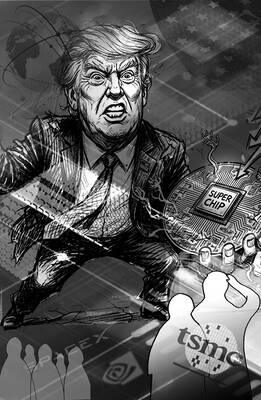
The White House’s decision to take a 9.9 percent stake in Intel Corp is looking like very shrewd business indeed. Since the government bought in at US$20.47 a share last August, the US chipmaker’s surging stock price has delivered the US a US$43 billion return. One of the reasons the investment has so far proved so sound is that the White House has made sure of it. According to The Wall Street Journal, Howard personally pushed deals on Intel’s behalf with some of the most lucrative clients imaginable. They include Nvidia Corp, the company at the heart of the AI
A single photograph can cut through a lot of noise, but it can also be used to misrepresent the truth. At the very least, it can concentrate the mind on something that requires further investigation. On Monday last week, Ma Ying-jeou Foundation CEO Tai Hsia-ling (戴遐齡) and former National Security Council secretary-general King Pu-tsung (金溥聰) held a news conference in which they showed a photograph of former foundation CEO Hsiao Hsu-tsen (蕭旭岑), now Chinese Nationalist Party (KMT) deputy chairman. In the image Hsiao is seated next to Xiamen Taiwan Businessmen Association chairman Han Ying-huan (韓螢煥). The two men were holding
I first met Professor Ray Jiing (井迎瑞) as a film and documentary student at Shih Hsin University’s (SHU) Department of Radio Television and Film in 1988. The following year, he went on to become the director of the Chinese Taipei Film Archive — forerunner of the Taiwan Film and Audiovisual Institute (TFAI). Over his eight-year tenure, Jiing rescued and restored over 200 classic Taiwanese films. In 1997, he established the Graduate Institute of Studies in Documentary and Film Archiving at Tainan National University of the Arts (TNNUA), and I joined the program in his third cohort of students. Beyond a
A recent report concerning a student who is suing his teacher posed the question in its headline: Does failing a student in two subjects constitute bullying? The college student in Chiayi County apparently sought NT$2 million (US$63,603) in state compensation, but a court dismissed the case. The first reaction of many might have been to ask: What has happened to students nowadays? Some say that teachers have lost their authority, while others say students are overindulged. Some even start reminiscing over the days when “whatever the teacher says goes.” However, the real issue might be overlooked if emotional reactions like that are the


 RSS
RSS