


The interesting question is not whyAbdul Qadeer Khan became a villain. That's easy. Money, money, money. Nuclear physicists toiling away on L15,000 tend to run short of it. No, the real question -- the one with the legs and authentic weapons of mass destruction (WMD) mushroom cloud -- is why, to this day, he remains a hero to his own people.
What, after all, is so heroic about flogging your country's nuclear secrets and surplus kit to the likes of North Korea, Libya and Iran? Why should the average Pakistani peasant revere this clever, arrogant, corrupt creature of the army, an exporter of mass destruction?
And yet, clearly, he does. There are, of course, plenty of seamier reasons why President Pervez Musharraf has pardoned Khan and banned any independent inquiries into his activities. The international "nuclear supermarket" now revealed was big business, and Pakistan's generals, from Musharraf down, are big businessmen during and after their years of service. They clearly can't countenance any kind of open investigation. Even Butler of Brockwell would set them trembling.

ILLUSTRATION MOUNTAIN PEOPLE
But still the crowds cheer for Khan. Still their reverence keeps him untouchable. They think he made them safe from war, safe with a seat at any summit table. He gave them the bomb and the bomb is a national boon. They think they've learned their Western lessons well.
India and China, after all, had joined the nuclear club. Islamabad could have been the odd, vulnerable one out. Through the second half of the 20th century, remember, New Delhi and Beijing went to war, and Pakistan fought India three times. But no more, brother.
Now we're all MAD together and Mutually Assured Destruction sets us free to do vital things -- like negotiate over Kashmir -- that the West is always begging us to do.
The trouble, though, is that the West also wallows in double standards. Why shouldn't North Korea, matched against Seoul and America's nuclear umbrella, have a little MAD of its own? Why shouldn't Iran have a modest counter-balance to the bombs it faces north, east and west? If you can have a Christian bomb, a Hindu bomb, a Chinese communist bomb and a Jewish bomb, why can't there be Muslim bombs as well?
Disingenuous? Up to a point. The world is full of bad, bad men and such arguments -- as self-serving as Khan's assorted bank accounts -- pretend that they don't exist. Equally, though, don't miss the duff arguments on our side.
We spent more than 40 years telling the world that MAD struck a wonderful balance, that being strong was the nuclear way to keep the peace. We strutted as our own WMD came into service, champagne bottles smashing on the subs -- and we strut still in our security council berths where nukes buy us seats at the top table. What's the essential problem here?
No problem from where we sit, to be sure. And no problem for countries of pragmatic prudence who, sooner or later, prefer trade and aid to the thrill of rusting rocketry. But that view has its limitations, too. It reflects a balance of power frozen in the past (essentially, 40 years ago again). It says that only those countries which happened to make a bomb are worthy of keeping it. And it seals that case in non-proliferation aspic, as superintended by the International Atomic Energy Agency.
The one small snag, however, is that none of this holds any longer. As the head of the IAEA, Mohamed ElBaradei, observes: "The spread of nuclear technology and knowledge is out of the tube -- and we won't be able to put it back." The world, beyond MAD, has gone genuinely mad; and there is no pat theory, no leftover control system, that can make it suddenly sane again. The west doesn't have the intelligence to save itself: see how Colonel Qaddafi shopped Abdul Qadeer Khan. Nor, after Iraq, does it have the physical resources to go zapping every transgressor, real or alleged.
The force is not with us; and that, alas, includes the force of argument. When I wrote here a few weeks ago about the Israeli bomb, I harvested a shoal of furious responses. Why, asked the cod, don't you and France give up your bomb first? Why, demanded the haddock, should we ever put our Jewish homeland security at risk by negotiating about the ultimate weapon which keeps us safe in a sea of enemies? Two questions requiring non-fishy answers.
Yes: what, indeed, is the point of our unilateral weapons of mass destruction? Do they make London -- or Paris, for that matter -- in any way safer from any conceivable outside threat? If you want others to go down the route of nuclear renunciation then you have to be honest about your own immobilities. But is that, any longer, the only route available?
The spread, says ElBaradei, is out of the tube. Unstoppable, irreversible. He could be talking about that other failed war, on drugs -- and he could, equally, be trying the other drug road: of acceptance, legalisation, of licensed growth. The trouble now is that black supermarket, selling to all with cash under the table. But if the cash comes openly from states with money to burn on nuclear technology and its alleged wonders, then those states themselves have a vested interest in keeping it out of maverick hands. For they are in danger too. Their secrets may be used against them. And more might really be less peril.
Is that totally mad in turn? Are we, from US President George W. Bush down, just stuck delivering the same old portentous lectures and flourishing the same old self-serving fears? Perhaps. But it's a cry without logic now: not one way or another, but failure in between. And listen to the noises off, the cheering as Khan takes us all further down his terrible tube.
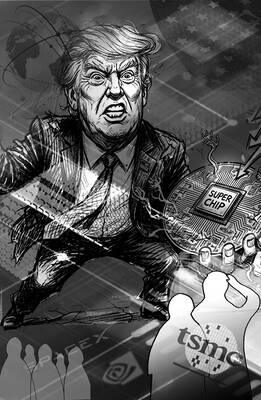
The White House’s decision to take a 9.9 percent stake in Intel Corp is looking like very shrewd business indeed. Since the government bought in at US$20.47 a share last August, the US chipmaker’s surging stock price has delivered the US a US$43 billion return. One of the reasons the investment has so far proved so sound is that the White House has made sure of it. According to The Wall Street Journal, Howard personally pushed deals on Intel’s behalf with some of the most lucrative clients imaginable. They include Nvidia Corp, the company at the heart of the AI
A single photograph can cut through a lot of noise, but it can also be used to misrepresent the truth. At the very least, it can concentrate the mind on something that requires further investigation. On Monday last week, Ma Ying-jeou Foundation CEO Tai Hsia-ling (戴遐齡) and former National Security Council secretary-general King Pu-tsung (金溥聰) held a news conference in which they showed a photograph of former foundation CEO Hsiao Hsu-tsen (蕭旭岑), now Chinese Nationalist Party (KMT) deputy chairman. In the image Hsiao is seated next to Xiamen Taiwan Businessmen Association chairman Han Ying-huan (韓螢煥). The two men were holding
I first met Professor Ray Jiing (井迎瑞) as a film and documentary student at Shih Hsin University’s (SHU) Department of Radio Television and Film in 1988. The following year, he went on to become the director of the Chinese Taipei Film Archive — forerunner of the Taiwan Film and Audiovisual Institute (TFAI). Over his eight-year tenure, Jiing rescued and restored over 200 classic Taiwanese films. In 1997, he established the Graduate Institute of Studies in Documentary and Film Archiving at Tainan National University of the Arts (TNNUA), and I joined the program in his third cohort of students. Beyond a
A recent report concerning a student who is suing his teacher posed the question in its headline: Does failing a student in two subjects constitute bullying? The college student in Chiayi County apparently sought NT$2 million (US$63,603) in state compensation, but a court dismissed the case. The first reaction of many might have been to ask: What has happened to students nowadays? Some say that teachers have lost their authority, while others say students are overindulged. Some even start reminiscing over the days when “whatever the teacher says goes.” However, the real issue might be overlooked if emotional reactions like that are the


 RSS
RSS