


Three social elites -- Academia Sinica President Lee Yuan-tseh (李遠哲), Cloud Gate Dance Theater founder Lin Hwai-min (林懷民) and Formosa Plastics Group chairman Wang Yung-ching (王永慶) -- published a "solemn statement" regarding the presidential election in a front-page newspaper advertisement in mid-January.
Unfortunately, some media intentionally misrepresented the ad as a condemnation of negative campaigning meant to protect the Chinese Nationalist Party (KMT)-People First Party alliance from its troubles with the issue of party and private assets.
But is negative campaigning necessarily bad for an election campaign that has no positive meaning?
Campaign attacks are carried out in two ways.
The first is called image attack -- for example, attacking the KMT's corruption and the Democratic Progressive Party's (DPP) pro-Taiwan independence stance, as well as calling other candidates feeble, corrupt or capricious. An image attack is usually made up of accusations against personal characteristics, made to entrench voters' preconceived ideas.
The second type is called issue attack -- attacking opponents' political accomplishments or policies or stances on specific issues. Examples of this are the KMT's criticism of the DPP's referendum proposal and the latter's criticism of the former's party assets.
The accusations in such negative ads have clarified various problems, and have made parties and their candidates unable to hide, echoing the social elite's call for resuming "rationality and clearness."
Through the KMT's attacks, we can think over the meaning and necessity of holding a preventive referendum on election day.
Through the DPP's attacks, we can understand how the KMT inappropriately obtained national assets that originally belonged to the people.
Through the attacks of both, we can have a clear picture of the two presidential candidates' wealth.
The quantity of their wealth is not the key point. What matters is whether illegitimate conduct occurred.
In addition, through a comparison of the negative ads in this election and in the previous presidential election, perhaps voters can also see the drastic changes in the attitudes of some politicians.
Thanks to negative ads, voters are able to view the two candidates more rationally.
Elections are always accompanied by negative campaigning. During the 1998 Taipei mayoral election campaign, the KMT's Ma Ying-jeou (馬英九) attacked President Chen Shui-bian (陳水扁), who was Taipei mayor at the time, with negative television ads regarding the city's parking and robbery problems.
Regardless of whether his points of view were right or wrong, they were very clever negative ads that calmly took aim at specific issues.
Negative campaigning should not be vicious. In the 1997 local government chief elections, the KMT attacked Sisy Chen (
Also, negative campaigning should not attack humanity.
It is wrong for the KMT to attack Chen's grandson in its ad. All grandsons are precious in the eyes of their grandparents.
KMT Chairman Lien Chan (
The martial-law era has ended. It is precisely through negative campaigning that we can tear off candidates' masks so that the truth can be shown.
As for the rest, it will be judged by voters.
Cheng Tzu-leong is a professor in the advertising department at National Chengchi University.
TRANSLATED BY EDDY CHANG
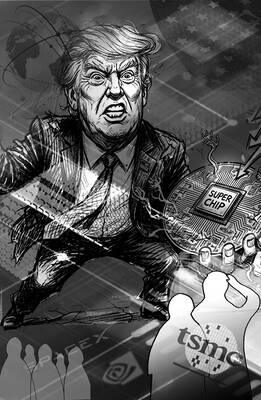
The White House’s decision to take a 9.9 percent stake in Intel Corp is looking like very shrewd business indeed. Since the government bought in at US$20.47 a share last August, the US chipmaker’s surging stock price has delivered the US a US$43 billion return. One of the reasons the investment has so far proved so sound is that the White House has made sure of it. According to The Wall Street Journal, Howard personally pushed deals on Intel’s behalf with some of the most lucrative clients imaginable. They include Nvidia Corp, the company at the heart of the AI
A single photograph can cut through a lot of noise, but it can also be used to misrepresent the truth. At the very least, it can concentrate the mind on something that requires further investigation. On Monday last week, Ma Ying-jeou Foundation CEO Tai Hsia-ling (戴遐齡) and former National Security Council secretary-general King Pu-tsung (金溥聰) held a news conference in which they showed a photograph of former foundation CEO Hsiao Hsu-tsen (蕭旭岑), now Chinese Nationalist Party (KMT) deputy chairman. In the image Hsiao is seated next to Xiamen Taiwan Businessmen Association chairman Han Ying-huan (韓螢煥). The two men were holding
I first met Professor Ray Jiing (井迎瑞) as a film and documentary student at Shih Hsin University’s (SHU) Department of Radio Television and Film in 1988. The following year, he went on to become the director of the Chinese Taipei Film Archive — forerunner of the Taiwan Film and Audiovisual Institute (TFAI). Over his eight-year tenure, Jiing rescued and restored over 200 classic Taiwanese films. In 1997, he established the Graduate Institute of Studies in Documentary and Film Archiving at Tainan National University of the Arts (TNNUA), and I joined the program in his third cohort of students. Beyond a
A recent report concerning a student who is suing his teacher posed the question in its headline: Does failing a student in two subjects constitute bullying? The college student in Chiayi County apparently sought NT$2 million (US$63,603) in state compensation, but a court dismissed the case. The first reaction of many might have been to ask: What has happened to students nowadays? Some say that teachers have lost their authority, while others say students are overindulged. Some even start reminiscing over the days when “whatever the teacher says goes.” However, the real issue might be overlooked if emotional reactions like that are the


 RSS
RSS