


Shanghai will raise the curtain next month on the biggest-ever World Expo — where China’s most cosmopolitan city hopes to stake a claim to being in the same league as London, Paris and New York.
Army trucks and contractors buzz around the Expo site — which is more than twice the size of Monaco — completing pavilions where more than 190 countries will show off their best in the six-month extravaganza, which opens on May 1.
For China, the World’s Fair is the latest showcase for its growing global clout after the 2008 Beijing Olympics — and Shanghai has planned an Expo on an unparalleled scale to show it can rival the world’s greatest cities.
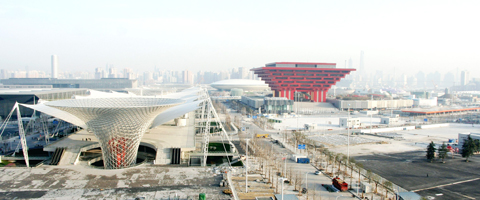
PHOTO: AFP
“What Shanghai stands to gain from the Expo cannot be measured simply in financial terms,” said vice-mayor Yang Xiong (楊雄), who is also an Expo deputy director.
“Expo will have a deep influence on Shanghai and will have an impact on several generations,” Yang said.
The massive Expo site is 20 times the size of the area used for the last Expo in Zaragoza, Spain, two years ago.
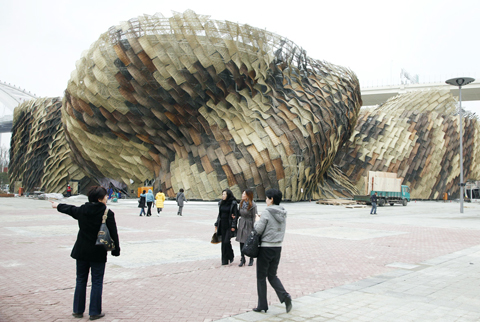
PHOTO: EPA
Officials initially said they aimed to attract 70 million visitors — 95 percent of them Chinese — to the World’s Fair, but as the opening draws closer, they have boosted that figure to 100 million.
Shanghai has been given a face lift ahead of their arrival. In the past month alone, the iconic Bund waterfront has reopened with a new look recalling its 1930s heyday, a new gleaming domestic airport has begun operation and the subway has been dramatically expanded.
“Shanghai completed the next 20 years worth of infrastructure investments in advance this year because of Expo,” said Chen Xinkang (陳信康), head of the Institute of World Expo Economy at the Shanghai University of Finance and Economics.
Shanghai residents will be treated to an Expo preview from April 20, allowing officials to test the facilities before the official opening. The city has declared April 30 to May 4 a holiday.
A record 192 countries are participating and national pavilion teams are racing — wiring, painting and setting up displays — to meet the deadline.
Despite the seemingly chaotic construction, Yang said fewer than 10 percent of the pavilions would not be ready by May 1.
“We will go all-out to reduce the number of pavilions that are unable to open on schedule,” he said.
Australia’s US$56 million pavilion is 99 percent finished, director Peter Sams said.
He said this Expo has special significance for Australia, as it does for many other countries, because it offers an opportunity to engage with people in the 21st century’s rising power.
“China is extraordinarily important to Australia and has been for a very long time,” Sams said. “Helping China have a successful Expo is a very important part of our bilateral relationship.”
For the director of Japan’s pavilion, Norishi Ehara, Expo will open a new chapter in Sino-Japanese relations.
Although Japan’s pop culture exports have long fascinated young Chinese, many also feel simmering anger over Japan’s World War II-era aggression.
“Historical is historical … now we are going to create new relations. This is it,” he said, gesturing around him inside the US$140 million pavilion, where violin-playing robots will serenade visitors.
Other countries are bringing national treasures to woo the Chinese.
Denmark has sent its Little Mermaid sculpture out of Copenhagen harbor for the first time, France is showing seven priceless artworks from Paris’ Musee d’Orsay and Italy will display two Renaissance paintings by Caravaggio.
In some cases, the pavilions themselves are modern masterpieces.
Britain’s “Seed Cathedral” stops people in their tracks — its 60,000 acrylic rods emanating from a timber cube creates a dandelion effect.
“This is the first time anyone’s done a project like this so it’s been quite scary and now I’m really, really happy. It’s worked out better than I’d hoped,” designer Thomas Heatherwick said during a site inspection.
“It’s thrilling that it’s actually come off,” he said.

DRONE CENTRAL: Taiwan aims to become Asia’s democratic hub for drones, with most exports focused on high-quality military-grade models, an official said Taiwan’s drone industry is expected to expand significantly by 2030, producing 100,000 units per month and exporting half of them, the Ministry of Economic Affairs said yesterday. Current drone production capacity is about 15,000 units per month, but the industry can quickly scale up as demand increases, Industrial Development Administration Director-General Chiou Chyou-huey (邱求慧) told a news conference in Taipei. Taiwan’s drone output grew 2.5-fold last year to NT$12.9 billion (US$408.3 million) under a government program to develop the uncrewed vehicle sector, he said. The Executive Yuan in October last year approved plans to invest NT$44.2 billion into domestic production of uncrewed aerial
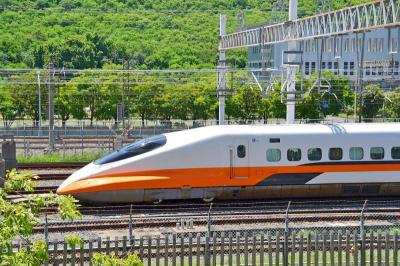
A signaling system malfunction disrupted high-speed rail (HSR) services beginning at 8am today, with trains temporarily reduced to three northbound and three southbound trains per hour as authorities conduct inspections. The malfunction occurred on a section of track in Miaoli County during pre-operation checks early this morning, forcing northbound and southbound trains to use a single track, the HSR operator said. The regular schedule has been replaced with three hourly trains offering only nonreserved seating in each direction, stopping at every station, it said, adding that business class cars would still have reserved seating. Departures from terminal stations are scheduled at the top
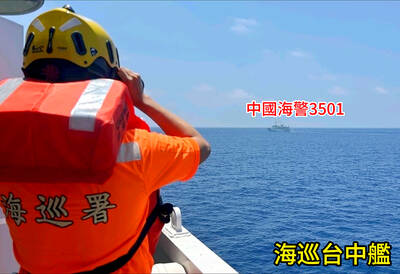
VERBOSE VESSELS: A CGA cutter and a China Coast Guard exchanged verbal barbs for more than a day in Taiwanese-controlled waters before the Chinese vessel left The Taiwanese and Chinese coast guards had a standoff near the strategically located Pratas Islands (Dongsha Islands, 東沙群島) in the north of the South China Sea, the Coast Guard Administration (CGA) said yesterday. The two sides engaged in intense radio exchanges over sovereignty claims during the 33-hour standoff. China Coast Guard vessel 3501 eventually left the restricted waters, 26.6 nautical miles (49.2km) west of the Pratas Islands, at 5pm yesterday, the CGA said. Lying approximately between southern Taiwan and Hong Kong, the Taiwan-controlled Pratas are seen by some security experts as vulnerable to Chinese attack due to their distance — more than
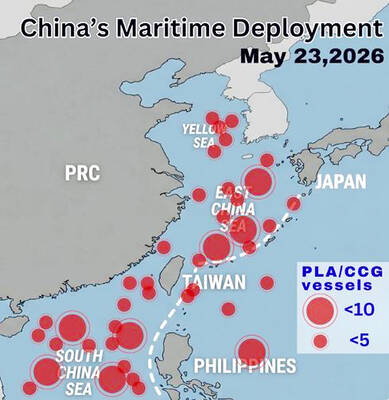
WARNING: China should stop engaging in actions that undermine regional peace and stability, as it would only build resentment among people across the Strait, the CGA said China has deployed more than 100 navy, coast guard and other vessels in waters from the Yellow Sea to the South China Sea and the western Pacific since US President Donald Trump and Chinese President Xi Jinping (習近平) met in Beijing, National Security Council Secretary-General Joseph Wu (吳釗燮) said yesterday. “In this part of the world, #China is the one & only PROBLEM wrecking the #StatusQuo & threatening regional peace & stability,” Wu wrote on X. In a separate post, he said Beijing was coercing Taiwan’s maritime domain, calling it illegal and provocative, after the Coast Guard Administration (CGA) expelled a


 RSS
RSS