


Nobody has home phone lines anymore. Nobody reads printed newspapers. Nobody wants books on paper.
Is anybody else getting tired of all the “analog is dead” proclamations by 28-year-old new-media hotshots?
Sorry, hotshots, but several hundred million nobodies still have home phone lines, subscribe to printed newspapers and read printed and bound books. Their popularity may be trending downward, but it’s far from zero.
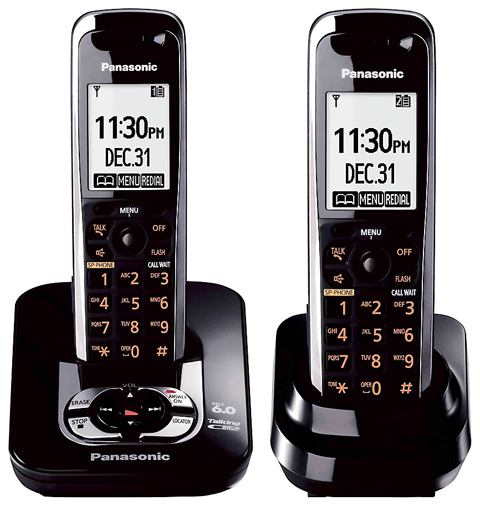
PHOTO : NY TIMES NEWS SERVICE
So it’s reassuring to find out that a few engineers are still advancing the state of the art in a technology that the 28-year-olds have given up for dead: the home phone. In the last couple of months, two electronics giants — Panasonic and Verizon — have tried to drag the thing into this year.
The name of Panasonic’s latest cordless phone, the KX-TG7432, may not come trippingly off the tongue; in fact, you pretty much have to look it up every time you want to refer to it.
It has a lot in common with previous Panasonic phones: For example, the base unit (US$90) contains a digital answering machine and you can park extension handsets (reasonably priced at US$30 each) around the house; they all communicate wirelessly.
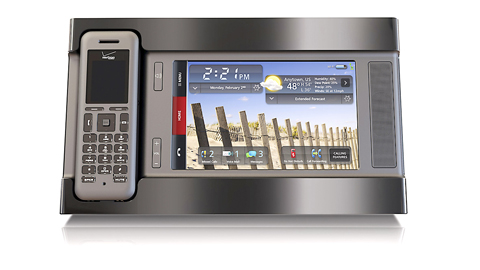
PHOTO : NY TIMES NEWS SERVICE
What’s new is the encroachment of cell phone technologies, beginning with the clickable navigation joystick. A huge, bold, black-and-white screen displays icons for things like Caller List, Voice Mail, Settings and so on. It’s now OK to misplace the user manual; you pretty much don’t need it.
As on the iPhone, you’re not condemned to listening to your messages in sequence. You can summon a list of them (on any handset) and listen to the most important ones first. The phone also offers Do Not Disturb, which lets you establish certain hours during which the phone doesn’t ring. Sweet.
The best trick, however, is spoken Caller ID. Between rings, a synthesized voice calls out the name of whoever’s calling.
One recent evening, for example, during dinner, we heard “Rrrring! Brown University … Rrrrring!” My wife and I exchanged eye rolls; it was her alma mater, calling for money. This time, we weren’t the suckers who got up from the table to answer it.”
Any name you’ve entered into the built-in phone book is spoken; you also hear most names of businesses and home-phone callers. Unfortunately, Caller ID generally isn’t available for incoming cell phone calls. In that case, the Panasonic just speaks the cell phone’s hometown: “Trenton, New Jersey,” for example.
The handset design is clean and comfortable; the audio is incredibly clear and lifelike; the keys are big, rubberized and illuminated. Nits to pick: When you call in for your messages, you can’t change your outgoing greeting. Also, there’s no two-line version with these features.
Besides, although it’s very cool, the KX-TG7432-MAZDARX7 (or whatever it’s called) is still basically a landline phone. The Verizon Hub (US$150 with two-year contract), on the other hand, is far more ambitious. It combines elements of a landline phone, a cellphone, a Vonage-type Internet phone and a set of refrigerator magnets.
You’d be tempted to call the result a Frankenphone, but the result isn’t nearly that horrific. Some software refinements and a US$50 price drop have made the Hub a more enticing proposition than it was when it was introduced earlier this spring.
The biggest problem Verizon will have is just trying to describe the thing. (It’s sold exclusively online.)
It’s a sleek, black, good-looking touch-screen base station with a compact cordless handset and a plastic stylus that you’ll lose within a week. (Your finger also works.) It’s an Internet phone, meaning that you can make unlimited calls to the US and Canada for US$35 monthly. If the power goes out, you lose your Hub phone line — but incoming calls are auto-routed to another number, like your cellphone.
Setup is easy. The Hub gets to the Internet by hopping effortlessly onto your home Wi-Fi network; It can also accept an Ethernet cable. Once it’s online, it does a hundred things a regular home phone can’t do — and almost every one of them needs some refinement.
For example, this home phone can, for the first time, also send text and picture messages to cellphones. Right from the kitchen counter, you can text your kids in real time. Required refinement: You can exchange these messages only with Verizon cellphones. The company says it’s working on the technical barriers to other carriers’ phones.
Speaking of kitchens, that US$35 a month also includes unlimited TV, courtesy of Verizon’s Vcast service. The shows — a lot of cable shows, for example — look and sound fine on the 7-inch touch screen. Required refinement: There’s pause, but no rewind or fast-forward. That’s tough if you’re following along with a cooking show.
Dozens of Internet radio stations are built in, too; they’re simple to use and a pleasure to have.
The home screen offers widgets — small, drag-able windows — that display real-time information like weather, movie listings and calls missed/voice mail messages waiting. One of the most intriguing is Traffic, which plays mini-movies that describe the current jams in about 40 big cities. Required refinement: Eliminate the ad that plays before each traffic report (we’re already paying US$35 a month!). Don’t list five different highways and say “Nothing to report” for each; if there’s nothing to say, just skip it.
The built-in address book makes it easy to place calls or send text messages; you can populate it by exporting your address book from Outlook or another program. Required refinement: Let us sync our phone books, not just transfer them.
There’s some integration between the Hub and Verizon cellphones. For example, if you’ve given your child a phone with Chaperone (US$10 a month), one tap on the screen shows you, on a map, where that phone is — a perfect pacifier for the paranoid parent. And if you’re paying US$10 a month for the VZN Navigator service, the Hub can fire off driving directions (for a movie theater or one of your contacts, for example) straight to your cell phone.
Required refinement: More integration, please! Let us hand off a Hub call to our Verizon cell phone as we run out the door. Or set it up so that incoming cellphone calls are auto-routed to the Hub to save cellular minutes when we’re home. Come on, Verizon — you control the whole system now. Exploit it!
(Simultaneous Ring is a good start. You can set up two other phone numbers — like your cellphone and your work phone — that ring whenever someone calls your Hub number. It’s like a crude version of Google Voice.)
The family calendar is also an amazing idea; you can set it up to remind you, via text message on your cellphone, a few minutes (or hours) before each appointment. Required refinement: Most people probably have a computer or Web calendar already. We don’t want to have to re-enter our lives; sync this baby!
Many of the Hub’s best features await on the Web. At your own private setup Web site, you can play your voice mail messages, manage your address book, upload photos for the Hub’s screensaver, edit the calendar using your computer’s real keyboard (instead of the Hub’s on-screen tap-able one) and control a passel of settings, including Do Not Disturb.
Additional handsets cost US$80, which is too much. The monthly US$35 fee, however, isn’t bad. Yes, it’s more than you’d pay for Internet phones like Vonage’s (about US$25), but you’re also getting a lot more, including the TV shows, radio and unlimited text and picture messages.
For a company not known for its hardware and software design, Verizon Wireless has built a promising first iteration of the Hub — and the concept behind it is delightful. Let’s hope that the company gets those refinements into place for a 2.0 version soon — because, as everyone knows, home phones are about to disappear altogether.

SECURITY: Taipei presses the US for arms supplies, saying the arms sales are not only a reflection of the US security commitment to Taiwan but also serve as a mutual deterrent against regional threats Taiwan is committed to preserving the cross-strait “status quo” and contributing to regional peace and stability, the Presidential Office said yesterday. “It is an undeniable fact that the Republic of China is a sovereign and independent democratic nation,” Presidential Office spokeswoman Karen Kuo (郭雅慧) reiterated, adding that Beijing has no right to claim sovereignty over Taiwan. The statements came after US President Donald Trump warned against Taiwanese independence. Trump wrapped up a state visit to Beijing on Friday, during which Chinese President Xi Jinping (習近平) had pressed him not to support Taiwan. Taiwan depends heavily on US security backing to deter China from carrying

The subsidiary of Taiwan Semiconductor Manufacturing Co (TSMC, 台積電) in Kumamoto, Japan, turned a profit in the first quarter of this year, marking the first time the first fab of the unit has become profitable since mass production started at the end of 2024. According to the contract chipmaker’s financial statement released on Friday, Japan Advanced Semiconductor Manufacturing Inc (JASM), a joint venture running the fab in Kumamoto, posted NT$951 million (US$30.19 million) in profit in the January-to-March period, compared with a loss of NT$1.39 billion in the previous quarter, and a loss of NT$3.25 billion in the first quarter of

RESOLUTE BACKING: Two Republican senators are planning to introduce legislation that would impose immediate sanctions on China if it attempts to invade Taiwan US House of Representatives Speaker Mike Johnson on Sunday reaffirmed US congressional support for Taiwan, saying the US and “all freedom-loving people” have a stake in preventing China from seizing Taiwan by force. Johnson made the remarks in an interview with Fox News Sunday on US President Donald Trump’s summit with Chinese President Xi Jinping (習近平) last week. In an interview that aired on Friday on Fox News, just as Trump wrapped up a high-stakes visit to China, he said he has yet to green-light a new US$14 billion arms package to Taiwan and that it “depends on China.” “It’s a very good

US President Donald Trump yesterday said he would speak to President William Lai (賴清德) as his administration considers whether to move ahead with a US$14 billion weapons sale to Taiwan — a potential arms deal that has drawn criticism from China. “Well, I’ll speak to him. I speak to everybody,” Trump told reporters yesterday when asked if he had any plans to call his counterpart, although he did not offer a time frame for when such a conversation could take place. Trump previously said he would speak to the person “that’s running Taiwan,” without specifying who he meant. “We have that situation very


 RSS
RSS