


How did a pint-sized car named Smart manage to make DaimlerChrysler look, well, dumb? On Friday, the German carmaker announced that it would drastically scale back its troubled Smart division, eliminating two models and cutting 700 employees, at a cost of up to 1.2 billion euros (US$1.55 billion).
The move came after DaimlerChrysler racked up years of losses, as it struggled with Smart's high production costs and cumbersome distribution network, which had been kept separate from existing Mercedes dealerships.
DaimlerChrysler's missteps, critics said, hobbled what should have been a car that is perfect for its times: fuel-efficient and tiny enough so that two could fit into the parking space of a single full-size US car.
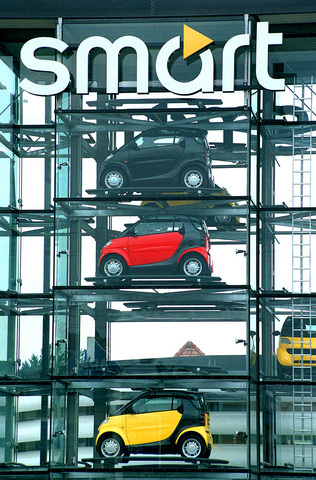
PHOTO: AP
"To make a two-seat car, stripped down for urban environments, was an absolutely great idea," said Ferdinand Dudenhoeffer, director of the Center for Automotive Research in Gelsenkirchen. "But then they made a lot of mistakes and wrong decisions."
DaimlerChrysler's chairman, Jurgen Schrempp, said the company considered shutting down Smart altogether, but concluded that this salvage plan, which aims to make Smart profitable by 2007, would be less costly.
"Why should we destroy brand equity, which is by any standard worth US$2 billion or more, when we have a cost problem?" Schrempp said in a tense meeting with analysts and reporters.
Several analysts bluntly questioned DaimlerChrysler's decision, saying they saw little prospect of Smart ever making money, particularly since the company, based in Stuttgart, plans to keep selling a money-losing, four-seat version of the original two-seat Smart.
"They're sticking to their old strategy," said Arndt Ellinghorst, an auto analyst at Dresdner Kleinwort Wasserstein in Frankfurt. "This is the easy solution for Schrempp, and a bad solution for shareholders."
Coming a day after Mercedes-Benz announced a recall of 1.3 million cars to fix glitches in their electronics systems, the announcement added to the picture of a company still lurching from crisis to crisis.
Shares of DaimlerChrysler declined slightly in Frankfurt, where they were among the most heavily traded stocks.
DaimlerChrysler insisted that the cutbacks would not affect a possible rollout of the two-seat Smart in the US. The company is developing a new version that will meet US road and safety requirements. Smart's problem, the company said, is its high cost, not lack of appeal.
"The US provides an additional opportunity, a significant opportunity," said Eckhard Cordes, the head of the Mercedes-Benz car group, which oversees Smart, during the call. "Our experience in Canada is extremely encouraging, as to market acceptance of the product."
In Canada, where Smart has been available since October, DaimlerChrysler's sales of 3,000 cars have exceeded its expectations. Still, Cordes said the plan to make Smart profitable did not hinge on bringing it to the US.
In Europe, the market for so-called city cars is already fiercely competitive and about to get more so, with the introduction of three vehicles from Peugeot, Citroen and Toyota, all manufactured in the Czech Republic in a joint venture of PSA Peugeot Citroen of France and Toyota of Japan.
Smart's roots go back to 1993, when DaimlerChrysler's predecessor, Daimler-Benz, began studying the viability of a minicar. The following year, it set up a novel joint venture with Swatch, the watch maker, to build one. Swatch dropped out of the partnership in 1998, but Daimler pressed on, introducing its first model, the City-Coupe in Western Europe that fall.
Smart soon became a quirky presence on the serpentine streets of European cities. In Rome, where the car is especially popular, it can be found wedged into comically tight parking spaces, like a latter-day Vespa.
But Smart's perky image has not translated into volume sales. DaimlerChrysler sold 167,900 cars last year, less than half that of the mid-sized Mercedes C-class and 15 percent of total Mercedes' sales.
Part of the problem is price. At 9,000 euros (US$11,664), the Smart is not cheap for its size.
"Their competitor is a Fiat, a Peugeot, a Toyota," Ellinghorst said. "That is why they are having such pricing problems."
Moreover, because DaimlerChrysler set up dedicated dealerships, it focused on major cities, neglecting rural and suburban areas where Dudenhoeffer contends it could have found additional customers.
DaimlerChrysler's efforts to expand the Smart brand have misfired. A roadster version sold poorly and was widely derided by auto critics as looking like a toy. The company considered building a sport utility vehicle initially viewing it as an entry model for the United States. To critics, that seemed to fly in the face of Smart's appeal, which is its compactness.
"Does the US really need another SUV?" Dudenhoeffer said. "Everybody is selling an SUV."
As part of the overhaul that was announced on Friday, the roadster and the SUV were scrapped. But DaimlerChrysler will retain the four-seat Smart, known as the "forfour," which has drawn similar criticism.
It is building the car in cooperation with Mitsubishi Motor, the ailing Japanese carmaker with which DaimlerChrysler had a broader partnership until last year when it announced it would not help bail it out.
Most of Smart's losses are from the forfour; Cordes said the two-seater was profitable "on a cash basis." But he said the cost of scrapping the larger model would be greater than trying to make it profitable.
That did not satisfy analysts, who peppered him and Schrempp with sharp questions not just about Smart, but about problems ranging from the Mitsubishi deal to the deteriorating quality at Mercedes.
The recall, which is the largest in Mercedes history, troubled analysts because it covers some models produced this year. That seems to contradict statements by Schrempp that the Mercedes-Benzes now rolling off the assembly are of as high quality as any in its history.
Cordes said the problems, which include faulty voltage regulators, stem from a supplier, not Mercedes itself.
"I don't want to be aggressive," he said at one point, "but I think some of you are prejudiced."
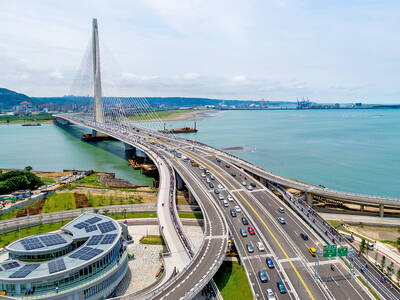
The Ministry of Transportation and Communications yesterday inaugurated the Danjiang Bridge across the Tamsui River in New Taipei City, saying that the structure would be an architectural icon and traffic artery for Taiwan. Feted as a major engineering achievement, the Danjiang Bridge is 920m long, 211m tall at the top of its pylon, and is the longest single-pylon asymmetric cable-stayed bridge in the world, the government’s Web site for the structure said. It was designed by late Iraqi-British architect Zaha Hadid. The structure, with a maximum deck of 70m, accommodates road and light rail traffic, and affords a 200m navigation channel for boats,
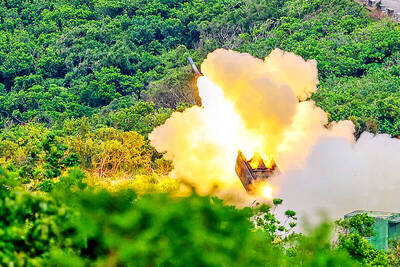
PRECISION STRIKES: The most significant reason to deploy HIMARS to outlying islands is to establish a ‘dead zone’ that the PLA would not dare enter, a source said A High Mobility Artillery Rocket System (HIMARS) would be deployed to Penghu County and Dongyin Island (東引) in Lienchiang County (Matsu) to force the Chinese military to retreat at least 100km from the coastline, a military source said yesterday. Taiwan has been procuring HIMARS and Army Tactical Missile Systems (ATACMS) from the US in batches. Once all batches have been delivered, Taiwan would possess 111 HIMARS units and 504 ATACMS, which have a range of 300km. Considering that “offense is the best defense,” the military plans to forward-deploy the systems to outlying islands such as Penghu and Dongyin so that

Taiwan Semiconductor Manufacturing Co (TSMC, 台積電), the world’s largest foundry service provider, yesterday said that global semiconductor revenue is projected to hit US$1.5 trillion in 2030, after the figure exceeds US$1 trillion this year, as artificial intelligence (AI) demand boosts consumption of token and compute power. “We are still at the beginning of the AI revolution, but we already see a significant impact across the whole semiconductor ecosystem,” TSMC deputy cochief operating officer Kevin Zhang (張曉強) said at the company’s annual technology symposium in Hsinchu City. “It is fair to say that in the past decade, smartphones and other mobile devices were
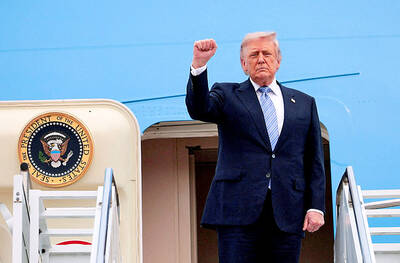
US-CHINA SUMMIT: MOFA welcomed US reassurance of no change in its Taiwan policy; Trump said he did not comment when Xi talked of opposing independence US President Donald Trump yesterday said he has not made a decision on whether to move forward with a major arms package for Taiwan after hearing concerns about it from Chinese President Xi Jinping (習近平). Trump’s comments on Taiwan came as he flew back to Washington after wrapping up critical talks in which both leaders said important progress was made in stabilizing US-China relations even as deep differences persist between the world’s two biggest powers on Iran and Taiwan. “I will make a determination,” Trump said, adding: “I’ll be making decisions. But, you know, I think the last thing we need right


 RSS
RSS