


Indonesian President Joko Widodo’s push to boost domestic petrochemical production has helped send shares of the nation’s largest plastic producer up 205 percent, making it this year’s top performer in the market.
The surge in shares of conglomerate PT Barito Pacific compares with a 0.6 percent gain for the benchmark Jakarta Composite Index.
The conglomerate, which produces everything from energy to petrochemicals, is also the best performer among 155 members of the MSCI ASEAN Index.
A growing middle class and urbanization have been driving the demand for plastic products in Indonesia. The strong appetite contributed to a deficit of 193 trillion rupiah (US$13.8 billion) in petrochemicals in Southeast Asia’s largest economy, which worsened the current-account deficit, said Widodo, who set a target to end imports of the material in the next three to four years.
Widodo, known by the nickname Jokowi, has pledged to support petrochemicals’ capacity upgrade as the nation aims to narrow the gap in the current-account balance, which stood at 2.7 percent of GDP in the third quarter.
Indonesia’s annual production capacity of polyethylene, a raw material for bottles and plastic bags, can only meet a third of its domestic demand of 2.3 million tonnes, he said in a speech.
Barito, originally a timber company founded by tycoon Prajogo Pangestu in 1979, would benefit from such a push, as it is the biggest petrochemical player in the nation. Shares of its unit, PT Chandra Asri Petrochemical, jumped 68 percent this year to a record high.
The usage of plastics has come under global scrutiny in a bid to protect the environment. The UN Environment Programme estimates about 300 million tonnes of such waste is produced annually and has initiatives to reduce single-use plastics, introducing levies or banning certain products outright.
Yet investors are bolstered by the resilient consumer sector in Indonesia amid global trade tensions.
Official data showed household consumption, which accounts for 56 percent of the economy, has been growing more than 5 percent over the past three quarters, a similar pace as last year.
That is adding to confidence that demand for plastics would drive consumption of 7.2 million tonnes of raw materials annually, according to official data.
“Petrochemical demand has a high correlation with GDP or consumption growth,” Lee Young Jun at PT Mirae Asset Sekuritas said.
An improvement in profitability and expectations that additional capacity built from next year to 2025 would provide better growth drove the gains in Barito and Chandra Asri shares, Lee said.
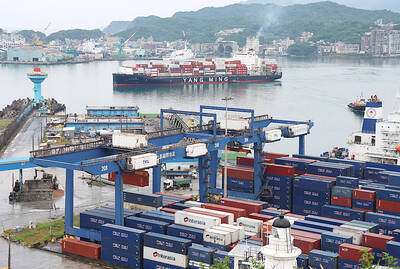
Taiwan’s exports soared 56 percent year-on-year to an all-time high of US$64.05 billion last month, propelled by surging global demand for artificial intelligence (AI), high-performance computing and cloud service infrastructure, the Ministry of Finance said yesterday. Department of Statistics Director-General Beatrice Tsai (蔡美娜) called the figure an unexpected upside surprise, citing a wave of technology orders from overseas customers alongside the usual year-end shopping season for technology products. Growth is likely to remain strong this month, she said, projecting a 40 percent to 45 percent expansion on an annual basis. The outperformance could prompt the Directorate-General of Budget, Accounting and

The demise of the coal industry left the US’ Appalachian region in tatters, with lost jobs, spoiled water and countless kilometers of abandoned underground mines. Now entrepreneurs are eyeing the rural region with ambitious visions to rebuild its economy by converting old mines into solar power systems and data centers that could help fuel the increasing power demands of the artificial intelligence (AI) boom. One such project is underway by a non-profit team calling itself Energy DELTA (Discovery, Education, Learning and Technology Accelerator) Lab, which is looking to develop energy sources on about 26,305 hectares of old coal land in

Netflix on Friday faced fierce criticism over its blockbuster deal to acquire Warner Bros Discovery. The streaming giant is already viewed as a pariah in some Hollywood circles, largely due to its reluctance to release content in theaters and its disruption of traditional industry practices. As Netflix emerged as the likely winning bidder for Warner Bros — the studio behind Casablanca, the Harry Potter movies and Friends — Hollywood’s elite launched an aggressive campaign against the acquisition. Titanic director James Cameron called the buyout a “disaster,” while a group of prominent producers are lobbying US Congress to oppose the deal,

Two Chinese chipmakers are attracting strong retail investor demand, buoyed by industry peer Moore Threads Technology Co’s (摩爾線程) stellar debut. The retail portion of MetaX Integrated Circuits (Shanghai) Co’s (上海沐曦) upcoming initial public offering (IPO) was 2,986 times oversubscribed on Friday, according to a filing. Meanwhile, Beijing Onmicro Electronics Co (北京昂瑞微), which makes radio frequency chips, was 2,899 times oversubscribed on Friday, its filing showed. The bids coincided with Moore Threads’ trading debut, which surged 425 percent on Friday after raising 8 billion yuan (US$1.13 billion) on bets that the company could emerge as a viable local competitor to Nvidia


 RSS
RSS