


Boeing Co on Monday said that it would temporarily suspend production of its globally grounded 737 MAX jets next month, as safety regulators delay the aircraft’s return to the skies after two crashes.
The decision confirmed investor fears that the company’s recovery from the crisis is dragging on longer and creating more uncertainty for Boeing than executives anticipated.
Boeing’s travails since March have weighed on the US economy, holding down US manufacturing output, trade and sales of durable goods, while damaging the company’s performance on Wall Street’s benchmark Dow Jones Industrial Average.
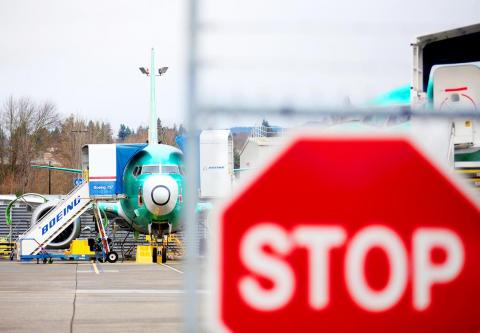
Photo: Reuters
The company said in a statement that it would continue to pay its workers, despite the temporary production stoppage, but the decision immediately raised questions regarding the future of parts suppliers that contribute to the jets’ manufacture.
“We have previously stated that we would continually evaluate our production plans should the MAX grounding continue longer than we expected,” the company said. “As a result of this ongoing evaluation, we have decided to prioritize the delivery of stored aircraft and temporarily suspend production on the 737 program beginning next month.”
The company said that it would focus on delivering 400 jets it has kept in storage.
Although the jets have been grounded worldwide since March following deadly crashes in Indonesia and Ethiopia, which left 346 people dead, Boeing had continued to produce 40 of the aircraft per month at a facility in Renton, Washington.
US aviation regulators last week issued the company an unusually sharp rebuke, accusing it of pursuing an “unrealistic” timeline for the MAX’s return to service and of making public statements intended to put pressure on federal authorities.
The Federal Aviation Administration on Wednesday said that it could not approve the jets’ return to service before next year, even though Boeing had long said that it planned to get officials’ green light before the end of this year.
Analysts have said that Boeing’s prospects would remain clouded until the company could get the all-clear for the MAX to fly again.
“As we have throughout the 737 MAX grounding, we will keep our customers, employees and supply chain top of mind as we continue to assess appropriate actions,” the company said, adding that it would disclose financial information tied to the suspension when it releases quarterly results late next month.
Major air carriers that had purchased 737 MAX jets have repeatedly pushed back the dates on which they anticipate a return to service.
Southwest Airlines Co yesterday said that it had reached a confidential agreement with Boeing partially compensating the airline for costs related to the grounding of the jets.
Shares in Boeing on Monday fell 4.3 percent as investors anticipated the airline’s decision. They were down another 0.4 percent in after-hours trading.
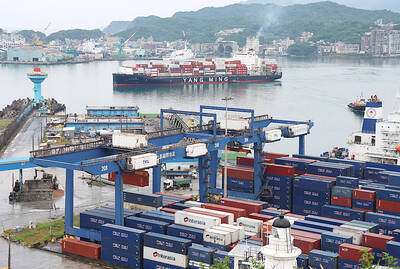
Taiwan’s exports soared 56 percent year-on-year to an all-time high of US$64.05 billion last month, propelled by surging global demand for artificial intelligence (AI), high-performance computing and cloud service infrastructure, the Ministry of Finance said yesterday. Department of Statistics Director-General Beatrice Tsai (蔡美娜) called the figure an unexpected upside surprise, citing a wave of technology orders from overseas customers alongside the usual year-end shopping season for technology products. Growth is likely to remain strong this month, she said, projecting a 40 percent to 45 percent expansion on an annual basis. The outperformance could prompt the Directorate-General of Budget, Accounting and

The demise of the coal industry left the US’ Appalachian region in tatters, with lost jobs, spoiled water and countless kilometers of abandoned underground mines. Now entrepreneurs are eyeing the rural region with ambitious visions to rebuild its economy by converting old mines into solar power systems and data centers that could help fuel the increasing power demands of the artificial intelligence (AI) boom. One such project is underway by a non-profit team calling itself Energy DELTA (Discovery, Education, Learning and Technology Accelerator) Lab, which is looking to develop energy sources on about 26,305 hectares of old coal land in

Netflix on Friday faced fierce criticism over its blockbuster deal to acquire Warner Bros Discovery. The streaming giant is already viewed as a pariah in some Hollywood circles, largely due to its reluctance to release content in theaters and its disruption of traditional industry practices. As Netflix emerged as the likely winning bidder for Warner Bros — the studio behind Casablanca, the Harry Potter movies and Friends — Hollywood’s elite launched an aggressive campaign against the acquisition. Titanic director James Cameron called the buyout a “disaster,” while a group of prominent producers are lobbying US Congress to oppose the deal,

Two Chinese chipmakers are attracting strong retail investor demand, buoyed by industry peer Moore Threads Technology Co’s (摩爾線程) stellar debut. The retail portion of MetaX Integrated Circuits (Shanghai) Co’s (上海沐曦) upcoming initial public offering (IPO) was 2,986 times oversubscribed on Friday, according to a filing. Meanwhile, Beijing Onmicro Electronics Co (北京昂瑞微), which makes radio frequency chips, was 2,899 times oversubscribed on Friday, its filing showed. The bids coincided with Moore Threads’ trading debut, which surged 425 percent on Friday after raising 8 billion yuan (US$1.13 billion) on bets that the company could emerge as a viable local competitor to Nvidia


 RSS
RSS