


Japan’s large manufacturers were losing optimism for the first time in more than six years as the government mulled measures to prop up the economy, according to a survey released by the Bank of Japan (BOJ) ahead of its meeting next week.
Sentiment among Japan’s biggest product makers slid to 0 from 5, according to the bank’s quarterly tankan survey released yesterday.
Economists forecast a reading of 3. Confidence has now weakened for four consecutive quarters, with the drop to zero indicating there are now as many pessimists as optimists.

Photo: AP
The results of the survey, which are mainly from the latter half of last month, show the depth of concern among large manufacturers at that time about business conditions amid an uncertain global outlook and the fallout from October’s sale tax hike and a destructive typhoon.
However, the report also contained some positives.
Sentiment at large companies outside the factory sector held up better than expected and capital spending plans edged up from the previous quarter.
“The results show companies are cautious about the impact of the tax hike,” Mitsubishi UFJ Morgan Stanley senior economist Hiroshi Miyazaki said, citing larger-than-expected falls in recent consumption data.
The US-China trade negotiations were also compounding their outlook, he said.
Still, resilience in the service sector suggests the damage from the global slowdown is still largely contained to Japan’s manufacturers.
The service industry has been a key prop for overall growth in the economy this year. Longer term, there are reasons for optimism.
Along with signs of progress in US-China trade talks, the stimulus package launched last week by Japanese Prime Minister Shinzo Abe administration’s has raised the nation’s growth prospects for next year, even if the situation in the current quarter remains challenging.
Economists surveyed by Bloomberg forecast that the economy would shrink by an annualized 2.6 percent this quarter, as the higher sales tax crimps consumer spending and production contends with a continued global slowdown and October’s super typhoon.
About 70 percent of businesses had responded to the survey by Nov. 27, according to the BOJ, long before the government’s announcement of the ¥13.2 trillion (US$122 billion) of fiscal stimulus, though it was known a package was in the pipeline.
“Capital spending remains strong and that means the BOJ can still stick to its view for a moderate recovery,” economist Hideo Kumano at Dai-ichi Life Research Institute said. “It’s likely that the BOJ will stand pat next week.”
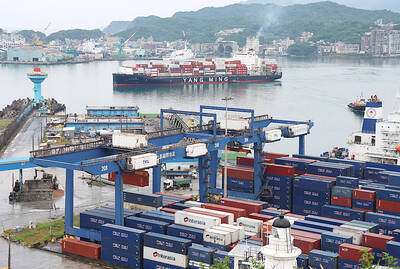
Taiwan’s exports soared 56 percent year-on-year to an all-time high of US$64.05 billion last month, propelled by surging global demand for artificial intelligence (AI), high-performance computing and cloud service infrastructure, the Ministry of Finance said yesterday. Department of Statistics Director-General Beatrice Tsai (蔡美娜) called the figure an unexpected upside surprise, citing a wave of technology orders from overseas customers alongside the usual year-end shopping season for technology products. Growth is likely to remain strong this month, she said, projecting a 40 percent to 45 percent expansion on an annual basis. The outperformance could prompt the Directorate-General of Budget, Accounting and

The demise of the coal industry left the US’ Appalachian region in tatters, with lost jobs, spoiled water and countless kilometers of abandoned underground mines. Now entrepreneurs are eyeing the rural region with ambitious visions to rebuild its economy by converting old mines into solar power systems and data centers that could help fuel the increasing power demands of the artificial intelligence (AI) boom. One such project is underway by a non-profit team calling itself Energy DELTA (Discovery, Education, Learning and Technology Accelerator) Lab, which is looking to develop energy sources on about 26,305 hectares of old coal land in

Netflix on Friday faced fierce criticism over its blockbuster deal to acquire Warner Bros Discovery. The streaming giant is already viewed as a pariah in some Hollywood circles, largely due to its reluctance to release content in theaters and its disruption of traditional industry practices. As Netflix emerged as the likely winning bidder for Warner Bros — the studio behind Casablanca, the Harry Potter movies and Friends — Hollywood’s elite launched an aggressive campaign against the acquisition. Titanic director James Cameron called the buyout a “disaster,” while a group of prominent producers are lobbying US Congress to oppose the deal,

Two Chinese chipmakers are attracting strong retail investor demand, buoyed by industry peer Moore Threads Technology Co’s (摩爾線程) stellar debut. The retail portion of MetaX Integrated Circuits (Shanghai) Co’s (上海沐曦) upcoming initial public offering (IPO) was 2,986 times oversubscribed on Friday, according to a filing. Meanwhile, Beijing Onmicro Electronics Co (北京昂瑞微), which makes radio frequency chips, was 2,899 times oversubscribed on Friday, its filing showed. The bids coincided with Moore Threads’ trading debut, which surged 425 percent on Friday after raising 8 billion yuan (US$1.13 billion) on bets that the company could emerge as a viable local competitor to Nvidia


 RSS
RSS