


Canada is to impose a levy on Internet giants such as Amazon.com Inc, Google and Facebook Inc similar to France’s digital services tax that created tensions with Washington, two ministers said on Monday.
“We’ve been very clear that we want to make sure that digital companies pay their fair share of taxes in our country,” Canadian Minister of Finance Bill Morneau told reporters.
“That means we will move forward,” he said.
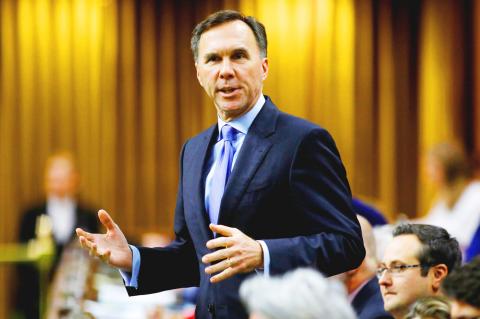
Photo: Reuters
Canadian Prime Minister Justin Trudeau, during an election campaign that returned his Liberals to power in October, called for a 3 percent tax on digital companies with Canadian revenue of at least C$40 million (US$30 million) and worldwide income topping C$1 billion.
A tax on online advertising and user data starting as early as April 1 next year would put an estimated C$540 million in government coffers in the first year, rising to C$730 million by fiscal year 2023-2024, the party’s election platform said.
Minister of Canadian Heritage Steven Guilbeault said that Ottawa intends to roll out the tax “in the shortest amount of time possible,” without specifying an exact time line.
Both ministers pointed to ongoing Organisation for Economic Co-operation and Development (OECD) negotiations on international taxation, saying they hoped for a multilateral consensus.
Washington has said that the OECD talks are key to resolving the taxation issue and has threatened to impose tariffs on French products over that nation’s digital services tax.
The French tax imposes a 3 percent levy on revenue earned by technology firms in France.
It targets revenue instead of profit, which is often reported by technology giants in low-tax jurisdictions such as Ireland or Luxembourg in a practice that has enraged other governments.
Separately, officials from the US, Canada and Mexico were to meet in Mexico yesterday for talks on a new continent-wide trade deal after US President Donald Trump hinted that efforts to push the pact through the US Congress were close to success.
The talks follow a report that US and Mexican trade negotiators reached an agreement making changes to labor enforcement under the US-Mexico-Canada Agreement signed last year.
That would remove a principal hurdle to ratification of the deal, the fate of which had seemed precarious.
“I am hearing very good things,” Trump said on Monday.
“I am hearing a lot of strides have been made over the last 48 hours,” he said.
US Trade Representative Robert Lighthizer and senior Trump adviser Jared Kushner, the president’s son-in-law, were expected to visit Mexico yesterday, the Washington Post reported.
Canadian Deputy Prime Minister Chrystia Freeland — the nation’s lead negotiator — was also headed to Mexico for meetings on the pact, her office said.
Trudeau earlier on Monday said that the chances of a deal were looking up.
“We’re working hard and hopeful it will get to ratification soon,” Trudeau said.

Taiwan’s exports soared 56 percent year-on-year to an all-time high of US$64.05 billion last month, propelled by surging global demand for artificial intelligence (AI), high-performance computing and cloud service infrastructure, the Ministry of Finance said yesterday. Department of Statistics Director-General Beatrice Tsai (蔡美娜) called the figure an unexpected upside surprise, citing a wave of technology orders from overseas customers alongside the usual year-end shopping season for technology products. Growth is likely to remain strong this month, she said, projecting a 40 percent to 45 percent expansion on an annual basis. The outperformance could prompt the Directorate-General of Budget, Accounting and

The demise of the coal industry left the US’ Appalachian region in tatters, with lost jobs, spoiled water and countless kilometers of abandoned underground mines. Now entrepreneurs are eyeing the rural region with ambitious visions to rebuild its economy by converting old mines into solar power systems and data centers that could help fuel the increasing power demands of the artificial intelligence (AI) boom. One such project is underway by a non-profit team calling itself Energy DELTA (Discovery, Education, Learning and Technology Accelerator) Lab, which is looking to develop energy sources on about 26,305 hectares of old coal land in

Netflix on Friday faced fierce criticism over its blockbuster deal to acquire Warner Bros Discovery. The streaming giant is already viewed as a pariah in some Hollywood circles, largely due to its reluctance to release content in theaters and its disruption of traditional industry practices. As Netflix emerged as the likely winning bidder for Warner Bros — the studio behind Casablanca, the Harry Potter movies and Friends — Hollywood’s elite launched an aggressive campaign against the acquisition. Titanic director James Cameron called the buyout a “disaster,” while a group of prominent producers are lobbying US Congress to oppose the deal,

Two Chinese chipmakers are attracting strong retail investor demand, buoyed by industry peer Moore Threads Technology Co’s (摩爾線程) stellar debut. The retail portion of MetaX Integrated Circuits (Shanghai) Co’s (上海沐曦) upcoming initial public offering (IPO) was 2,986 times oversubscribed on Friday, according to a filing. Meanwhile, Beijing Onmicro Electronics Co (北京昂瑞微), which makes radio frequency chips, was 2,899 times oversubscribed on Friday, its filing showed. The bids coincided with Moore Threads’ trading debut, which surged 425 percent on Friday after raising 8 billion yuan (US$1.13 billion) on bets that the company could emerge as a viable local competitor to Nvidia


 RSS
RSS