


The World Bank on Thursday said that its board adopted a new plan to aid China with US$1 billion to US$1.5 billion in low-interest loans annually through June 2025, despite the objections of US Secretary of the Treasury Steven Mnuchin and several US lawmakers.
The US Treasury’s representative on the board had objected on to the plan on Wednesday, Mnuchin told a US House of Representatives Financial Services Committee hearing, adding that he wants the World Bank to “graduate” China from its concessional loan programs for low and middle-income countries.
The five-year lending strategy plan was published on Thursday afternoon after the World Bank’s board “expressed broad support” for the multilateral development lender’s engagement in China’s structural and environmental reforms.
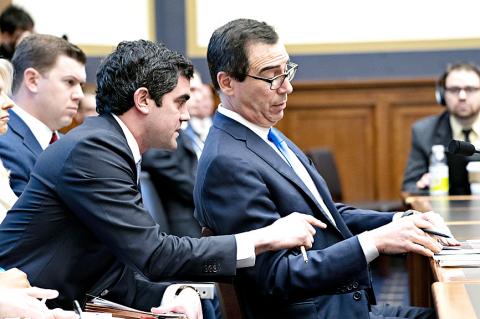
Photo: Bloomberg
The World Bank said its lending would decline over the “country partnership framework” plan, in line with reforms agreed on under a US$13 billion capital increase agreed to last year.
The World Bank loaned China US$1.3 billion in the fiscal 2019 year ended June 30, down from about US$2.4 billion in fiscal 2017. The new plan calls for lending to “gradually decline” from the previous five-year average of US$1.8 billion.
“Lending levels may fluctuate up and down from year to year due to normal pipeline management based on project readiness,” the World Bank said in its plan.
Beijing had requested continued financing from the World Bank’s International Bank for Reconstruction and Development division “as platforms for reform, institution building and knowledge transfer,” it said.
Mnuchin has argued that China is too wealthy for such international aid when it is lending hundreds of billions of dollars of its own to poor countries through its Belt and Road Infrastructure drive.
US lawmakers are also increasingly expressing concerns that US taxpayer funds loaned through the World Bank to China will enable human rights abuses and unfair economic competition with the US.
In US Senate floor remarks on Thursday, Senate Finance Committee Chairman Charles Grassley cited alleged human rights abuses in Xinjiang associated with detention camps for Muslim Uighurs in criticizing the World Bank lending plan.
“The World Bank, using American tax dollars, should not be lending to wealthy countries that violate the human rights of their citizens and attempt to dominate weaker countries either militarily or economically,” Grassley said.
US Representative Anthony Gonzalez, who has introduced legislation to curb World Bank funding to China, said: “For me, even a dollar is too much for our taxpayers to be contributing to China.”
Although the US hold an effective veto power over major board decisions such as capital increases and leadership appointments, the latest China lending plan did not require a formal vote.
Mnuchin told lawmakers he expected the World Bank’s lending to China to fall below US$1 billion during the current fiscal year, with more repayment funds flowing back to the lender from China than loan funds going out.
The World Bank said the lending to China in the five-year plan would be aimed at advancing market and fiscal reforms to encourage private-sector development; promoting greener growth by reducing pollution and reducing carbon emissions; and increasing Chinese citizens’ access to health and social services.
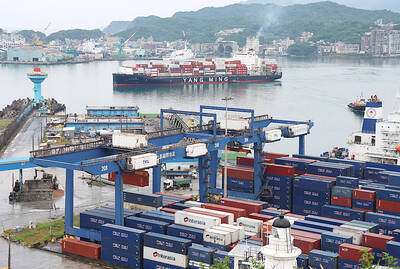
Taiwan’s exports soared 56 percent year-on-year to an all-time high of US$64.05 billion last month, propelled by surging global demand for artificial intelligence (AI), high-performance computing and cloud service infrastructure, the Ministry of Finance said yesterday. Department of Statistics Director-General Beatrice Tsai (蔡美娜) called the figure an unexpected upside surprise, citing a wave of technology orders from overseas customers alongside the usual year-end shopping season for technology products. Growth is likely to remain strong this month, she said, projecting a 40 percent to 45 percent expansion on an annual basis. The outperformance could prompt the Directorate-General of Budget, Accounting and
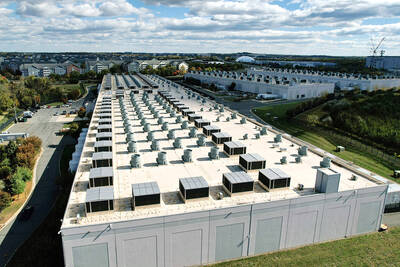
The demise of the coal industry left the US’ Appalachian region in tatters, with lost jobs, spoiled water and countless kilometers of abandoned underground mines. Now entrepreneurs are eyeing the rural region with ambitious visions to rebuild its economy by converting old mines into solar power systems and data centers that could help fuel the increasing power demands of the artificial intelligence (AI) boom. One such project is underway by a non-profit team calling itself Energy DELTA (Discovery, Education, Learning and Technology Accelerator) Lab, which is looking to develop energy sources on about 26,305 hectares of old coal land in

Netflix on Friday faced fierce criticism over its blockbuster deal to acquire Warner Bros Discovery. The streaming giant is already viewed as a pariah in some Hollywood circles, largely due to its reluctance to release content in theaters and its disruption of traditional industry practices. As Netflix emerged as the likely winning bidder for Warner Bros — the studio behind Casablanca, the Harry Potter movies and Friends — Hollywood’s elite launched an aggressive campaign against the acquisition. Titanic director James Cameron called the buyout a “disaster,” while a group of prominent producers are lobbying US Congress to oppose the deal,

Two Chinese chipmakers are attracting strong retail investor demand, buoyed by industry peer Moore Threads Technology Co’s (摩爾線程) stellar debut. The retail portion of MetaX Integrated Circuits (Shanghai) Co’s (上海沐曦) upcoming initial public offering (IPO) was 2,986 times oversubscribed on Friday, according to a filing. Meanwhile, Beijing Onmicro Electronics Co (北京昂瑞微), which makes radio frequency chips, was 2,899 times oversubscribed on Friday, its filing showed. The bids coincided with Moore Threads’ trading debut, which surged 425 percent on Friday after raising 8 billion yuan (US$1.13 billion) on bets that the company could emerge as a viable local competitor to Nvidia


 RSS
RSS