


OPEC stood on the verge of a deal to reduce its official output target in line with recent production, but after six hours of fraught talks in Vienna on Thursday, ministers left the cartel’s headquarters before a final agreement was nailed down.
Saudi Prince Abdulaziz bin Salman, in his first meeting as minister of energy, left reporters with a promise that “beautiful news” was to be revealed yesterday.
His comments were the culmination of a long day that yielded little of substance for oil traders wondering if OPEC and its allies would take action to prevent a crude surplus coming back next year.
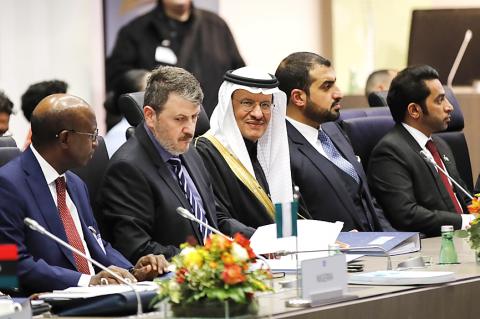
Photo: Bloomberg
Earlier in the day, ministers reached a deal in principle to deepen their output-cuts target by 500,000 barrels a day, delegates said.
A reduction of that magnitude would be largely symbolic, simply formalizing the extra supply reductions the group has already been making for most of this year, rather than taking barrels off the market.
Saudi Arabia’s new production target was likely to be above 10.1 million barrels a day, according to one delegate, slightly higher than recent levels.
Even so, the cartel could not finalize the details of how to divide the adjustment between members before further discussions with partners from the wider OPEC+ group yesterday, delegates said.
The new output target for Iraq, which has the worst record of implementing the existing cuts of any major oil producer in OPEC, was a particular sticking point, delegates said.
“The ruckus reflects pushback by producers facing stronger pressure than in the past to comply and contribute real, voluntary cuts,” said Bob McNally, president of Rapidan Energy Group and a former oil official at the White House under then-US president George W. Bush. “Nobody said collective supply management was easy or fun, especially after four years of struggle against surpluses.”
Brent crude traded little changed at US$63.30 a barrel as of 7:47am in London yesterday after climbing 0.6 percent on Thursday. West Texas Intermediate futures for next month were also little changed, trading at US$58.36 in New York.
In any event, OPEC’s policy decision was not due to be officially ratified until yesterday, when the OPEC+ meeting was scheduled.
However, unresolved questions around Iraq’s contribution posed a bigger obstacle to a deal than usual.
Crucially, the new 500,000 barrel-a-day quota reduction, which would apply in the first quarter of next year, would only come into force if all members of OPEC+ implement 100 percent of their pledged curbs, Russian Minister of Energy Alexander Novak said in a Bloomberg TV interview.
That is something that the alliance has struggled to achieve throughout the three years of its existence, with some countries such as Iraq actually increasing output after promising to cut.
OPEC+ last year agreed to reduce volumes by about 1.2 million barrels a day to eliminate a surplus and bolster crude prices. In reality, the alliance has cut far deeper for most of this year due to a combination of voluntary and involuntary measures.
The group’s Joint Technical Committee said that supply reductions exceeded that target by about 40 percent in October, equivalent to about 500,000 barrels a day of additional curbs.

Taiwan’s exports soared 56 percent year-on-year to an all-time high of US$64.05 billion last month, propelled by surging global demand for artificial intelligence (AI), high-performance computing and cloud service infrastructure, the Ministry of Finance said yesterday. Department of Statistics Director-General Beatrice Tsai (蔡美娜) called the figure an unexpected upside surprise, citing a wave of technology orders from overseas customers alongside the usual year-end shopping season for technology products. Growth is likely to remain strong this month, she said, projecting a 40 percent to 45 percent expansion on an annual basis. The outperformance could prompt the Directorate-General of Budget, Accounting and

The demise of the coal industry left the US’ Appalachian region in tatters, with lost jobs, spoiled water and countless kilometers of abandoned underground mines. Now entrepreneurs are eyeing the rural region with ambitious visions to rebuild its economy by converting old mines into solar power systems and data centers that could help fuel the increasing power demands of the artificial intelligence (AI) boom. One such project is underway by a non-profit team calling itself Energy DELTA (Discovery, Education, Learning and Technology Accelerator) Lab, which is looking to develop energy sources on about 26,305 hectares of old coal land in

Netflix on Friday faced fierce criticism over its blockbuster deal to acquire Warner Bros Discovery. The streaming giant is already viewed as a pariah in some Hollywood circles, largely due to its reluctance to release content in theaters and its disruption of traditional industry practices. As Netflix emerged as the likely winning bidder for Warner Bros — the studio behind Casablanca, the Harry Potter movies and Friends — Hollywood’s elite launched an aggressive campaign against the acquisition. Titanic director James Cameron called the buyout a “disaster,” while a group of prominent producers are lobbying US Congress to oppose the deal,

Two Chinese chipmakers are attracting strong retail investor demand, buoyed by industry peer Moore Threads Technology Co’s (摩爾線程) stellar debut. The retail portion of MetaX Integrated Circuits (Shanghai) Co’s (上海沐曦) upcoming initial public offering (IPO) was 2,986 times oversubscribed on Friday, according to a filing. Meanwhile, Beijing Onmicro Electronics Co (北京昂瑞微), which makes radio frequency chips, was 2,899 times oversubscribed on Friday, its filing showed. The bids coincided with Moore Threads’ trading debut, which surged 425 percent on Friday after raising 8 billion yuan (US$1.13 billion) on bets that the company could emerge as a viable local competitor to Nvidia


 RSS
RSS