


IC packaging and testing services provider Orient Semiconductor Engineering Inc (OSE, 華泰電子) is to invest NT$4.3 billion (US$140.98 million) in the nation, the Ministry of Economic Affairs said yesterday, as it approved two companies’ applications to participate in the government program seeking to attract Taiwanese companies back home.
Citing order transfers and clients relocating to Taiwan, OSE plans to move its server production in Suzhou, China, to Kaohsiung, where it plans to expand an idle production facility at the Nantze Export Processing Zone (楠梓加工出口區), the ministry said.
Leveraging off its electronics manufacturing services at the Nantze plant, OSE plans to offer one-stop services to clients for its solid state drive products, the ministry added.
Hydraulic pumps and valves manufacturer Camel Precision Co (全懋精機), which has previously partnered with Germany’s Eckerle Technologies GmbH to produce gear pumps, is to invest NT$300 million by setting up a new plant in Changhua County’s Tianjhong Township (田中) to meet client demand, the ministry said.
The government program has to date attracted investment applications from 158 companies, pledging about NT$707.8 billion in total investments and creating an estimated 57,801 job opportunities, the ministry said.
In a separate government program, the ministry yesterday approved plans by four companies to invest NT$16.8 billion in Taiwan.
Wafer thinning and integration specialist Phoenix Silicon International Corp (昇陽國際半導體), which supplies Taiwan Semiconductor Manufacturing Co (台積電), United Microelectronics Co (聯電) and Powerchip Semiconductor Manufacturing Co (力積電), plans to expand its wafer production by introducing two automated production lines at its Hsinchu Science Park (新竹科學園區) plant.
The investment would offer up to 117 job opportunities, the ministry said.
Win Semiconductors Corp (Win Semi, 穩懋半導體), the world’s largest compound semiconductor foundry, is to expand its plant in Taoyuan to meet expected strong demand as 5G takes off.
Win Semi also plans to build cleanrooms and purchase machinery for its plant, the ministry said, adding that the investment would provide 600 job opportunities.
TBI Motion Technology Co (全球傳動), which manufactures linear motion products, is to invest more than NT$1.7 billion to set up a new plant in New Taipei City’s Yingge District (鶯歌) and expand its Shulin District(樹林) plant to boost its production capacity and economies of scale.
The project is to offer 445 job opportunities, the ministry said.
An unnamed radio frequency identification (RFID) specialist plans to invest NT$1.2 billion to set up a new plant and office building in Taiwan to explore new RFID applications, the ministry said.
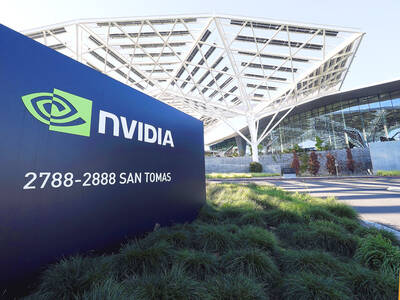
CHIP RACE: Three years of overbroad export controls drove foreign competitors to pursue their own AI chips, and ‘cost US taxpayers billions of dollars,’ Nvidia said China has figured out the US strategy for allowing it to buy Nvidia Corp’s H200s and is rejecting the artificial intelligence (AI) chip in favor of domestically developed semiconductors, White House AI adviser David Sacks said, citing news reports. US President Donald Trump on Monday said that he would allow shipments of Nvidia’s H200 chips to China, part of an administration effort backed by Sacks to challenge Chinese tech champions such as Huawei Technologies Co (華為) by bringing US competition to their home market. On Friday, Sacks signaled that he was uncertain about whether that approach would work. “They’re rejecting our chips,” Sacks

NATIONAL SECURITY: Intel’s testing of ACM tools despite US government control ‘highlights egregious gaps in US technology protection policies,’ a former official said Chipmaker Intel Corp has tested chipmaking tools this year from a toolmaker with deep roots in China and two overseas units that were targeted by US sanctions, according to two sources with direct knowledge of the matter. Intel, which fended off calls for its CEO’s resignation from US President Donald Trump in August over his alleged ties to China, got the tools from ACM Research Inc, a Fremont, California-based producer of chipmaking equipment. Two of ACM’s units, based in Shanghai and South Korea, were among a number of firms barred last year from receiving US technology over claims they have

It is challenging to build infrastructure in much of Europe. Constrained budgets and polarized politics tend to undermine long-term projects, forcing officials to react to emergencies rather than plan for the future. Not in Austria. Today, the country is to officially open its Koralmbahn tunnel, the 5.9 billion euro (US$6.9 billion) centerpiece of a groundbreaking new railway that will eventually run from Poland’s Baltic coast to the Adriatic Sea, transforming travel within Austria and positioning the Alpine nation at the forefront of logistics in Europe. “It is Austria’s biggest socio-economic experiment in over a century,” said Eric Kirschner, an economist at Graz-based Joanneum

OPTION: Uber said it could provide higher pay for batch trips, if incentives for batching is not removed entirely, as the latter would force it to pass on the costs to consumers Uber Technologies Inc yesterday warned that proposed restrictions on batching orders and minimum wages could prompt a NT$20 delivery fee increase in Taiwan, as lower efficiency would drive up costs. Uber CEO Dara Khosrowshahi made the remarks yesterday during his visit to Taiwan. He is on a multileg trip to the region, which includes stops in South Korea and Japan. His visit coincided the release last month of the Ministry of Labor’s draft bill on the delivery sector, which aims to safeguard delivery workers’ rights and improve their welfare. The ministry set the minimum pay for local food delivery drivers at


 RSS
RSS