


Google cofounders Larry Page and Sergey Brin are stepping down from their roles at the helm of parent firm Alphabet Inc, and handing the reins to Google chief executive officer Sundar Pichai, the company said on Tuesday.
Pichai is to take over from Page as chief executive officer of the holding firm, a Silicon Valley titan that includes Google as well as units focused on “other bets” in areas including self-driving vehicles and life sciences.
Page and Brin, who is Alphabet president, “will continue their involvement as cofounders, shareholders and members of Alphabet’s board of directors,” the company said.
In a letter to employees, the two wrote: “We’ve never been ones to hold on to management roles when we think there’s a better way to run the company.”
They added that 46-year-old Pichai “brings humility and a deep passion for technology to our users, partners and our employees every day,” and that there is “no better person to lead Google and Alphabet into the future.”
Alphabet was formed in 2015, giving separate identities to Google and newer projects such as autonomous vehicle unit Waymo and smart cities group Sidewalk Labs.
Pichai, born in India, takes the helm at a time when Page and Brin, both 46, have been noticeably absent, and the company faces a torrent of controversies relating to its dominant position in the tech world.
“Google is the vast, vast majority of Alphabet in terms of revenues, profit and everything else, so why not put the guy doing a great job running all of that in charge of [the] whole company?” Technalysis Research chief analyst Bob O’Donnell said.
Pichai is likely to fill a void at the company as it faces antitrust investigations and controversies over privacy and data practices in the US and elsewhere.
The company has also faced allegations of failing to adequately address sexual harassment in the workplace and of straying from the ideals espoused by the founders in the company’s early code of conduct, which included the motto “don’t be evil.”
“He’s a technologist, but he’s been a steady hand for the last few years and has proven his ability to conduct business at the highest level,” Endpoint Technologies Associates analyst Roger Kay said.
The move “ratifies that the [Google] founders have stepped aside almost entirely,” he added.
Pichai would have a new role as he faces up to claims from US President Donald Trump of “bias” in Internet search results, and the latest charge from Amnesty International that Alphabet’s business model leads to human rights violations by enabling surveillance of users.
In the past few years, Alphabet has become one of the world’s most valuable companies, with a profit of about US$30 billion on revenue of US$136.8 billion last year.
The 2015 reorganization appeared aimed at installing the start-up mentality for new ventures, described by Google as “moonshots.”
These ventures, including the life sciences group Verily and the biotech operation Calico, have been losing money.
Kay said the “other bets” have been struggling, because even though they have the financial backing from Google’s profits, “they don’t have the do-or-die element” of other start-ups.

Taiwan’s exports soared 56 percent year-on-year to an all-time high of US$64.05 billion last month, propelled by surging global demand for artificial intelligence (AI), high-performance computing and cloud service infrastructure, the Ministry of Finance said yesterday. Department of Statistics Director-General Beatrice Tsai (蔡美娜) called the figure an unexpected upside surprise, citing a wave of technology orders from overseas customers alongside the usual year-end shopping season for technology products. Growth is likely to remain strong this month, she said, projecting a 40 percent to 45 percent expansion on an annual basis. The outperformance could prompt the Directorate-General of Budget, Accounting and

The demise of the coal industry left the US’ Appalachian region in tatters, with lost jobs, spoiled water and countless kilometers of abandoned underground mines. Now entrepreneurs are eyeing the rural region with ambitious visions to rebuild its economy by converting old mines into solar power systems and data centers that could help fuel the increasing power demands of the artificial intelligence (AI) boom. One such project is underway by a non-profit team calling itself Energy DELTA (Discovery, Education, Learning and Technology Accelerator) Lab, which is looking to develop energy sources on about 26,305 hectares of old coal land in
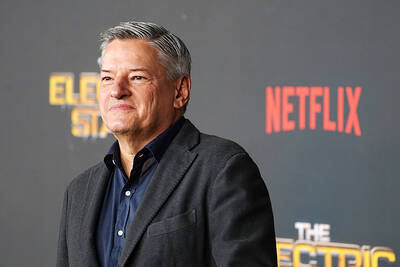
Netflix on Friday faced fierce criticism over its blockbuster deal to acquire Warner Bros Discovery. The streaming giant is already viewed as a pariah in some Hollywood circles, largely due to its reluctance to release content in theaters and its disruption of traditional industry practices. As Netflix emerged as the likely winning bidder for Warner Bros — the studio behind Casablanca, the Harry Potter movies and Friends — Hollywood’s elite launched an aggressive campaign against the acquisition. Titanic director James Cameron called the buyout a “disaster,” while a group of prominent producers are lobbying US Congress to oppose the deal,

Two Chinese chipmakers are attracting strong retail investor demand, buoyed by industry peer Moore Threads Technology Co’s (摩爾線程) stellar debut. The retail portion of MetaX Integrated Circuits (Shanghai) Co’s (上海沐曦) upcoming initial public offering (IPO) was 2,986 times oversubscribed on Friday, according to a filing. Meanwhile, Beijing Onmicro Electronics Co (北京昂瑞微), which makes radio frequency chips, was 2,899 times oversubscribed on Friday, its filing showed. The bids coincided with Moore Threads’ trading debut, which surged 425 percent on Friday after raising 8 billion yuan (US$1.13 billion) on bets that the company could emerge as a viable local competitor to Nvidia


 RSS
RSS