


Wall Street’s major indices ended Friday’s shorter session lower as US-China discord over Hong Kong fueled investor anxiety about trade talks and retail stocks dipped as in-store Black Friday sales appeared to draw smaller crowds.
China on Thursday threatened to retaliate against a US law backing pro-democracy protesters in Hong Kong with potential measures including barring drafters of the legislation from China, Hong Kong and Macau, the editor of China’s state-backed Global Times said on Twitter.
On Friday a Reuters report cited two sources saying that the US government might expand its power to stop more foreign shipments of products with US technology to China’s Huawei Technologies Co (華為), due to frustration that a blacklisting failed to end supplies to the world’s largest telecoms equipment maker.

While the S&P closed above its session low, selling intensified in the last hour of trading after the report on Huawei.
All three of Wall Street’s major indices had registered record highs earlier in the week when hopes were higher for an imminent “phase one” trade deal.
For the month, preliminary Refinitiv data showed that the S&P rose 3.4 percent, while the Dow Jones Industrial Average gained 3.7 percent and NASDAQ Composite climbed 4.5 percent. It was the biggest monthly gain for all three major indices since June.
The US-China news gave “a little bit of a weaker tone” to Friday’s market, Jack Janasiewicz, a portfolio manager and strategist at Natixis Investment Managers Solutions in Boston.
The Dow Jones Industrial Average fell 112.59 points, or 0.4 percent, to 28,051.41, the S&P 500 lost 12.65 points, or 0.4 percent, to 3,140.98 and the NASDAQ Composite dropped 39.70 points, or 0.46 percent, to 8,665.47.
For the week, the Dow rose 0.6 percent, the S&P gained 0.9 percent and the NASDAQ added 1.7 percent.
While many traders took the day off after Thursday’s US Thanksgiving holiday, Janasiewicz said others were likely on the sidelines as they waited for economic data, including the jobs report due out next week, and any retailer comments about initial numbers for the year-end holiday shopping season.
“We’ve got a good slate of data coming next week that’ll give us a better indication where we are in the cycle and people are going to want to know how did today’s retail sales go,” he said.
Spot check reports on retailers around the US showed fewer people than in past years lining up outside stores at the start of Black Friday, suggesting that online buying might have taken the shine off the country’s biggest shopping day.
“Looking at foot traffic volume is not quite as telling any more. It’s going to be online shopping as well. That’s going to be the bigger one,” Janasiewicz said. “Are people getting up, getting dressed and going out and shopping physically or are they just getting dressed, moving to the couch and turning on their computer and ordering online.”
The S&P 500 retail sector fell 0.8 percent, with Kohl’s Corp dropping 2.7 percent and Gap Inc falling 1.8 percent.
Shares of Tech Data Corp jumped 12.3 percent as private equity firm Apollo Global Management raised its bid for the US information technology equipment distributor to about US$5.14 billion.
Declining issues outnumbered advancing ones on the New York Stock Exchange by a 1.86-to-1 ratio; on NASDAQ, a 1.35-to-1 ratio favored decliners.
The S&P 500 posted 18 new 52-week highs and one new low; the NASDAQ Composite recorded 75 new highs and 28 new lows.
Trading volume was light in the truncated session, with 3.55 billion shares changing hands on US exchanges compared with the 6.86 billion average for the past 20 sessions.

Taiwan’s exports soared 56 percent year-on-year to an all-time high of US$64.05 billion last month, propelled by surging global demand for artificial intelligence (AI), high-performance computing and cloud service infrastructure, the Ministry of Finance said yesterday. Department of Statistics Director-General Beatrice Tsai (蔡美娜) called the figure an unexpected upside surprise, citing a wave of technology orders from overseas customers alongside the usual year-end shopping season for technology products. Growth is likely to remain strong this month, she said, projecting a 40 percent to 45 percent expansion on an annual basis. The outperformance could prompt the Directorate-General of Budget, Accounting and
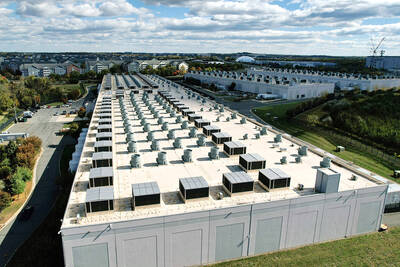
The demise of the coal industry left the US’ Appalachian region in tatters, with lost jobs, spoiled water and countless kilometers of abandoned underground mines. Now entrepreneurs are eyeing the rural region with ambitious visions to rebuild its economy by converting old mines into solar power systems and data centers that could help fuel the increasing power demands of the artificial intelligence (AI) boom. One such project is underway by a non-profit team calling itself Energy DELTA (Discovery, Education, Learning and Technology Accelerator) Lab, which is looking to develop energy sources on about 26,305 hectares of old coal land in

Netflix on Friday faced fierce criticism over its blockbuster deal to acquire Warner Bros Discovery. The streaming giant is already viewed as a pariah in some Hollywood circles, largely due to its reluctance to release content in theaters and its disruption of traditional industry practices. As Netflix emerged as the likely winning bidder for Warner Bros — the studio behind Casablanca, the Harry Potter movies and Friends — Hollywood’s elite launched an aggressive campaign against the acquisition. Titanic director James Cameron called the buyout a “disaster,” while a group of prominent producers are lobbying US Congress to oppose the deal,

Two Chinese chipmakers are attracting strong retail investor demand, buoyed by industry peer Moore Threads Technology Co’s (摩爾線程) stellar debut. The retail portion of MetaX Integrated Circuits (Shanghai) Co’s (上海沐曦) upcoming initial public offering (IPO) was 2,986 times oversubscribed on Friday, according to a filing. Meanwhile, Beijing Onmicro Electronics Co (北京昂瑞微), which makes radio frequency chips, was 2,899 times oversubscribed on Friday, its filing showed. The bids coincided with Moore Threads’ trading debut, which surged 425 percent on Friday after raising 8 billion yuan (US$1.13 billion) on bets that the company could emerge as a viable local competitor to Nvidia


 RSS
RSS