


Japan’s retail sales last month tumbled at their fastest pace in more than four-and-a-half years as a sales tax hike prompted consumers to cut spending, raising a red flag over the strength of domestic demand.
The Japanese government increased the nationwide sales tax to from 8 percent to 10 percent on Oct. 1 in a bid to fix the industrial world’s heaviest public debt burden, which is more than twice the size of the country’s GDP.
However, some analysts have warned the tax hike, previously postponed twice, could leave the economy without a growth driver amid a slump in exports and production, and as other factors drag on the consumer sector.
Retail sales fell 7.1 percent from a year earlier, pulled down by weak demand for big ticket items such as cars and household appliances, as well as clothing, Japanese Ministry of Economy, Trade and Industry data showed yesterday, with department stores hit particularly hard.
The drop was the biggest since a 9.7 percent fall in March 2015 and worse than a 4.4 percent decline predicted by economists in a Reuters poll.
“Regardless of today’s outcome, consumption has been of a weak tone, and consumer sentiment is getting worse,” said Taro Saito, an executive research fellow at NLI Research Institute in Tokyo. “Incomes haven’t been rising originally, so consumption hasn’t been growing since before the sales tax hike.”
The slump was also sharper than the declines reported after the previous two sales tax hikes, in 1997 and 2014, suggesting other factors are dragging on consumption.
Seasonally adjusted retail sales dropped 14.4 percent month-on-month last month, the data showed.
The negative reading comes after separate data this month showed Japan’s economy nearly stalled in the third quarter, while exports last month shrank at their fastest pace in three years.
The gloomy conditions have led to calls for the government to compile a big spending package to keep the country’s fragile economic recovery on track.
Analysts said retail sales were also hit by poor weather, after a huge typhoon ripped through central and eastern Japan, forcing stores and restaurants to temporarily close.
Others also noted more structural pressures faced by retailers even before the sales tax hike, such as the prolonged decline in real wages.
Data earlier this month showed inflation-adjusted wages rose 0.6 percent in the year to September, their first increase since the end of last year.
All those factors pose challenges to a government seeking to shake consumers out of a long-entrenched deflationary mindset, which has weighed on prices, hurt company profits and established a prolonged regime of ultra-easy monetary policy.
Adding to these woes is the risk retailers will continue to cut prices to offset the hit from the tax hike, while many stores are also offering discounts for cashless payments.
The government has introduced a rebate program for cashless transactions designed to both soften the tax hike blow to retailers and encourage Japanese consumers to use electronic payments instead of cash.
Other retailers are simply reducing prices to lure customers.
“This could spark stiff price competition and induce deflation. Small firms that lack competitiveness will be forced out of business,” Japan Supermarket Association chairman Yukio Kawano said.
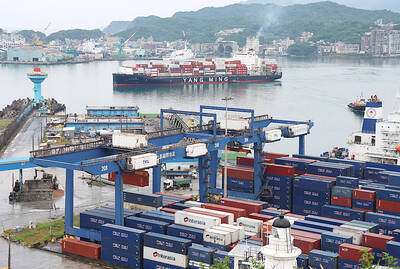
Taiwan’s exports soared 56 percent year-on-year to an all-time high of US$64.05 billion last month, propelled by surging global demand for artificial intelligence (AI), high-performance computing and cloud service infrastructure, the Ministry of Finance said yesterday. Department of Statistics Director-General Beatrice Tsai (蔡美娜) called the figure an unexpected upside surprise, citing a wave of technology orders from overseas customers alongside the usual year-end shopping season for technology products. Growth is likely to remain strong this month, she said, projecting a 40 percent to 45 percent expansion on an annual basis. The outperformance could prompt the Directorate-General of Budget, Accounting and

The demise of the coal industry left the US’ Appalachian region in tatters, with lost jobs, spoiled water and countless kilometers of abandoned underground mines. Now entrepreneurs are eyeing the rural region with ambitious visions to rebuild its economy by converting old mines into solar power systems and data centers that could help fuel the increasing power demands of the artificial intelligence (AI) boom. One such project is underway by a non-profit team calling itself Energy DELTA (Discovery, Education, Learning and Technology Accelerator) Lab, which is looking to develop energy sources on about 26,305 hectares of old coal land in

Netflix on Friday faced fierce criticism over its blockbuster deal to acquire Warner Bros Discovery. The streaming giant is already viewed as a pariah in some Hollywood circles, largely due to its reluctance to release content in theaters and its disruption of traditional industry practices. As Netflix emerged as the likely winning bidder for Warner Bros — the studio behind Casablanca, the Harry Potter movies and Friends — Hollywood’s elite launched an aggressive campaign against the acquisition. Titanic director James Cameron called the buyout a “disaster,” while a group of prominent producers are lobbying US Congress to oppose the deal,

Two Chinese chipmakers are attracting strong retail investor demand, buoyed by industry peer Moore Threads Technology Co’s (摩爾線程) stellar debut. The retail portion of MetaX Integrated Circuits (Shanghai) Co’s (上海沐曦) upcoming initial public offering (IPO) was 2,986 times oversubscribed on Friday, according to a filing. Meanwhile, Beijing Onmicro Electronics Co (北京昂瑞微), which makes radio frequency chips, was 2,899 times oversubscribed on Friday, its filing showed. The bids coincided with Moore Threads’ trading debut, which surged 425 percent on Friday after raising 8 billion yuan (US$1.13 billion) on bets that the company could emerge as a viable local competitor to Nvidia


 RSS
RSS