


The earliest-available indicators of China’s economic performance pointed to a continued slowdown this month.
Profits at Chinese industrial firms fell the most on record last month, dropping 9.9 percent from a year earlier, data from the Chinese National Bureau of Statistics showed yesterday.
The decline in prices at the factory gate is one of the factors undercutting those profits and is expected to continue this month, according to a Bloomberg tracker of producer prices.
The falling prices indicate that domestic demand is weak.
If those deflationary effects continue, it would further hurt corporate profits at home, and eventually drag down prices and profits overseas.
Sales managers at Chinese companies reported the worst conditions on record, with the headline index and sub-indices for manufacturing and services all below the 50 level that separates growth from contraction.
Business confidence was at a 14-month low, and all the gauges for manufacturing dropped from recent months, suggesting widespread problems, according to World Economics, which compiles the data.
SAIC Motor Corp (上海汽車), the biggest Chinese automaker, has reported four consecutive quarters of falling profit as consumers have stayed away from showrooms.
Auto sales have slowed in particular outside big cities, where less affluent people are more likely to be hit by the slowing economy.
The automaker cut its sales forecast in July, predicting the first annual decline in 14 years.
Warren Buffett-backed BYD Co (比亞迪), China’s biggest maker of new-energy vehicles, last month reported an 89 percent slump in third-quarter earnings and said that profit could fall as much as 43 percent this year.
Electric-vehicle maker BAIC BluePark New Energy Technology Co (北汽藍谷新能源科技) forecast an annual loss in a grim earnings update.
Yet there is some optimism among the parts of the economy most exposed to the global economy.
Export-focused firms were more upbeat in a Standard Chartered PLC survey of smaller businesses.
“Production activity accelerated as external demand rebounded,” while the new orders sub-index for domestically focused smaller companies weakened, Hunter Chan (陳宏) and Ding Shuang (丁爽) from Standard Chartered wrote in the report. “The manufacturing sector outperformed, its performance index rising to a seven-month high, while that of the services sector dropped.”
Iron ore prices have risen on optimism for domestic demand next year, with prices of steel rebar, which is used in construction, surging to their highest since May.
Bloomberg Economics generates the overall activity reading by aggregating the three-month weighted average of the monthly changes of eight indicators, which are based on business surveys or market prices.
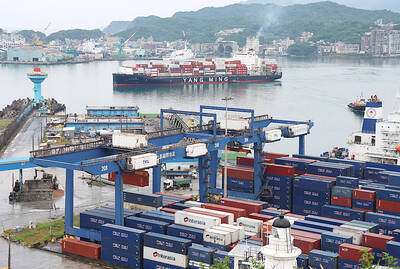
Taiwan’s exports soared 56 percent year-on-year to an all-time high of US$64.05 billion last month, propelled by surging global demand for artificial intelligence (AI), high-performance computing and cloud service infrastructure, the Ministry of Finance said yesterday. Department of Statistics Director-General Beatrice Tsai (蔡美娜) called the figure an unexpected upside surprise, citing a wave of technology orders from overseas customers alongside the usual year-end shopping season for technology products. Growth is likely to remain strong this month, she said, projecting a 40 percent to 45 percent expansion on an annual basis. The outperformance could prompt the Directorate-General of Budget, Accounting and
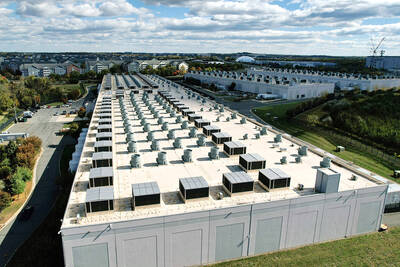
The demise of the coal industry left the US’ Appalachian region in tatters, with lost jobs, spoiled water and countless kilometers of abandoned underground mines. Now entrepreneurs are eyeing the rural region with ambitious visions to rebuild its economy by converting old mines into solar power systems and data centers that could help fuel the increasing power demands of the artificial intelligence (AI) boom. One such project is underway by a non-profit team calling itself Energy DELTA (Discovery, Education, Learning and Technology Accelerator) Lab, which is looking to develop energy sources on about 26,305 hectares of old coal land in

Netflix on Friday faced fierce criticism over its blockbuster deal to acquire Warner Bros Discovery. The streaming giant is already viewed as a pariah in some Hollywood circles, largely due to its reluctance to release content in theaters and its disruption of traditional industry practices. As Netflix emerged as the likely winning bidder for Warner Bros — the studio behind Casablanca, the Harry Potter movies and Friends — Hollywood’s elite launched an aggressive campaign against the acquisition. Titanic director James Cameron called the buyout a “disaster,” while a group of prominent producers are lobbying US Congress to oppose the deal,

Two Chinese chipmakers are attracting strong retail investor demand, buoyed by industry peer Moore Threads Technology Co’s (摩爾線程) stellar debut. The retail portion of MetaX Integrated Circuits (Shanghai) Co’s (上海沐曦) upcoming initial public offering (IPO) was 2,986 times oversubscribed on Friday, according to a filing. Meanwhile, Beijing Onmicro Electronics Co (北京昂瑞微), which makes radio frequency chips, was 2,899 times oversubscribed on Friday, its filing showed. The bids coincided with Moore Threads’ trading debut, which surged 425 percent on Friday after raising 8 billion yuan (US$1.13 billion) on bets that the company could emerge as a viable local competitor to Nvidia


 RSS
RSS