

Nearly one-quarter of German companies operating in China are planning to relocate all or part of their business out of the country, according to a study released yesterday, with many blaming rising costs.
The German Chamber of Commerce’s annual survey of 526 member firms in China found that 23 percent have either already decided to withdraw production capacity in the country or are considering it.
One-third of those companies have planned to leave China entirely.
The rest would transfer part of their business and production overseas, largely to lower-cost countries such as India or in Southeast Asia.
Operating costs in China have been rising as the country seeks to rebalance its economy from an export and investment-led model to one driven by consumer spending.
Of the 104 companies that have decided to leave or are considering to, 71 percent cited the rise in production costs — particularly for labor. One-third blamed an unfavorable public policy environment and one in four said the China-US trade dispute is having an impact.
“Business expectations have dropped to their lowest level in years,” the study warned, with only a quarter of companies surveyed expecting to meet or exceed their goals this year.
More than one-third said Beijing’s efforts to “level the playing field” for foreign companies are “insufficient.”
“Competition has to be fair,” German Ambassador Clemens von Goetze said at the launch of the study. “Foreign companies, including German companies, and Chinese companies should play on a level field.”
Von Goetze also said German companies had been “not so well informed” about China’s huge Belt and Road Initiative — a US$1 trillion global investment drive — and said they had not been able to benefit from the economic potential of the project.
Beijing’s initiative “is mainly Chinese-financed and implemented by Chinese companies,” the ambassador said.
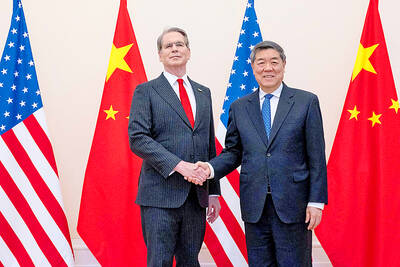
MINIMAL EXPECTATIONS: Analysts think that the two sides are likely to aim for ‘status quo’-level agreements, maintaining civility, without major trade breakthroughs US Secretary of the Treasury Scott Bessent and Chinese Vice Premier He Lifeng (何立峰) were set to meet yesterday to try to set up potential agreements on artificial intelligence (AI), tariffs and critical minerals for a summit in Washington this week between US President Donald Trump and Chinese President Xi Jinping (習近平). The meetings at JPMorgan Chase & Co’s headquarters in Manhattan, which included US Trade Representative Jamieson Greer, were due to start at about 10:30am on Sunday morning and were expected to run all day. Key topics would be the status of a US-China trade truce that is set to expire

APPEAL: Any agreement to produce advanced memory such as HBM or DRAM could run into opposition from Seoul as those technologies are sensitive, sources said South Korea’s SK Hynix Inc is in talks with Intel Corp about a deal that would see it manufacture memory chips on US soil for the first time, three people familiar with the discussions said. Under one potential scenario, SK Hynix would lease part of Intel’s long-planned chipmaking facility in Ohio, they said. Under another scenario, it could form a venture with Intel and major cloud firms that are keen to lock in memory supplies, two of the people said. A deal would relieve pressure on Intel, which has been struggling, and mark a big win for US President Donald

MORE DATA CENTERS: Microsoft’s Taiwan-area general manager said the corporation is looking to add two more data centers in northern Taiwan over the next few years Microsoft Corp plans to double its data centers in Taiwan from two facilities to four, Microsoft Taiwan general manager Sean Pien (卞志祥) said yesterday. “Over the past two to three years, we have consistently seen demand outstrip supply, and we expect that situation to continue over the next two to three years,” Pien said on the sidelines of a news conference in Taipei. The data center sites would mainly be in northern Taiwan to meet customer demand and reduce the risk of operational disruptions caused by a single event, he said, without saying their exact locations. Microsoft enabled the first phase of

Anthropic PBC CEO Dario Amodei and Salesforce Inc CEO Marc Benioff said companies have just begun taking advantage of artificial intelligence (AI) tools and need more help to gain the greatest benefits for their businesses. The power of AI is barely diffused through the economy, with only 5 to 10 percent of the value of the technology being used, Amodei said on Tuesday during an appearance with Benioff at Salesforce’s annual Dreamforce conference in San Francisco. Implementation of AI at large businesses — like the kind Salesforce mostly serves — remains far away from the futuristic vision professed by executives such as


 RSS
RSS