


Tesla Inc plans to double the number of repair and maintenance shops, add about 100 charging stations and revamp showrooms in China as the electric vehicle maker gears up to open its Shanghai plant.
Tesla plans to turn some of its showrooms in China into one-stop shops called “Tesla Centers” that also serve as delivery sites and offer maintenance support, two sources familiar with the matter said.
The sources, who spoke on condition of anonymity because they were not authorized to speak to the media, said the rollout would start in Shanghai and Guangzhou.
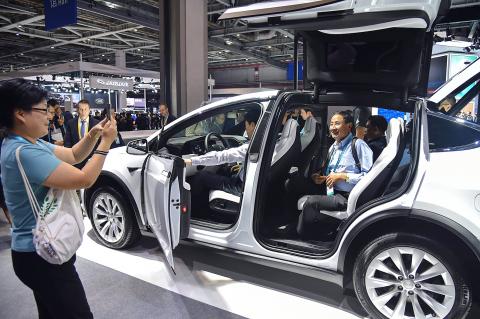
Photo: AFP
In coming months, the company also plans to double its service centers to 63 from 29 and boost fast charging stations by 39 percent to 362, according to Tesla planning documents.
“Expanding the service network is very important to boost customer confidence,” Tesla China general manager Wang Hao (王昊) said, adding that the firm would build more charging stations in China next year at a “faster pace.”
“There is growing sales potential from more inland cities, and a need to prepare for growing repair and maintenance demands to avoid complaints,” one of the sources said.
Tesla, whose service centers are mostly in China’s coastal regions and big provincial capitals, would open new ones in Urumqi, Kunming and Harbin, the documents showed.
The sources cautioned that plans might change depending on the circumstances.
Tesla’s corporate headquarters in the US did not respond to a request for comment.
Its efforts to boost its physical presence in China comes as the automaker has started trial production at the US$2 billion Shanghai plant, its first overseas factory, ahead of mass production by the end of next month.
Tesla has said it should be able to build 3,000 Model 3 sedans a week in its initial phases.
That is nearly four times the number of imported Model 3 vehicles sold in China per month this year, according to figures from research firm LMC Automotive.
It was not immediately clear how much Tesla would need to spend to expand its sales and after-sales network in China.
Maintaining growth momentum in China has become even more crucial to Tesla, as its US revenue tumbled 39 percent in the third quarter, its first decline in more than two years.
By contrast, sales in China rose 64 percent to US$669 million.
Tesla is also expanding its sales and delivery workforce in China: It has held several hiring events in Shanghai, Beijing and Shenzhen for sales and delivery staff in recent months, according to recruitment advertisements posted on social media.
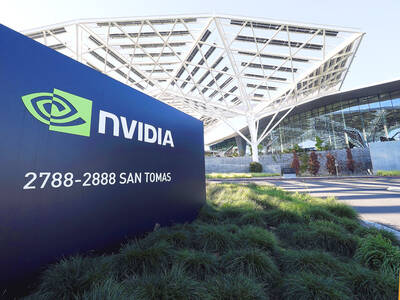
CHIP RACE: Three years of overbroad export controls drove foreign competitors to pursue their own AI chips, and ‘cost US taxpayers billions of dollars,’ Nvidia said China has figured out the US strategy for allowing it to buy Nvidia Corp’s H200s and is rejecting the artificial intelligence (AI) chip in favor of domestically developed semiconductors, White House AI adviser David Sacks said, citing news reports. US President Donald Trump on Monday said that he would allow shipments of Nvidia’s H200 chips to China, part of an administration effort backed by Sacks to challenge Chinese tech champions such as Huawei Technologies Co (華為) by bringing US competition to their home market. On Friday, Sacks signaled that he was uncertain about whether that approach would work. “They’re rejecting our chips,” Sacks
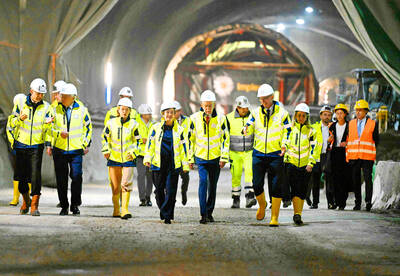
It is challenging to build infrastructure in much of Europe. Constrained budgets and polarized politics tend to undermine long-term projects, forcing officials to react to emergencies rather than plan for the future. Not in Austria. Today, the country is to officially open its Koralmbahn tunnel, the 5.9 billion euro (US$6.9 billion) centerpiece of a groundbreaking new railway that will eventually run from Poland’s Baltic coast to the Adriatic Sea, transforming travel within Austria and positioning the Alpine nation at the forefront of logistics in Europe. “It is Austria’s biggest socio-economic experiment in over a century,” said Eric Kirschner, an economist at Graz-based Joanneum

BUBBLE? Only a handful of companies are seeing rapid revenue growth and higher valuations, and it is not enough to call the AI trend a transformation, an analyst said Artificial intelligence (AI) is entering a more challenging phase next year as companies move beyond experimentation and begin demanding clear financial returns from a technology that has delivered big gains to only a small group of early adopters, PricewaterhouseCoopers (PwC) Taiwan said yesterday. Most organizations have been able to justify AI investments through cost recovery or modest efficiency gains, but few have achieved meaningful revenue growth or long-term competitive advantage, the consultancy said in its 2026 AI Business Predictions report. This growing performance gap is forcing executives to reconsider how AI is deployed across their organizations, it said. “Many companies
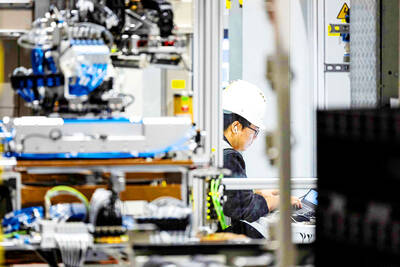
France is developing domestic production of electric vehicle (EV) batteries with an eye on industrial independence, but Asian experts are proving key in launching operations. In the Verkor factory outside the northern city of Dunkirk, which was inaugurated on Thursday, foreign specialists, notably from South Korea and Malaysia, are training the local staff. Verkor is the third battery gigafactory to open in northern France in a region that has become known as “Battery Valley.” At the Automotive Energy Supply Corp (AESC) factory near the city of Douai, where production has been under way for several months, Chinese engineers and technicians supervise French recruits. “They


 RSS
RSS