


Westpac Banking Corp capped a horror year for Australia’s banks with its worst earnings since the global financial crisis.
The country’s second-largest bank plans to tap shareholders for A$2.5 billion (US$1.7 billion) in new capital and slashed its dividend, as full-year cash profit plunged 15 percent — the first decline in earnings since the aftermath of the financial crisis in 2009.
The nation’s big banks have endured a torrid year, punctuated by a damning report uncovering years of misconduct, executive departures and a mounting bill to compensate customers for wrongdoing. Add a slowing economy, shrinking margins and tougher regulation — and the outlook is bleak.
After announcing the earnings yesterday, Westpac chief executive officer Brian Hartzer said: “2019 has been a disappointing year... Financial results are down significantly in a challenging, low-growth, low interest rate environment.”
Hartzer, 52, was not paid a short-term bonus, and has forgone a maximum of A$8.1 million in incentive payments, the bank’s annual report said.
RIPPLE EFFECT
While Westpac shares were halted from trading yesterday, the ripples were felt across the banking sector.
National Australia Bank Ltd, which is to report its earnings on Thursday, fell 2.53 percent in Sydney trading yesterday, and Commonwealth Bank of Australia declined 1.52 percent.
Australia & New Zealand Banking Group Ltd dropped 0.92 percent.
While analysts had been braced for a weak result from Westpac, the outcome was worse than expected across the board.
Cash profit fell to A$6.85 billion, ending nine years of growth, return on equity, a key measure of profitability, fell 225 basis points to 10.75 percent, well below the bank’s target of about 13 to 14 percent, and the final dividend was slashed to 80 cents a share from 94 cents last year.
GAME PLAN
To shore up its balance sheet ahead of tougher capital rules, the bank plans to sell A$2 billion of shares to institutional investors at A$25.32 each, a 9.2 percent discount on Friday’s closing price.
By comparison, when Macquarie Group Ltd, Australia’s largest investment bank, raised A$1 billion in August, it sold shares at just a 2.8 percent discount.
A further A$500 million of shares are to be offered to retail investors.
Banks would continue to struggle as margins decline further, said Aaron Binsted, a portfolio manager at Lazard Asset Management in Sydney.
“There’s just a lot of headwinds there,” he said.
CHIP RACE: Three years of overbroad export controls drove foreign competitors to pursue their own AI chips, and ‘cost US taxpayers billions of dollars,’ Nvidia said China has figured out the US strategy for allowing it to buy Nvidia Corp’s H200s and is rejecting the artificial intelligence (AI) chip in favor of domestically developed semiconductors, White House AI adviser David Sacks said, citing news reports. US President Donald Trump on Monday said that he would allow shipments of Nvidia’s H200 chips to China, part of an administration effort backed by Sacks to challenge Chinese tech champions such as Huawei Technologies Co (華為) by bringing US competition to their home market. On Friday, Sacks signaled that he was uncertain about whether that approach would work. “They’re rejecting our chips,” Sacks
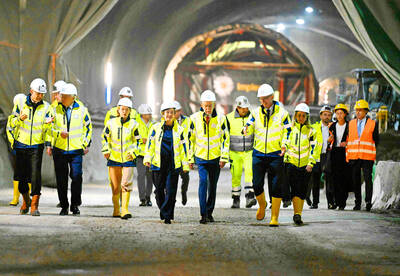
It is challenging to build infrastructure in much of Europe. Constrained budgets and polarized politics tend to undermine long-term projects, forcing officials to react to emergencies rather than plan for the future. Not in Austria. Today, the country is to officially open its Koralmbahn tunnel, the 5.9 billion euro (US$6.9 billion) centerpiece of a groundbreaking new railway that will eventually run from Poland’s Baltic coast to the Adriatic Sea, transforming travel within Austria and positioning the Alpine nation at the forefront of logistics in Europe. “It is Austria’s biggest socio-economic experiment in over a century,” said Eric Kirschner, an economist at Graz-based Joanneum

BUBBLE? Only a handful of companies are seeing rapid revenue growth and higher valuations, and it is not enough to call the AI trend a transformation, an analyst said Artificial intelligence (AI) is entering a more challenging phase next year as companies move beyond experimentation and begin demanding clear financial returns from a technology that has delivered big gains to only a small group of early adopters, PricewaterhouseCoopers (PwC) Taiwan said yesterday. Most organizations have been able to justify AI investments through cost recovery or modest efficiency gains, but few have achieved meaningful revenue growth or long-term competitive advantage, the consultancy said in its 2026 AI Business Predictions report. This growing performance gap is forcing executives to reconsider how AI is deployed across their organizations, it said. “Many companies
Taiwan’s long-term economic competitiveness will hinge not only on national champions like Taiwan Semiconductor Manufacturing Co. (TSMC, 台積電) but also on the widespread adoption of artificial intelligence (AI) and other emerging technologies, a US-based scholar has said. At a lecture in Taipei on Tuesday, Jeffrey Ding, assistant professor of political science at the George Washington University and author of "Technology and the Rise of Great Powers," argued that historical experience shows that general-purpose technologies (GPTs) — such as electricity, computers and now AI — shape long-term economic advantages through their diffusion across the broader economy. "What really matters is not who pioneers


 RSS
RSS