


Wall Street surged on Friday after moderate jobs growth data from last month offered relief from a spate of dismal economic data this week that has rankled markets and fueled concerns that the world’s largest economy might be sliding into a recession.
A rally in technology stocks led by Apple Inc also helped lift the benchmark indices at the end of a rollercoaster week. After losing about 3 percent over Tuesday and Wednesday, the S&P 500 on Friday logged its biggest one-day gain since Aug. 16, thanks in part to a late-session surge.
Still, for a third consecutive week, the Dow Jones Industrial Average and S&P 500 lost ground.
The US Department of Labor’s report showed that non-farm payrolls last month increased by 136,000 and the unemployment rate dropped to a 50-year low, but manufacturing payrolls declined for the first time in six months.
“It’s sort of a Goldilocks report: It’s not strong enough to move the Federal Reserve away from cutting rates at the end of October, but it’s not weak enough to make you concerned about the labor market or the consumer,” said Shawn Snyder, head of investment strategy at Citi Personal Wealth Management in New York.
Bets that the Fed will cut interest rates have surged this week after a dramatic contraction in US manufacturing, cooling private-sector hiring and a fall in service-sector activity pointed to widening fallout from the US-China trade dispute.
Traders see a 77.5 percent chance that the central bank will lower borrowing costs at its policy meeting later this month, up from 40 percent on Monday.
The Fed last month cut rates for the second time this year and said future reductions would be “data-dependent.”
With fears related to the trade dispute and its effect on the US economy weighing on sentiment, the S&P 500 is up 2 percent over the past 12 months, and about 2 percent off its record-high close in July.
“Although market participants have been selling stocks and buying bonds, at the end of the day you say: ‘Gee, I still have to have some return for my investment, and that’s going to come from stocks,’” Globalt Investments senior portfolio manager Tom Martin said.
Apple shares rose 2.8 percent after a report that the company would ramp up production of iPhone 11 models.
The S&P information technology index climbed 1.7 percent, while the Philadelphia chip index advanced 1.9 percent.
All 11 major sector indices rose, led by a 1.9 percent jump in the S&P financials.
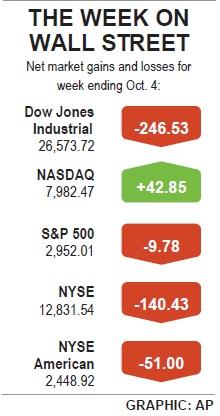
The Dow Jones Industrial Average jumped 1.42 percent to close at 26,573.72 points, while the S&P 500 also surged 1.42 percent, finishing at 2,952.01. The NASDAQ Composite added 1.4 percent to end at 7,982.47.
Volume on US exchanges was light at 5.9 billion shares, compared with the 7.3 billion average for the full session over the past 20 trading days.
For the week, the S&P 500 fell 0.3 percent and the Dow lost 0.9 percent, while the NASDAQ added 0.5 percent.
During Friday’s session, HP Inc tumbled 9.6 percent after the computer maker said it would cut up to 16 percent of its workforce as part of a restructuring plan that would result in an overall charge of US$1 billion.
Advancing issues outnumbered declining ones on the New York Stock Exchange by a 3.12-to-1 ratio; on NASDAQ, a 2.26-to-1 ratio favored advancers.
The S&P 500 posted 18 new 52-week highs and one new low; the NASDAQ Composite recorded 17 new highs and 70 new lows.
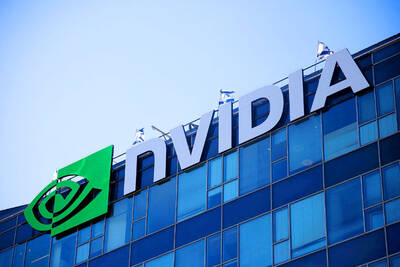
AI TALENT: No financial details were released about the deal, in which top Groq executives, including its CEO, would join Nvidia to help advance the technology Nvidia Corp has agreed to a licensing deal with artificial intelligence (AI) start-up Groq, furthering its investments in companies connected to the AI boom and gaining the right to add a new type of technology to its products. The world’s largest publicly traded company has paid for the right to use Groq’s technology and is to integrate its chip design into future products. Some of the start-up’s executives are leaving to join Nvidia to help with that effort, the companies said. Groq would continue as an independent company with a new chief executive, it said on Wednesday in a post on its Web

RESPONSE: The Japanese Ministry of Finance might have to intervene in the currency markets should the yen keep weakening toward the 160 level against the US dollar Japan’s chief currency official yesterday sent a warning on recent foreign exchange moves, after the yen weakened against the US dollar following Friday last week’s Bank of Japan (BOJ) decision. “We’re seeing one-directional, sudden moves especially after last week’s monetary policy meeting, so I’m deeply concerned,” Japanese Vice Finance Minister for International Affairs Atsushi Mimura told reporters. “We’d like to take appropriate responses against excessive moves.” The central bank on Friday raised its benchmark interest rate to the highest in 30 years, but Bank of Japan Governor Kazuo Ueda chose to keep his options open rather than bolster the yen,

Even as the US is embarked on a bitter rivalry with China over the deployment of artificial intelligence (AI), Chinese technology is quietly making inroads into the US market. Despite considerable geopolitical tensions, Chinese open-source AI models are winning over a growing number of programmers and companies in the US. These are different from the closed generative AI models that have become household names — ChatGPT-maker OpenAI or Google’s Gemini — whose inner workings are fiercely protected. In contrast, “open” models offered by many Chinese rivals, from Alibaba (阿里巴巴) to DeepSeek (深度求索), allow programmers to customize parts of the software to suit their
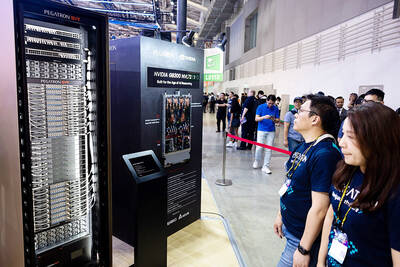
Global server shipments are expected to surge to 15 million units next year, from 4 million units this year, with artificial intelligence (AI) servers accounting for about 30 percent, driven by massive capital spending by major cloud service providers, the Market Intelligence and Consulting Institute (MIC) said on Thursday last week. Major cloud service providers — including Google’s parent company Alphabet Inc, Microsoft Corp, Amazon.com Inc and Meta Platforms Inc — are projected to budget US$450 million for capital expenditure next year, up from US$400 million this year, MIC ICT [information and communications technology] Industry Research Center director Edward Lin


 RSS
RSS