


The US Federal Reserve, under intense pressure from US President Donald Trump to stimulate the economy, on Wednesday cut the benchmark interest rate for the first time in more than a decade, but struggled to justify the move or explain where it goes next.
The move to ease the cost of borrowing was well telegraphed and meant to inoculate against global risks washing onto US shores, but financial markets were whipsawed by confusion over whether another cut would be coming.
Fed Chairman Jerome Powell told reporters he remains confident in the US economy and sees no sectors ready to go “bust.”
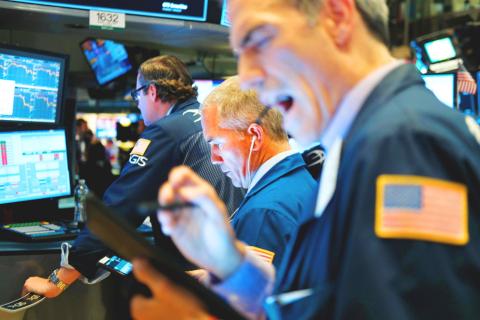
Photo: AFP
However, he said the Fed decided on a cut of 25 basis points to “insure against downside risks from weak global growth and trade policy uncertainty, to help offset the effects these factors are having on the economy.”
However, Trump — who had been loudly calling for a rate cut — wasted no time in attacking on Twitter, saying the move fell far short of the “aggressive rate-cutting cycle” he wanted.
The target for the federal funds rate was lowered to 2.0 to 2.25 percent and the central bank again vowed to “act as appropriate to sustain the expansion.”
It was a quick turnaround for the Fed, coming after four rate increases last year — the last one in December.
However, Powell tried to paint it as part of a continuum, with central bankers shifting their policy stance as economic data changed over the course of the year, especially trade tensions, which nearly “boiled over” last month, but have now returned “to a simmer.”
US markets plunged after Powell said the Fed was not on the threshold of a “lengthy cutting cycle,” with the Dow Jones Industrial Average at one point losing nearly 500 points.
Powell later clarified, saying that neither was he ruling out another rate cut, and the Dow pared losses to close down a little more than 300 points or 1.2 percent.
“Let me be clear. I said it’s not the beginning of a long series of rate cuts. I didn’t say it’s just one or anything like that,” he said.
It was another example of the Fed’s communication woes, as it is buffeted by conflicting economic signals and constant verbal attacks.
Nor is the Fed’s policy-setting Federal Open Market Committee presenting a unified front: Esther George and Eric Rosengren, presidents of the Federal Reserve banks of Kansas City and Boston respectively, dissented in the 8-2 vote, preferring to leave rates unchanged.
The Fed also gave Trump something else he has demanded in his unrelenting attacks: an early end to a policy known as “quantitative tightening,” or QT.
Starting yesterday — two months ahead of schedule — the Fed would stop reducing the huge amount of securities it built up during the global financial crisis.
Trump’s aggressive trade policies, and his conflict with China in particular, have thrown a wrench into the world economy and complicated the Fed’s carefully laid plans.
On Wednesday, Trump welcomed the end of QT, but said: “As usual, Powell let us down.”
“What the market wanted to hear from Jay Powell and the Federal Reserve was that this was the beginning of a lengthy and aggressive rate-cutting cycle which would keep pace with China, the European Union and other countries around the world,” he tweeted.
“We are winning anyway but I am certainly not getting much,” the president added.
Powell again dismissed fears that central bankers are swayed by outside pressure on the independent Fed, saying policy is “going to depend on the evolving data and the evolving risk picture.”
“We never take into account political considerations. There’s no place in our discussions for that,” Powell added.
And despite speculation that the last rate increase was a move to defy Trump, Powell said: “We don’t conduct monetary policy in order to prove our independence.”
While the committee continues to expect sustained economic expansion and inflation gradually rising to the Fed’s 2 percent target, “uncertainties about this outlook remain,” he said.
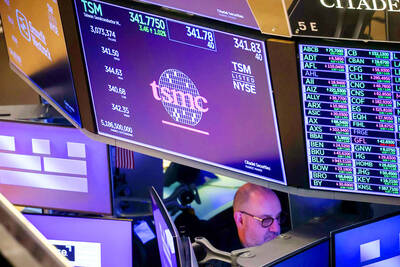
STRONG INTEREST: Analysts have pointed to optimism in TSMC’s growth prospects in the artificial intelligence era as the cause of the rising number of shareholders The number of people holding shares of chipmaker Taiwan Semiconductor Manufacturing Co (TSMC, 台積電) hit a new high last week despite a decline in its stock price, the Taiwan Depository and Clearing Corp (TDCC, 台灣集保) said. The number of TSMC shareholders rose to 2.46 million as of Friday, up 75,536 from a week earlier, TDCC data showed. The stock price fell 1.34 percent during the same week to close at NT$1,840 (US$57.55). The decline in TSMC’s share price resulted from volatility in global tech stocks, driven by rising international crude oil prices as the war against Iran continues. Dealers said
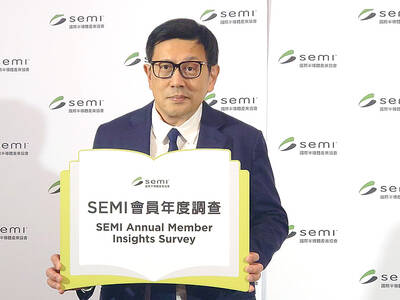
PRICE HIKES: The war in the Middle East would not significantly disrupt supply in the short term, but semiconductor companies are facing price surges for materials Taiwan’s semiconductor companies are not facing imminent supply disruptions of essential chemicals or raw materials due to the war in the Middle East, but surges in material costs loom large, industry association SEMI Taiwan said yesterday. The association’s comments came amid growing concerns that supplies of helium and other key raw materials used in semiconductor production could become a choke point after Qatar shut down its liquefied natural gas (LNG) production and helium output earlier this month due to the conflict. Qatar is the second-largest LNG supplier in the world and accounts for about 33 percent of global helium output. Helium is

China is clamping down on fertilizer exports to protect its domestic market, industry sources said, putting an additional strain on global markets that were already grappling with shortages caused by the US-Israeli war on Iran. China is among the largest fertilizer exporters — shipping more than US$13 billion of it last year — and it has a history of controlling exports to keep prices low for farmers. Shipments through the war-blocked Strait of Hormuz account for about one-third of the sea-borne supply. This month, Beijing banned exports of nitrogen-potassium fertilizer blends and certain phosphate varieties, sources said. The ban, which has not

AMAZING ABUNDANCE: Elon Musk has announced plans for a new facility in Texas which would manufacture chips for Tesla and SpaceX to use in robotics and AI Elon Musk said his Terafab project — a grand plan to eventually manufacture his own chips for robotics, artificial intelligence (AI) and space data centers — would be built in Austin and jointly run by Tesla Inc and Space Exploration Technologies Corp (SpaceX). Musk, the chief executive officer of the two companies, said he would start off with an “advanced technology fab” in Austin that would have all of the equipment necessary to make chips of any kind. The project would call for one day supporting 1 terawatt (TW) of computing power per year, the amount Musk expects the companies to


 RSS
RSS