


US President Donald Trump’s renewed focus on what he calls “unfair” exchange rates could presage a new global battlefield that has the potential to do great damage to the world economy.
Trump has spent two years attacking the underpinnings of the global trading system, launching multifront tariff wars on allies and adversaries alike, while complaining that the US has been taken advantage of.
Under a proposed new rule that could come into effect as early as next month, the US might impose punitive tariffs on any nation it determines is manipulating its currency to make its products more competitive than US goods.
Trump has frequently attacked eurozone countries such as Germany for benefiting from a relatively weak currency and last week said: “They have been getting away with this for years, along with China and others.”
As Trump’s attack on European Central Bank President Mario Draghi in the past week shows, once-mundane monetary policy moves could be used as ammunition to justify retaliation.
Economists warn that this opens the door to a damaging global currency war pitting everyone against everyone.
If Trump follows this new path, likely with the backing of US Secretary of Commerce and trade hardliner Wilbur Ross, the US would be vulnerable to retaliation when the US Federal Reserve eventually cuts the benchmark interest rate as Trump has demanded that they do.
Central banks use interest rate cuts to spur a sluggish economy, weakening a currency’s value in exchange for boosting exports, which then power economic growth.
FUNDAMENTALLY FLAWED
Mark Sobel, who served in the US Treasury for years under both Republican and Democratic administrations, said that he has “serious reservations” about the plan.
In his submission to the US Department of Commerce, he said that the rule change is “fundamentally flawed ... and could prove counterproductive and harm the US economy.”
Over the years, lawmakers and presidents from the Democratic and Republican parties have floated plans to go after governments that manipulate their exchange rate to compete in the global trading system.
However, the efforts — mostly aimed at China — have always been resisted and eventually abandoned, in part because they were viewed as a contravention of global trade rules.
Ironically, China has not been intervening in markets in the past few years, except to keep the yuan from falling, and the currency has instead gained in value since the financial crisis.
The US Treasury issues a twice-yearly report scrutinizing possible currency manipulation, but since the mid-1990s, the department has never taken the final step of labeling a country as a manipulator, even in the years when China was active in its efforts to keep the yuan weak.
Now the department has moved to wrest control of the issue away from the Treasury by proposing a rule modification that would allow it to treat currency manipulation the same as it would a foreign government subsidy that harms US manufacturers.
OPEN FOR COMMENT
If approved, the department could impose tariffs to offset the weaker exchange rate against the US dollar.
The department is accepting comments from the public until Thursday and could implement the change any time after that.
According to the proposal, the department said that it would defer to Treasury’s evaluation of whether a currency is undervalued, “unless we have good reason to believe otherwise.”
That ambiguity raises red flags for economists, many of whom believe the department does not have the technical expertise to make that evaluation.
The plan “would grant the commerce department excessive discretion,” Sobel said.
It also is notoriously difficult to calculate objectively whether a particular currency is undervalued and, if so, by how much.
For years, the Peterson Institute for International Economics produced a report evaluating exchange rates, but stopped “because they were completely arbitrary,” the think tank’s president Adam Posen told reporters.
“China should have been hammered hard in the early, mid-2000s for massive manipulation of the currency,” Posen said, but to do so now would be “pretty close to absurd.”

CHIP RACE: Three years of overbroad export controls drove foreign competitors to pursue their own AI chips, and ‘cost US taxpayers billions of dollars,’ Nvidia said China has figured out the US strategy for allowing it to buy Nvidia Corp’s H200s and is rejecting the artificial intelligence (AI) chip in favor of domestically developed semiconductors, White House AI adviser David Sacks said, citing news reports. US President Donald Trump on Monday said that he would allow shipments of Nvidia’s H200 chips to China, part of an administration effort backed by Sacks to challenge Chinese tech champions such as Huawei Technologies Co (華為) by bringing US competition to their home market. On Friday, Sacks signaled that he was uncertain about whether that approach would work. “They’re rejecting our chips,” Sacks
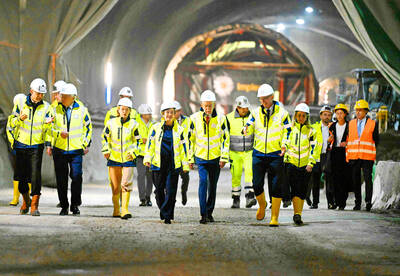
It is challenging to build infrastructure in much of Europe. Constrained budgets and polarized politics tend to undermine long-term projects, forcing officials to react to emergencies rather than plan for the future. Not in Austria. Today, the country is to officially open its Koralmbahn tunnel, the 5.9 billion euro (US$6.9 billion) centerpiece of a groundbreaking new railway that will eventually run from Poland’s Baltic coast to the Adriatic Sea, transforming travel within Austria and positioning the Alpine nation at the forefront of logistics in Europe. “It is Austria’s biggest socio-economic experiment in over a century,” said Eric Kirschner, an economist at Graz-based Joanneum

BUBBLE? Only a handful of companies are seeing rapid revenue growth and higher valuations, and it is not enough to call the AI trend a transformation, an analyst said Artificial intelligence (AI) is entering a more challenging phase next year as companies move beyond experimentation and begin demanding clear financial returns from a technology that has delivered big gains to only a small group of early adopters, PricewaterhouseCoopers (PwC) Taiwan said yesterday. Most organizations have been able to justify AI investments through cost recovery or modest efficiency gains, but few have achieved meaningful revenue growth or long-term competitive advantage, the consultancy said in its 2026 AI Business Predictions report. This growing performance gap is forcing executives to reconsider how AI is deployed across their organizations, it said. “Many companies
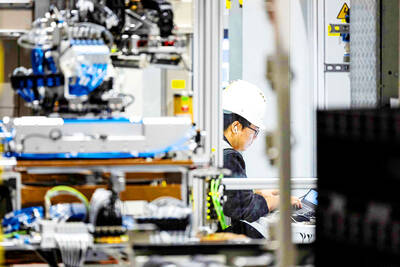
France is developing domestic production of electric vehicle (EV) batteries with an eye on industrial independence, but Asian experts are proving key in launching operations. In the Verkor factory outside the northern city of Dunkirk, which was inaugurated on Thursday, foreign specialists, notably from South Korea and Malaysia, are training the local staff. Verkor is the third battery gigafactory to open in northern France in a region that has become known as “Battery Valley.” At the Automotive Energy Supply Corp (AESC) factory near the city of Douai, where production has been under way for several months, Chinese engineers and technicians supervise French recruits. “They


 RSS
RSS