


US President Donald Trump yesterday threatened to hit China with tariffs on “at least” another US$300 billion of Chinese goods, but said he thought both China and Mexico wanted to make deals in their trade disputes with the US.
Tensions between the world’s two largest economies have risen sharply since talks aimed at ending a festering trade dispute broke down early last month.
While Trump yesterday said that talks with China were ongoing, no face-to-face meetings have been held since May 10, the day he sharply increased tariffs on a US$200 billion list of Chinese goods to 25 percent, prompting Beijing to retaliate.

Photo: AFP
“Our talks with China, a lot of interesting things are happening. We’ll see what happens... I could go up another at least US$300 billion and I’ll do that at the right time,” Trump told reporters, without specifying which goods could be impacted.
“But I think China wants to make a deal and I think Mexico wants to make a deal badly,” said Trump before boarding Air Force One at the airport in Shannon, Ireland, on his way to France for D-Day commemorations.
In Beijing, the Chinese Ministry of Commerce struck a defiant tone.
“If the United States willfully decides to escalate tensions, we’ll fight to the end,” ministry spokesman Gao Feng (高峰) told a regular news briefing.
“China does not want to fight a trade war, but also is not afraid of one. If the United States willfully decides to escalate trade tensions, we’ll adopt necessary countermeasures and resolutely safeguard the interests of China and its people,” he said.
The ministry also issued a report on how the US has benefited from years of economic and trade cooperation with China, saying US claims that China has taken advantage in bilateral trade were groundless.
“Since the new US administration took office, it has disregarded the mutually beneficial and win-win nature of China-US economic and trade cooperation, and has advocated the theory that the United States has ‘lost out’ to China on trade,” the ministry report said. “It has also taken the trade deficit issue as an excuse to provoke economic and trade frictions.”
Adding to concerns China might target US companies in the trade dispute, the ministry last week said that it was drafting a list of “unreliable entities” that have harmed Chinese companies’ interests.
Gao said the list did not target specific industries, companies or individuals, and details would be disclosed soon.
Companies that abide by Chinese laws and market rules had nothing to worry about, he added.
US Secretary of the Treasury Steven Mnuchin is scheduled to meet People’s Bank of China Governor Yi Gang (易綱) this weekend at a gathering of G20 finance leaders in Japan, the first face-to-face discussion between key negotiators in nearly a month.
Mexican and US officials were also scheduled yesterday to resume their talks in Washington aimed at averting an imposition of tariffs on Mexican goods.
Trump yesterday said that Mexico had made progress in the talks, but needed to do more.
He reiterated that 5 percent tariffs on all Mexico’s exports to the US due to start on Monday would go ahead if progress was not made.
The tariffs can rise to as much as 25 percent later in the year.
“Mexico was in yesterday. They’re coming back this morning... I think a lot of progress was made yesterday, but we need to make a lot of progress,” Trump said.
“They have to step up and they have to step up to the plate — and perhaps they will,” he said.
CHIP RACE: Three years of overbroad export controls drove foreign competitors to pursue their own AI chips, and ‘cost US taxpayers billions of dollars,’ Nvidia said China has figured out the US strategy for allowing it to buy Nvidia Corp’s H200s and is rejecting the artificial intelligence (AI) chip in favor of domestically developed semiconductors, White House AI adviser David Sacks said, citing news reports. US President Donald Trump on Monday said that he would allow shipments of Nvidia’s H200 chips to China, part of an administration effort backed by Sacks to challenge Chinese tech champions such as Huawei Technologies Co (華為) by bringing US competition to their home market. On Friday, Sacks signaled that he was uncertain about whether that approach would work. “They’re rejecting our chips,” Sacks
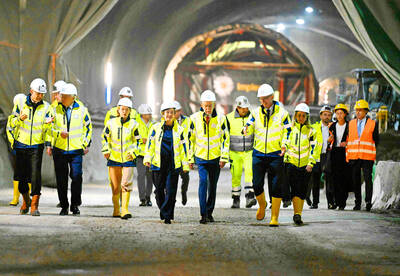
It is challenging to build infrastructure in much of Europe. Constrained budgets and polarized politics tend to undermine long-term projects, forcing officials to react to emergencies rather than plan for the future. Not in Austria. Today, the country is to officially open its Koralmbahn tunnel, the 5.9 billion euro (US$6.9 billion) centerpiece of a groundbreaking new railway that will eventually run from Poland’s Baltic coast to the Adriatic Sea, transforming travel within Austria and positioning the Alpine nation at the forefront of logistics in Europe. “It is Austria’s biggest socio-economic experiment in over a century,” said Eric Kirschner, an economist at Graz-based Joanneum

BUBBLE? Only a handful of companies are seeing rapid revenue growth and higher valuations, and it is not enough to call the AI trend a transformation, an analyst said Artificial intelligence (AI) is entering a more challenging phase next year as companies move beyond experimentation and begin demanding clear financial returns from a technology that has delivered big gains to only a small group of early adopters, PricewaterhouseCoopers (PwC) Taiwan said yesterday. Most organizations have been able to justify AI investments through cost recovery or modest efficiency gains, but few have achieved meaningful revenue growth or long-term competitive advantage, the consultancy said in its 2026 AI Business Predictions report. This growing performance gap is forcing executives to reconsider how AI is deployed across their organizations, it said. “Many companies
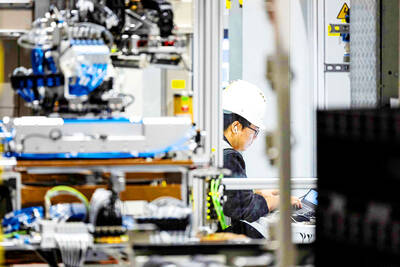
France is developing domestic production of electric vehicle (EV) batteries with an eye on industrial independence, but Asian experts are proving key in launching operations. In the Verkor factory outside the northern city of Dunkirk, which was inaugurated on Thursday, foreign specialists, notably from South Korea and Malaysia, are training the local staff. Verkor is the third battery gigafactory to open in northern France in a region that has become known as “Battery Valley.” At the Automotive Energy Supply Corp (AESC) factory near the city of Douai, where production has been under way for several months, Chinese engineers and technicians supervise French recruits. “They


 RSS
RSS