


Vietnam is by far the biggest winner from the US-China trade war as importers look to divert their orders to bypass higher tariffs.
The Southeast Asian nation gained orders from trade diversion on tariffed goods equal to 7.9 percent of GDP in the year through the first quarter, according to a study by Nomura Holdings Inc economists Rob Subbaraman, Sonal Varma and Michael Loo.
Taiwan is a distant second among the winners, with gains equivalent to 2.1 percent of GDP.
Both economies gained far more from US tariffs on China than from Chinese duties on the US.
US and Chinese orders for more than half of the 1,981 tariffed products in the US-China trade dispute thus far have been rerouted, upending the winners and losers in the global supply chain, the analysis shows.
Nomura started with the official tariff lists of product codes and compared those with monthly trade data of the same goods — incorporating the levies on US$250 billion in Chinese goods and US$110 billion in US products.
The analysts estimated the gain for the world’s top 50 economies in the 12-month period.
The US’ tariffs on China have prompted import substitution primarily in electronic products, followed by furniture and travel goods.
For China’s duties on the US, orders for soybeans, aircraft, grains and cotton were most likely to be diverted away from the US to third-party economies like Chile and Argentina.
The Nomura analysts see potential for significantly more disruption in the electronics supply chains, given US-China disputes over technology, including US restrictions Huawei Technologies Co (華為) and ZTE Corp (中興).

GROWING OWINGS: While Luxembourg and China swapped the top three spots, the US continued to be the largest exposure for Taiwan for the 41st consecutive quarter The US remained the largest debtor nation to Taiwan’s banking sector for the 41st consecutive quarter at the end of September, after local banks’ exposure to the US market rose more than 2 percent from three months earlier, the central bank said. Exposure to the US increased to US$198.896 billion, up US$4.026 billion, or 2.07 percent, from US$194.87 billion in the previous quarter, data released by the central bank showed on Friday. Of the increase, about US$1.4 billion came from banks’ investments in securitized products and interbank loans in the US, while another US$2.6 billion stemmed from trust assets, including mutual funds,
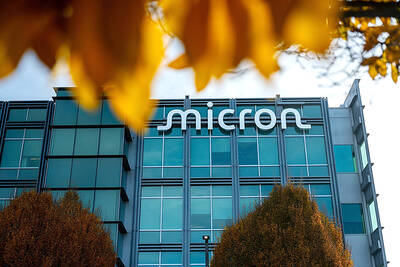
Micron Memory Taiwan Co (台灣美光), a subsidiary of US memorychip maker Micron Technology Inc, has been granted a NT$4.7 billion (US$149.5 million) subsidy under the Ministry of Economic Affairs A+ Corporate Innovation and R&D Enhancement program, the ministry said yesterday. The US memorychip maker’s program aims to back the development of high-performance and high-bandwidth memory chips with a total budget of NT$11.75 billion, the ministry said. Aside from the government funding, Micron is to inject the remaining investment of NT$7.06 billion as the company applied to participate the government’s Global Innovation Partnership Program to deepen technology cooperation, a ministry official told the
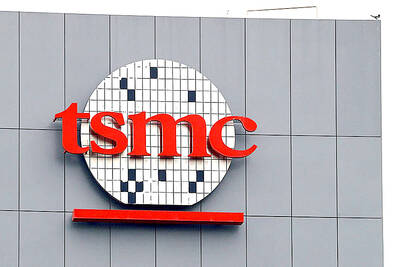
Taiwan Semiconductor Manufacturing Co (TSMC, 台積電), the world’s leading advanced chipmaker, officially began volume production of its 2-nanometer chips in the fourth quarter of this year, according to a recent update on the company’s Web site. The low-key announcement confirms that TSMC, the go-to chipmaker for artificial intelligence (AI) hardware providers Nvidia Corp and iPhone maker Apple Inc, met its original roadmap for the next-generation technology. Production is currently centered at Fab 22 in Kaohsiung, utilizing the company’s first-generation nanosheet transistor technology. The new architecture achieves “full-node strides in performance and power consumption,” TSMC said. The company described the 2nm process as
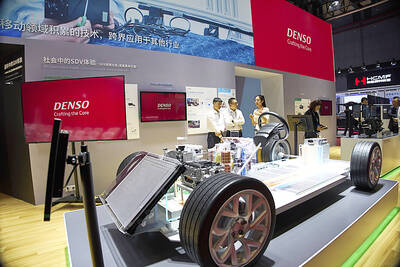
JOINT EFFORTS: MediaTek would partner with Denso to develop custom chips to support the car-part specialist company’s driver-assist systems in an expanding market MediaTek Inc (聯發科), the world’s largest mobile phone chip designer, yesterday said it is working closely with Japan’s Denso Corp to build a custom automotive system-on-chip (SoC) solution tailored for advanced driver-assistance systems and cockpit systems, adding another customer to its new application-specific IC (ASIC) business. This effort merges Denso’s automotive-grade safety expertise and deep vehicle integration with MediaTek’s technologies cultivated through the development of Media- Tek’s Dimensity AX, leveraging efficient, high-performance SoCs and artificial intelligence (AI) capabilities to offer a scalable, production-ready platform for next-generation driver assistance, the company said in a statement yesterday. “Through this collaboration, we are bringing two


 RSS
RSS