


Investors on Friday rushed into the perceived safety of the Japanese yen, with the currency scoring its best day against the US dollar in four months, after US President Donald Trump’s threat to impose tariffs on Mexico roiled financial markets and stoked recession fears.
Taking aim at what he said was a surge of illegal immigrants across the southern border, Trump on Thursday vowed to impose a tariff on all goods coming from Mexico, starting at 5 percent and ratcheting higher until the flow of people ceases.
The Mexican peso tumbled against the greenback, losing as much as 3.4 percent at one point, for its steepest single-day loss since October last year.
It was down 2.65 percent at 19.6485 per US dollar.
Trump’s surprise duties on Mexican imports “spurred sharp losses in the Mexican peso and a general risk-off move that strengthened the yen,” Bannockburn Global Forex LLC chief market strategist Marc Chandler said.
Several different currencies have served as safe havens during the global trade conflict, but the yen has consistently been among the strongest this year, and on Friday investors appeared to opt for the Japanese currency.
The yen increased 1.11 percent at ¥108.41 per US dollar and 0.75 percent per euro.
However, for the week, the yen was still 0.9 weaker against the US dollar.
For May, the Japanese currency gained 2.72 percent against the greenback and 3.15 percent versus the euro.
The Swiss franc also enticed safe-haven buying, rising 0.69 percent to US$1.0008, near its strongest versus the US dollar since April 10 and up 0.2 percent for the week.
In Taipei, the New Taiwan dollar on Friday fell NT$0.002 against the US dollar to close at NT$31.612, down 0.3 percent for the week.
The impact of escalating trade tensions between Washington and Beijing is starting to show up in economic data, with a key measure of Chinese manufacturing activity disappointing investors.
Trump’s latest salvo fueled a rush on Friday to safe-haven assets such as government bonds and the yen.
The US dollar has itself served as a safe haven currency in recent times, but on Friday, it fell 0.54 percent to 97.61 against a basket of other currencies, unchanged for the week.
For the month, it eked out a 0.1 percent gain, extending its winning monthly streak to four.
“The US dollar may be embarking on a major turning point,” Brandywine Global portfolio manager Jack McIntyre said.
The US dollar’s broad losses on Friday were compounded by comments from senior policymakers, with the US Federal Reserve Vice Chairman Richard Clarida on Thursday discussing the possibility of rate cuts should the world’s biggest economy take a turn for the worse, although he also said he thought the US economy is in “a very good place.”
US interest rates futures implied traders expect at least one rate cut from the Fed by the end of this year.
Additional reporting by CNA

GROWING OWINGS: While Luxembourg and China swapped the top three spots, the US continued to be the largest exposure for Taiwan for the 41st consecutive quarter The US remained the largest debtor nation to Taiwan’s banking sector for the 41st consecutive quarter at the end of September, after local banks’ exposure to the US market rose more than 2 percent from three months earlier, the central bank said. Exposure to the US increased to US$198.896 billion, up US$4.026 billion, or 2.07 percent, from US$194.87 billion in the previous quarter, data released by the central bank showed on Friday. Of the increase, about US$1.4 billion came from banks’ investments in securitized products and interbank loans in the US, while another US$2.6 billion stemmed from trust assets, including mutual funds,
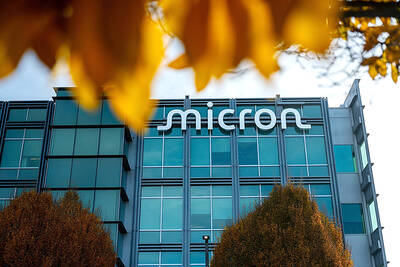
Micron Memory Taiwan Co (台灣美光), a subsidiary of US memorychip maker Micron Technology Inc, has been granted a NT$4.7 billion (US$149.5 million) subsidy under the Ministry of Economic Affairs A+ Corporate Innovation and R&D Enhancement program, the ministry said yesterday. The US memorychip maker’s program aims to back the development of high-performance and high-bandwidth memory chips with a total budget of NT$11.75 billion, the ministry said. Aside from the government funding, Micron is to inject the remaining investment of NT$7.06 billion as the company applied to participate the government’s Global Innovation Partnership Program to deepen technology cooperation, a ministry official told the

Taiwan Semiconductor Manufacturing Co (TSMC, 台積電), the world’s leading advanced chipmaker, officially began volume production of its 2-nanometer chips in the fourth quarter of this year, according to a recent update on the company’s Web site. The low-key announcement confirms that TSMC, the go-to chipmaker for artificial intelligence (AI) hardware providers Nvidia Corp and iPhone maker Apple Inc, met its original roadmap for the next-generation technology. Production is currently centered at Fab 22 in Kaohsiung, utilizing the company’s first-generation nanosheet transistor technology. The new architecture achieves “full-node strides in performance and power consumption,” TSMC said. The company described the 2nm process as

Even as the US is embarked on a bitter rivalry with China over the deployment of artificial intelligence (AI), Chinese technology is quietly making inroads into the US market. Despite considerable geopolitical tensions, Chinese open-source AI models are winning over a growing number of programmers and companies in the US. These are different from the closed generative AI models that have become household names — ChatGPT-maker OpenAI or Google’s Gemini — whose inner workings are fiercely protected. In contrast, “open” models offered by many Chinese rivals, from Alibaba (阿里巴巴) to DeepSeek (深度求索), allow programmers to customize parts of the software to suit their


 RSS
RSS