


Huaku Development Co (華固建設) could see its revenue jump this year with profits from three luxury residential projects, senior company officials said yesterday.
The Taipei-based company gave the guidance on the sidelines of its annual shareholders’ conference that gave its go-ahead to plans to distribute NT$5 per share in cash dividends from earnings per share of NT$3.12 for last year.
The payout rate exceeds 100 percent, a practice that is not uncommon among Taiwanese developers and reflects the company’s positive earnings outlook for this year.
The three projects might generate NT$17.2 billion (US$456.31 million) in revenue upon their completion later this year, Huaku general manager Carson Hung (洪嘉昇) told reporters.
The company is about to complete the “Your Majesty” (華固名鑄) complex on Taipei’s Dunhua N Road and “Delight Gallery” (華固樂慕) on Bade Road, while the “Sweet Garden” (華固新代田) project in New Taipei City’s Tucheng District (土城) is expected to be finished in the fourth quarter, Hung said.
Your Majesty, which features apartments of 100 ping (330m2) and 132 ping, is nearly 90 percent sold and might bring NT$8 billion in revenue, Hung said.
The Delight Gallery and the Sweet Garden might generate NT$5 billion and NT$4.2 billion respectively, he said.
“This year might prove a bountiful year for Huaku,” chairman Chung Long-chang (鍾榮昌) said.
Its sales rates are approaching 45 percent for presale and new housing projects, compared with 42 percent in Taipei and 38 percent in New Taipei City last year, he said.
The company last year refrained from launching new projects and relied on selling existing houses to drive revenue, Chung said.
That would explain why revenue for last year plunged 55.3 percent to NT$4.63 billion from 2017, as company data showed.
Huaku has created a strategy to develop boutique housing that might help it to cope with market changes and recover investment in faster, Chung said.
Three-bedroom apartments of 37 ping are the most popular in Taipei, he said.
Prices might pick up 3 to 5 percent for Huaku products in the Greater Taipei area due to healthy real demand and a lack of land supply, Chung said.
It plans to start construction on a joint venture on Taipei’s Chengde Road and roll out a presale project in the city’s Neihu District (內湖) in the fourth quarter.

SECOND-RATE: Models distilled from US products do not perform the same as the original and undo measures that ensure the systems are neutral, the US’ cable said The US Department of State has ordered a global push to bring attention to what it said are widespread efforts by Chinese companies, including artificial intelligence (AI) start-up DeepSeek (深度求索), to steal intellectual property from US AI labs, according to a diplomatic cable. The cable, dated Friday and sent to diplomatic and consular posts around the world, instructs diplomatic staff to speak to their foreign counterparts about “concerns over adversaries’ extraction and distillation of US AI models.” Distillation is the process of training smaller AI models using output from larger, more expensive ones to lower the costs of training a powerful new

Singapore-based ride-hailing and delivery giant Grab Holdings’ planned acquisition of Foodpanda’s Taiwan operations has yet to enter the formal review stage, as regulators await supplementary documents, the Fair Trade Commission (FTC) said yesterday. Acting FTC Chairman Chen Chih-min (陳志民) told the legislature’s Economics Committee that although Grab submitted its application on March 27, the case has not been officially accepted because required materials remain incomplete. Once the filing is finalized, the FTC would launch a formal probe into the deal, focusing on issues such as cross-shareholding and potential restrictions on market competition, Chen told lawmakers. Grab last month announced that it would acquire
Shares of Taiwan Semiconductor Manufacturing Co (TSMC, 台積電) have repeatedly hit new highs, but an equity analyst said the stock’s valuation remains within a reasonable range and any pullback would likely be technical. The contract chipmaker’s historical price-to-earnings (P/E) ratio has ranged between 20 and 30, Cathay Futures Consultant Co (國泰證期) analyst Tsai Ming-han (蔡明翰) told Central News Agency. With market consensus projecting that TSMC would post earnings per share of about NT$100 (US$3.17) this year, supported by strong global demand for artificial intelligence (AI) applications, and the stock currently trading at a P/E ratio of below 25, Tsai said the valuation
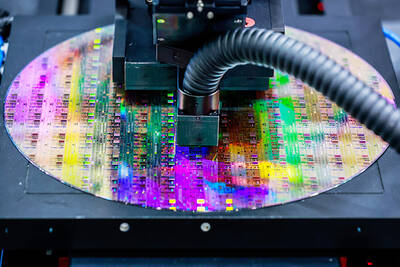
The artificial intelligence (AI) boom has triggered a seismic reshuffling of global equity markets, with Taiwan and South Korea muscling past European nations one by one. With its stock market now valued at nearly US$4.3 trillion, Taiwan surpassed the UK, Europe’s biggest market, earlier this month, data compiled by Bloomberg showed. South Korea is about US$140 billion away from doing the same. The tech-heavy Asian markets have shot past Germany and France in the past seven months. The shift is largely down to massive gains in shares of three companies that provide essential hardware for AI: Taiwan Semiconductor Manufacturing Co (TSMC, 台積電),


 RSS
RSS