


Advanced Micro Devices Inc (AMD) yesterday said that it is using Taiwan Semiconductor Manufacturing Co’s (TSMC, 台積電) advanced 7-nanometer technology to produce a new series of high-performance processors for desktop computers and new processors for gaming PCs, consoles and cloud devices, which would enter the market in July.
The company unveiled its third-generation high-performance Ryzen desktop processor and Radeon graphics chips, both made using TSMC’s 7-nanometer technology, at the Computex Taipei.
The company used to rely on GlobalFoundries Inc for chips.
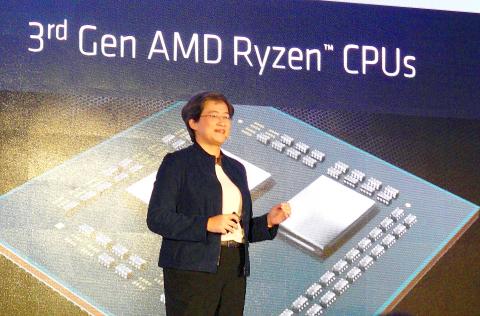
Photo: CNA
However, the US firm in August last year said that it would indefinitely put on hold its development of 7-nanometer technology and technologies beyond that, making TSMC the sole foundry for AMD’s processors.
AMD’s vision is to push the technology to its limits, chief executive officer Lisa Su (蘇姿豐) said.
To serve that end, the company has to make some “bets” requiring high-performance leadership, Su said at the Computex in a keynote speech titled “The future of the high-performance computing market.”
“The first [bet] is advanced process technology. We have chosen to be the leader of advanced process technology. We want the best the industry has to offer,” which this year is the 7-nanometer process technology, she said.
“We are extremely proud to be partnering with TSMC, because it has the best technology in the industry,” she added.
It is a “tremendous” time to be in the high-performance market, Su said.
Data centers, gaming devices and PCs, as well as new technologies that can make a difference in people’s lives, are growth areas for AMD, she said.
AMD is one of TSMC’s major clients for 7-nanometer chips alongside Apple Inc, HiSilicon Technologies Co (海思半導體), Nvidia Inc and MediaTek Inc (聯發科).
TSMC considers 7-nanometer technology an important growth engine.
The company has said that it expects the technology to contribute 25 percent to revenue this year, its second year of ramping.
Last year, it accounted for 9 percent of total revenue.
Asustek Computer Inc (華碩) and Acer Inc (宏碁) yesterday showcased their new gaming laptops equipped with AMD’s latest processors.
Asustek also introduced a new motherboard based on AMD’s Ryzen processor.
Fifty-six such motherboards were launched and more than 100 are ready to hit the market, AMD said.
The company is next quarter to unveil its next-generation EPYC processor, dubbed Rome, also made using TSMC’s 7-nanometer technology.
The Computex trade show is to officially begin today and will run through Saturday at the Taipei World Trade Center Exhibition Hall, Nangang Exhibition Hall and Taipei International Convention Center.
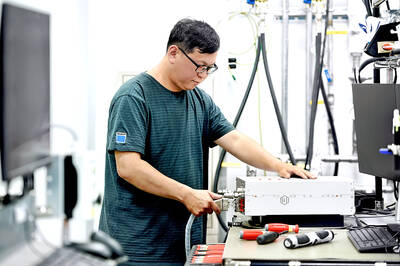
SEMICONDUCTORS: The German laser and plasma generator company will expand its local services as its specialized offerings support Taiwan’s semiconductor industries Trumpf SE + Co KG, a global leader in supplying laser technology and plasma generators used in chip production, is expanding its investments in Taiwan in an effort to deeply integrate into the global semiconductor supply chain in the pursuit of growth. The company, headquartered in Ditzingen, Germany, has invested significantly in a newly inaugurated regional technical center for plasma generators in Taoyuan, its latest expansion in Taiwan after being engaged in various industries for more than 25 years. The center, the first of its kind Trumpf built outside Germany, aims to serve customers from Taiwan, Japan, Southeast Asia and South Korea,
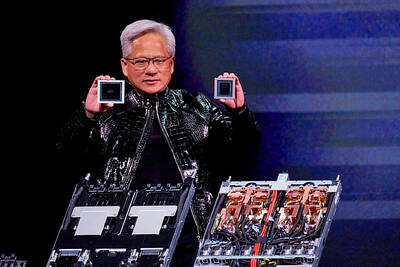
Nvidia Corp chief executive officer Jensen Huang (黃仁勳) on Monday introduced the company’s latest supercomputer platform, featuring six new chips made by Taiwan Semiconductor Manufacturing Co (TSMC, 台積電), saying that it is now “in full production.” “If Vera Rubin is going to be in time for this year, it must be in production by now, and so, today I can tell you that Vera Rubin is in full production,” Huang said during his keynote speech at CES in Las Vegas. The rollout of six concurrent chips for Vera Rubin — the company’s next-generation artificial intelligence (AI) computing platform — marks a strategic

Gasoline and diesel prices at domestic fuel stations are to fall NT$0.2 per liter this week, down for a second consecutive week, CPC Corp, Taiwan (台灣中油) and Formosa Petrochemical Corp (台塑石化) announced yesterday. Effective today, gasoline prices at CPC and Formosa stations are to drop to NT$26.4, NT$27.9 and NT$29.9 per liter for 92, 95 and 98-octane unleaded gasoline respectively, the companies said in separate statements. The price of premium diesel is to fall to NT$24.8 per liter at CPC stations and NT$24.6 at Formosa pumps, they said. The price adjustments came even as international crude oil prices rose last week, as traders
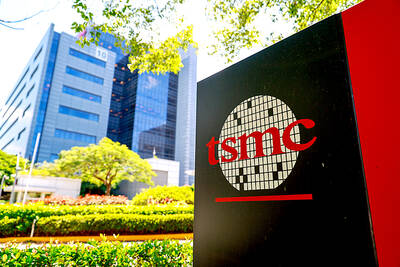
Taiwan Semiconductor Manufacturing Co (TSMC, 台積電), which supplies advanced chips to Nvidia Corp and Apple Inc, yesterday reported NT$1.046 trillion (US$33.1 billion) in revenue for last quarter, driven by constantly strong demand for artificial intelligence (AI) chips, falling in the upper end of its forecast. Based on TSMC’s financial guidance, revenue would expand about 22 percent sequentially to the range from US$32.2 billion to US$33.4 billion during the final quarter of 2024, it told investors in October last year. Last year in total, revenue jumped 31.61 percent to NT$3.81 trillion, compared with NT$2.89 trillion generated in the year before, according to


 RSS
RSS