


TPK Holding Co (宸鴻), a touch sensor supplier for Apple Inc’s iPads, yesterday said it is seeking to wrap up talks for a 50 percent stake in Japan Display Inc (JDI) by the end of this year.
The Taipei-based company said that it is not giving up yet, as the deal would create synergy for the company’s touch business, TPK chairman Michael Chiang (江朝瑞) told reporters on the sidelines of the firm’s annual shareholders’ meeting in Taipei.
The deal would help secure panel supply from the Tokyo-based maker based on a proposed supply agreement by TPK, with an aim to boost TPK’s role in the supply chain, enlarge its customer base and expand its market share in automotive displays.
“The negotiation is still going on. We cannot disclose details, but what I can tell you is that we are working together toward solving differences between the two parties,” Chiang said in response to a shareholder’s question about the deal.
“It will not take too long. It is our hope [to wrap up the deal] this year,” Chiang said, dismissing speculation that the negotiations have broken down.
TPK last month said that it had signed a letter of intent to invest US$230 million in a consortium, Suwa Investment Holdings LLC, that would acquire a 49.82 percent stake in JDI for ¥60 billion (US$546.6 million).
Commenting on its business outlook, TPK said it is in talks with five potential clients for its silver nanowire (SNW) touch technology to produce touch modules for 65-inch, 75-inch and 85-inch electronic whiteboards for schools.
TPK is scheduled to start small-volume production of touch modules using SNW technology at the end of this year and start mass production next year, Chiang said.
The volume could rise significantly in 2021 and 2022, he said.
“We are bullish about SNW technology because it can be widely applied to different product sizes,” he said.
TPK has been developing SNW technology for 15 years and the commercialization of the technology should be a new growth driver for the firm, especially at a time when the industry is facing difficult times, it said.
“This year will be a tough year... Prices have fallen severely in recent years,” Chiang said. “It is still our goal to eke out a profit this year.”
TPK posted a net profit of NT$192 million (US$6.16 million) for last quarter, little changed from NT$191 million in the previous quarter.
The US-China trade dispute has made no impact on the company, Chiang said.
The company is monitoring how the situation goes as it is costly to allocate production lines outside China, he said.
If fab relocation becomes unavoidable, Vietnam is a potential option, he said, citing the establishment of iPhone supply chains there.
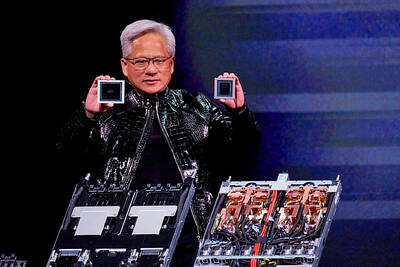
Nvidia Corp chief executive officer Jensen Huang (黃仁勳) on Monday introduced the company’s latest supercomputer platform, featuring six new chips made by Taiwan Semiconductor Manufacturing Co (TSMC, 台積電), saying that it is now “in full production.” “If Vera Rubin is going to be in time for this year, it must be in production by now, and so, today I can tell you that Vera Rubin is in full production,” Huang said during his keynote speech at CES in Las Vegas. The rollout of six concurrent chips for Vera Rubin — the company’s next-generation artificial intelligence (AI) computing platform — marks a strategic
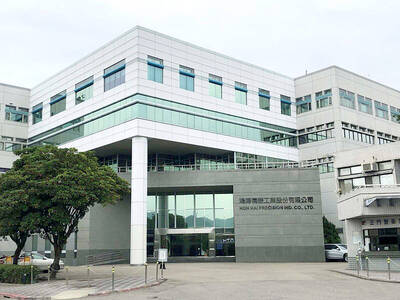
REVENUE PERFORMANCE: Cloud and network products, and electronic components saw strong increases, while smart consumer electronics and computing products fell Hon Hai Precision Industry Co (鴻海精密) yesterday posted 26.51 percent quarterly growth in revenue for last quarter to NT$2.6 trillion (US$82.44 billion), the strongest on record for the period and above expectations, but the company forecast a slight revenue dip this quarter due to seasonal factors. On an annual basis, revenue last quarter grew 22.07 percent, the company said. Analysts on average estimated about NT$2.4 trillion increase. Hon Hai, which assembles servers for Nvidia Corp and iPhones for Apple Inc, is expanding its capacity in the US, adding artificial intelligence (AI) server production in Wisconsin and Texas, where it operates established campuses. This
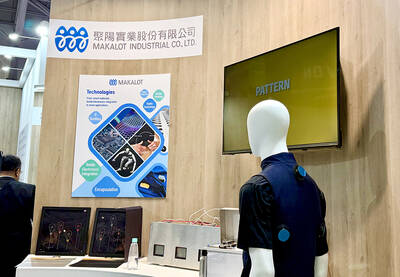
Garment maker Makalot Industrial Co (聚陽) yesterday reported lower-than-expected fourth-quarter revenue of NT$7.93 billion (US$251.44 million), down 9.48 percent from NT$8.76 billion a year earlier. On a quarterly basis, revenue fell 10.83 percent from NT$8.89 billion, company data showed. The figure was also lower than market expectations of NT$8.05 billion, according to data compiled by Yuanta Securities Investment and Consulting Co (元大投顧), which had projected NT$8.22 billion. Makalot’s revenue this quarter would likely increase by a mid-teens percentage as the industry is entering its high season, Yuanta said. Overall, Makalot’s revenue last year totaled NT$34.43 billion, down 3.08 percent from its record NT$35.52
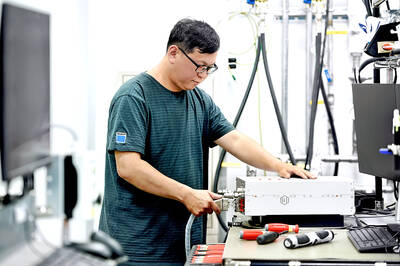
SEMICONDUCTORS: The German laser and plasma generator company will expand its local services as its specialized offerings support Taiwan’s semiconductor industries Trumpf SE + Co KG, a global leader in supplying laser technology and plasma generators used in chip production, is expanding its investments in Taiwan in an effort to deeply integrate into the global semiconductor supply chain in the pursuit of growth. The company, headquartered in Ditzingen, Germany, has invested significantly in a newly inaugurated regional technical center for plasma generators in Taoyuan, its latest expansion in Taiwan after being engaged in various industries for more than 25 years. The center, the first of its kind Trumpf built outside Germany, aims to serve customers from Taiwan, Japan, Southeast Asia and South Korea,


 RSS
RSS