


China’s economy showed further signs of weakness last month as the slowest growth in retail sales for 16 years highlighted the task leaders have in ramping up domestic demand at the same time as fighting a painful trade dispute with the US.
Authorities have for years been attempting to transition the world’s No. 2 economy from being reliant on state investment and exports to a more stable one driven by China’s huge army of consumers, with the tariffs standoff reinforcing the need for such a change.
However, there were signs that those consumers were starting to pull back, with clothes and auto sales falling last month from the same period last year.
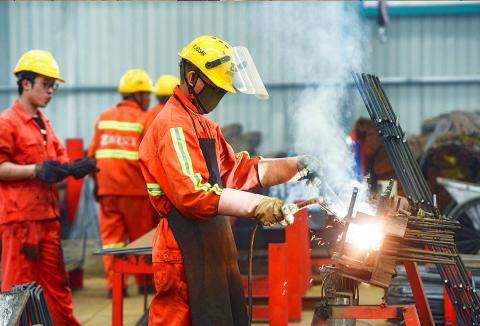
Photo: AFP
Total retail sales expanded 7.2 percent year-on-year last month, figures released yesterday showed. That was well off the 8.4 percent tipped by economists in a Bloomberg News survey and a big drop from March.
The Chinese National Bureau of Statistics data represent the worst pace since 2003, at the height of the SARS crisis.
Growth in output at China’s factories and workshops last month slowed sharply to 5.4 percent year-on-year, down from 8.5 percent in March, and below forecasts.
Fixed-asset investment during January to April rose 6.1 percent, from 6.3 percent in the first three months, with private-sector investment growth slowing to 5.5 percent expansion and infrastructure investment steady from last month.
The readings fanned speculation that authorities could unveil another round of pump-priming — having wound back on such stimulus in recent weeks following signs of a bounce in the economy — with Shanghai’s composite index yesterday jumping almost 2 percent.
The government lowered its growth target for the year to 6 to 6.5 percent, while growth in the first quarter stabilized at 6.4 percent after decelerating every quarter last year.
“It’s quite safe to say that the double dip is confirmed and growth has yet to truly bottom out,” said Nomura Holdings Inc economist Lu Ting (陸挺), forecasting continued headwinds for China’s exports, property markets in smaller cities and sales of passenger vehicles, mobile phones and construction machinery.
However, while growth remains relatively slow, the crucial unemployment rate remains low and fell to 5 percent last month from 5.2 percent in March.
While policymakers want to prevent the economy from taking a bad hit, analysts say their room to maneuver is smaller than in previous tough spots.
“With the scale of stimulus likely to remain smaller than in previous downturns, we don’t anticipate a strong recovery,” Julian Evans-Pritchard of Capital Economics Ltd said.
On a brighter note, Australia and New Zealand Banking Group Ltd economist Betty Wang (王蕊) said property investment had picked up over the first four months of the year thanks to “a big jump in developers’ funding conditions,” with bank loans, down payments and mortgages all growing at a quicker pace.

Nvidia Corp chief executive officer Jensen Huang (黃仁勳) on Monday introduced the company’s latest supercomputer platform, featuring six new chips made by Taiwan Semiconductor Manufacturing Co (TSMC, 台積電), saying that it is now “in full production.” “If Vera Rubin is going to be in time for this year, it must be in production by now, and so, today I can tell you that Vera Rubin is in full production,” Huang said during his keynote speech at CES in Las Vegas. The rollout of six concurrent chips for Vera Rubin — the company’s next-generation artificial intelligence (AI) computing platform — marks a strategic
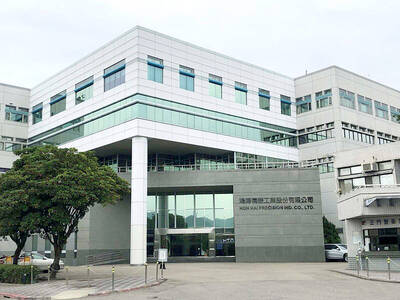
REVENUE PERFORMANCE: Cloud and network products, and electronic components saw strong increases, while smart consumer electronics and computing products fell Hon Hai Precision Industry Co (鴻海精密) yesterday posted 26.51 percent quarterly growth in revenue for last quarter to NT$2.6 trillion (US$82.44 billion), the strongest on record for the period and above expectations, but the company forecast a slight revenue dip this quarter due to seasonal factors. On an annual basis, revenue last quarter grew 22.07 percent, the company said. Analysts on average estimated about NT$2.4 trillion increase. Hon Hai, which assembles servers for Nvidia Corp and iPhones for Apple Inc, is expanding its capacity in the US, adding artificial intelligence (AI) server production in Wisconsin and Texas, where it operates established campuses. This
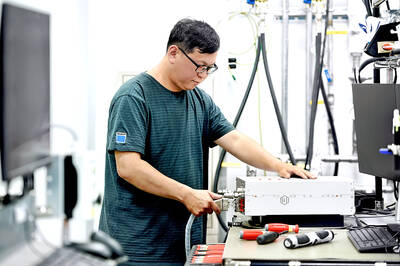
SEMICONDUCTORS: The German laser and plasma generator company will expand its local services as its specialized offerings support Taiwan’s semiconductor industries Trumpf SE + Co KG, a global leader in supplying laser technology and plasma generators used in chip production, is expanding its investments in Taiwan in an effort to deeply integrate into the global semiconductor supply chain in the pursuit of growth. The company, headquartered in Ditzingen, Germany, has invested significantly in a newly inaugurated regional technical center for plasma generators in Taoyuan, its latest expansion in Taiwan after being engaged in various industries for more than 25 years. The center, the first of its kind Trumpf built outside Germany, aims to serve customers from Taiwan, Japan, Southeast Asia and South Korea,
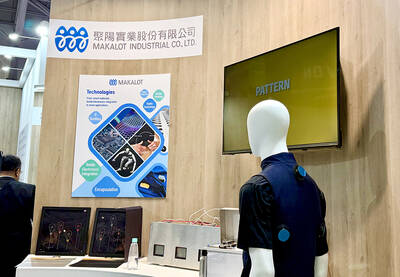
Garment maker Makalot Industrial Co (聚陽) yesterday reported lower-than-expected fourth-quarter revenue of NT$7.93 billion (US$251.44 million), down 9.48 percent from NT$8.76 billion a year earlier. On a quarterly basis, revenue fell 10.83 percent from NT$8.89 billion, company data showed. The figure was also lower than market expectations of NT$8.05 billion, according to data compiled by Yuanta Securities Investment and Consulting Co (元大投顧), which had projected NT$8.22 billion. Makalot’s revenue this quarter would likely increase by a mid-teens percentage as the industry is entering its high season, Yuanta said. Overall, Makalot’s revenue last year totaled NT$34.43 billion, down 3.08 percent from its record NT$35.52


 RSS
RSS