


German chemicals maker Covestro AG yesterday said that the escalating US-China trade dispute would have a limited effect on its Taiwanese business, as its local operation mainly supplies high-tech materials to Southeast Asian markets.
“The trade war has [had] some impact on the market, but we, with production sites over the world, can shift production to where the customers are if needed and avoid the tariffs,” Thomas Roemer, head of thermoplastic polyurethanes (TPUs) at Covestro, told the Taipei Times in an interview in Taipei.
The trade spat started to weigh on demand from Chinese clients several months ago, but the market is volatile and can change quickly, Roemer said, adding that the company has seen demand rise before the US increased tariffs on US$200 billion of Chinese imports on Friday last week.
Covestro’s production and investment policy would not change because of some tweets and it would focus on its products’ long-term development, Roemer said.
Covestro operates TPU plants in Taiwan, China, Japan, India, Germany and the US.
The plants in Taiwan, Japan and Germany supply products to the US, albeit in limited volumes, Roemer said.
The company has a policy of using its production bases to meet regional demand, Covestro said.
Its Taiwanese operations have remained stable thus far, thanks to growing domestic demand and rising TPU shipments to the Asia-Pacific region, Roemer said.
“The Taiwanese site is important for our Asia-Pacific business. As the biggest production site in the region, it satisfies growing demand and also serves as the research center for new products,” Covestro’s global head of TPU production and technology Stephan Ehlers said.
The company yesterday celebrated the completion of a new production line at its TPU plant in Changhua County, which boosted its annual capacity 30 percent from 18,000 tonnes to 23,000 tonnes.
TPU, which has high abrasion resistance and greater flexibility over a wide range of temperatures, can be used in a variety of products, including medical devices, footwear, fabrics, home appliances and automotive components, the company said.
Covestro has seen double-digit percentage growth in demand for TPU over the past three years, and expects an average growth of 6 percent in global demand from 2017 to 2022, which would mark the highest pace among all high-tech materials, it said.
The company plans to recruit more employees in Taiwan to keep up with the growing capacity, Roemer said, but declined to reveal a number.
However, the company said that Taiwan not having many free-trade agreements with neighboring countries would be a weak point.
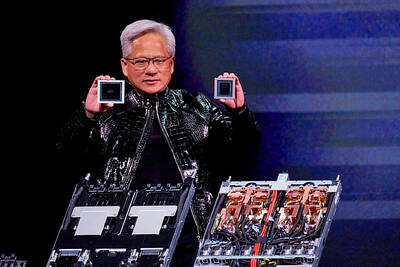
Nvidia Corp chief executive officer Jensen Huang (黃仁勳) on Monday introduced the company’s latest supercomputer platform, featuring six new chips made by Taiwan Semiconductor Manufacturing Co (TSMC, 台積電), saying that it is now “in full production.” “If Vera Rubin is going to be in time for this year, it must be in production by now, and so, today I can tell you that Vera Rubin is in full production,” Huang said during his keynote speech at CES in Las Vegas. The rollout of six concurrent chips for Vera Rubin — the company’s next-generation artificial intelligence (AI) computing platform — marks a strategic
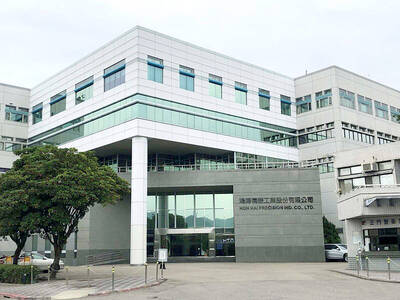
REVENUE PERFORMANCE: Cloud and network products, and electronic components saw strong increases, while smart consumer electronics and computing products fell Hon Hai Precision Industry Co (鴻海精密) yesterday posted 26.51 percent quarterly growth in revenue for last quarter to NT$2.6 trillion (US$82.44 billion), the strongest on record for the period and above expectations, but the company forecast a slight revenue dip this quarter due to seasonal factors. On an annual basis, revenue last quarter grew 22.07 percent, the company said. Analysts on average estimated about NT$2.4 trillion increase. Hon Hai, which assembles servers for Nvidia Corp and iPhones for Apple Inc, is expanding its capacity in the US, adding artificial intelligence (AI) server production in Wisconsin and Texas, where it operates established campuses. This
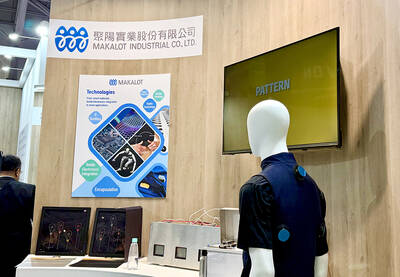
Garment maker Makalot Industrial Co (聚陽) yesterday reported lower-than-expected fourth-quarter revenue of NT$7.93 billion (US$251.44 million), down 9.48 percent from NT$8.76 billion a year earlier. On a quarterly basis, revenue fell 10.83 percent from NT$8.89 billion, company data showed. The figure was also lower than market expectations of NT$8.05 billion, according to data compiled by Yuanta Securities Investment and Consulting Co (元大投顧), which had projected NT$8.22 billion. Makalot’s revenue this quarter would likely increase by a mid-teens percentage as the industry is entering its high season, Yuanta said. Overall, Makalot’s revenue last year totaled NT$34.43 billion, down 3.08 percent from its record NT$35.52
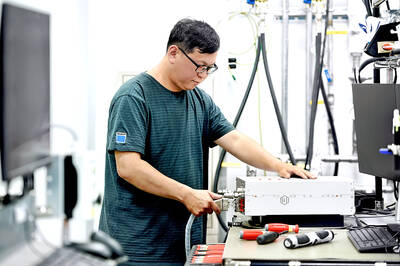
SEMICONDUCTORS: The German laser and plasma generator company will expand its local services as its specialized offerings support Taiwan’s semiconductor industries Trumpf SE + Co KG, a global leader in supplying laser technology and plasma generators used in chip production, is expanding its investments in Taiwan in an effort to deeply integrate into the global semiconductor supply chain in the pursuit of growth. The company, headquartered in Ditzingen, Germany, has invested significantly in a newly inaugurated regional technical center for plasma generators in Taoyuan, its latest expansion in Taiwan after being engaged in various industries for more than 25 years. The center, the first of its kind Trumpf built outside Germany, aims to serve customers from Taiwan, Japan, Southeast Asia and South Korea,


 RSS
RSS