


Walt Disney Co’s adjusted second-quarter net income declined as higher revenue from its parks was not enough to offset lower theatrical revenue.
However, the entertainment giant’s results still beat analysts’ expectations.
The lower theater revenue in the quarter that ended March 30 was due to tough comparisons from a year earlier, when the company released Black Panther and Star Wars: The Last Jedi. During the same period this year Disney released Captain Marvel.

Photo: AP
The quarter closed just ahead of the release of the Marvel movie Avengers: Endgame last month. That movie has become one of the most successful movies of all time.
Net income for the quarter ended March 30 jumped 85 percent to US$5.34 billion, or US$3.55 per share. Its bottom line got a big boost from a non-cash gain from its acquisition of controlling interest in streaming service Hulu.
Adjusting for that and other one-time items, Disney’s quarterly net income came to US$1.61 per share, down from US$1.84 a share a year earlier.
The average estimate of five analysts surveyed by Zacks Investment Research was for earnings of US$1.59 per share.
Revenue edged up 3 percent to US$14.92 billion.
According to FactSet, analysts had expected US$14.56 billion.
Disney, which is based in Burbank, California, closed on its US$71 billion acquisition of 21st Century Fox Inc’s entertainment assets during the quarter. It is using Fox assets, including The Simpsons, National Geographic and other properties to help launch its streaming service Disney Plus in November.
Avengers: Endgame is slated to hit the service in December.
Its upcoming theatrical releases over the course of this year include live-action versions of Aladdin and The Lion King, as well as Maleficent: Mistress of Evil, Toy Story 4, Frozen 2 and Star Wars: The Rise of Skywalker.
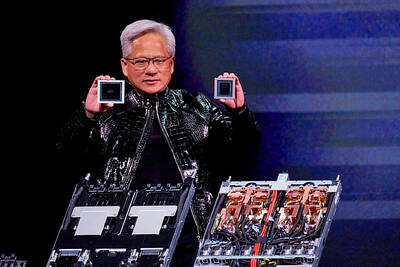
Nvidia Corp chief executive officer Jensen Huang (黃仁勳) on Monday introduced the company’s latest supercomputer platform, featuring six new chips made by Taiwan Semiconductor Manufacturing Co (TSMC, 台積電), saying that it is now “in full production.” “If Vera Rubin is going to be in time for this year, it must be in production by now, and so, today I can tell you that Vera Rubin is in full production,” Huang said during his keynote speech at CES in Las Vegas. The rollout of six concurrent chips for Vera Rubin — the company’s next-generation artificial intelligence (AI) computing platform — marks a strategic
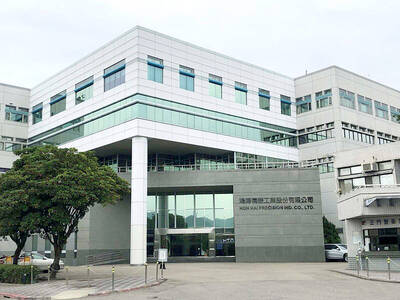
REVENUE PERFORMANCE: Cloud and network products, and electronic components saw strong increases, while smart consumer electronics and computing products fell Hon Hai Precision Industry Co (鴻海精密) yesterday posted 26.51 percent quarterly growth in revenue for last quarter to NT$2.6 trillion (US$82.44 billion), the strongest on record for the period and above expectations, but the company forecast a slight revenue dip this quarter due to seasonal factors. On an annual basis, revenue last quarter grew 22.07 percent, the company said. Analysts on average estimated about NT$2.4 trillion increase. Hon Hai, which assembles servers for Nvidia Corp and iPhones for Apple Inc, is expanding its capacity in the US, adding artificial intelligence (AI) server production in Wisconsin and Texas, where it operates established campuses. This
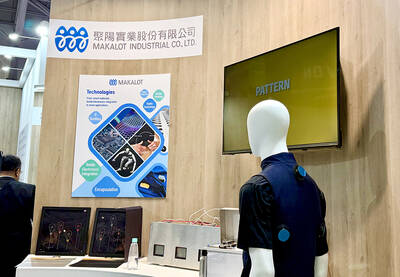
Garment maker Makalot Industrial Co (聚陽) yesterday reported lower-than-expected fourth-quarter revenue of NT$7.93 billion (US$251.44 million), down 9.48 percent from NT$8.76 billion a year earlier. On a quarterly basis, revenue fell 10.83 percent from NT$8.89 billion, company data showed. The figure was also lower than market expectations of NT$8.05 billion, according to data compiled by Yuanta Securities Investment and Consulting Co (元大投顧), which had projected NT$8.22 billion. Makalot’s revenue this quarter would likely increase by a mid-teens percentage as the industry is entering its high season, Yuanta said. Overall, Makalot’s revenue last year totaled NT$34.43 billion, down 3.08 percent from its record NT$35.52
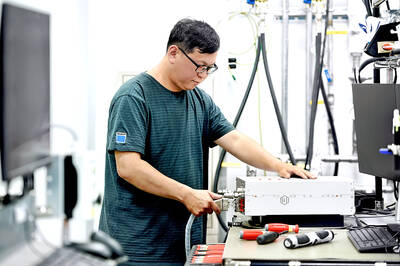
SEMICONDUCTORS: The German laser and plasma generator company will expand its local services as its specialized offerings support Taiwan’s semiconductor industries Trumpf SE + Co KG, a global leader in supplying laser technology and plasma generators used in chip production, is expanding its investments in Taiwan in an effort to deeply integrate into the global semiconductor supply chain in the pursuit of growth. The company, headquartered in Ditzingen, Germany, has invested significantly in a newly inaugurated regional technical center for plasma generators in Taoyuan, its latest expansion in Taiwan after being engaged in various industries for more than 25 years. The center, the first of its kind Trumpf built outside Germany, aims to serve customers from Taiwan, Japan, Southeast Asia and South Korea,


 RSS
RSS