


German high-end automaker BMW AG yesterday reported a plunge in profits in the first quarter of this year as it booked a 1.4 billion euro (US$1.6 billion) charge related to an EU cartel probe.
Net profits at the group nosedived 74.2 percent year-on-year to 588 million euros from 2.28 billion euros, the group said in a statement.
Brussels’ allegation that BMW colluded with Daimler AG and Volkswagen AG to avoid competing on emission control technology means “it is probable that the EU Commission will issue a significant fine,” the Munich-based manufacturer said.
BMW already warned investors when details of the probe were published last month that it would have to set aside at least 1 billion euros.
However, the firm said that competition authorities were trying “to equate the permissible coordination of industry positions regarding the regulatory framework with unlawful cartel agreements.”
“If necessary [BMW] will contest the EU Commission’s allegations with all the legal means at its disposal,” it added.
On top of the provision, the group said growing research and development costs and investments had also sapped earnings, while revenue fell 0.9 percent to 22.46 billion euros.
Nevertheless “in operational terms, we remain firmly on course,” chief executive Harald Krueger said, adding that a wave of new models arriving in the second half of the year should lift business.
Excluding the effect of the provision, BMW achieved an operating margin of 5.6 percent, lower than in the first three months of last year.
The group was able to slightly increase the number of vehicles sold to 605,333 and confirmed its targets for the remainder of the year, aiming for a “slight increase” in unit sales, but pointing to continuing cost increases and protectionist threats undermining earnings.
Pre-tax profit is “expected to be well below the previous year’s level,” BMW said, following an 8.1 percent fall last year.

Nvidia Corp chief executive officer Jensen Huang (黃仁勳) on Monday introduced the company’s latest supercomputer platform, featuring six new chips made by Taiwan Semiconductor Manufacturing Co (TSMC, 台積電), saying that it is now “in full production.” “If Vera Rubin is going to be in time for this year, it must be in production by now, and so, today I can tell you that Vera Rubin is in full production,” Huang said during his keynote speech at CES in Las Vegas. The rollout of six concurrent chips for Vera Rubin — the company’s next-generation artificial intelligence (AI) computing platform — marks a strategic
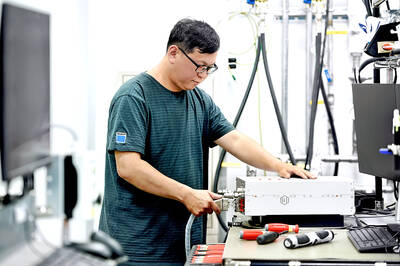
SEMICONDUCTORS: The German laser and plasma generator company will expand its local services as its specialized offerings support Taiwan’s semiconductor industries Trumpf SE + Co KG, a global leader in supplying laser technology and plasma generators used in chip production, is expanding its investments in Taiwan in an effort to deeply integrate into the global semiconductor supply chain in the pursuit of growth. The company, headquartered in Ditzingen, Germany, has invested significantly in a newly inaugurated regional technical center for plasma generators in Taoyuan, its latest expansion in Taiwan after being engaged in various industries for more than 25 years. The center, the first of its kind Trumpf built outside Germany, aims to serve customers from Taiwan, Japan, Southeast Asia and South Korea,
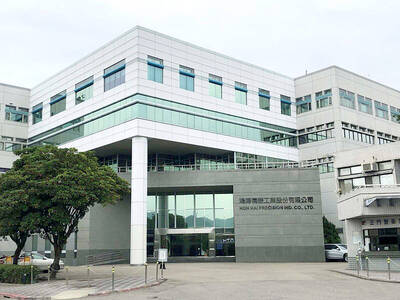
REVENUE PERFORMANCE: Cloud and network products, and electronic components saw strong increases, while smart consumer electronics and computing products fell Hon Hai Precision Industry Co (鴻海精密) yesterday posted 26.51 percent quarterly growth in revenue for last quarter to NT$2.6 trillion (US$82.44 billion), the strongest on record for the period and above expectations, but the company forecast a slight revenue dip this quarter due to seasonal factors. On an annual basis, revenue last quarter grew 22.07 percent, the company said. Analysts on average estimated about NT$2.4 trillion increase. Hon Hai, which assembles servers for Nvidia Corp and iPhones for Apple Inc, is expanding its capacity in the US, adding artificial intelligence (AI) server production in Wisconsin and Texas, where it operates established campuses. This

Garment maker Makalot Industrial Co (聚陽) yesterday reported lower-than-expected fourth-quarter revenue of NT$7.93 billion (US$251.44 million), down 9.48 percent from NT$8.76 billion a year earlier. On a quarterly basis, revenue fell 10.83 percent from NT$8.89 billion, company data showed. The figure was also lower than market expectations of NT$8.05 billion, according to data compiled by Yuanta Securities Investment and Consulting Co (元大投顧), which had projected NT$8.22 billion. Makalot’s revenue this quarter would likely increase by a mid-teens percentage as the industry is entering its high season, Yuanta said. Overall, Makalot’s revenue last year totaled NT$34.43 billion, down 3.08 percent from its record NT$35.52


 RSS
RSS