


Boeing Co and US regulators on Monday grappled with a crisis of confidence in the 737 Max that moved with the speed of an Internet rumor after the second deadly crash of the model in five months.
Boeing tumbled the most on the S&P 500 Index as questions swirled around the newest version of its 737 family, a cash cow that generates almost one-third of the company’s operating profit.
“Boeing has lost control of the timetable to provide the safe, reliable solution,” said Neil Hansford, chairman of Australian consultancy Strategic Aviation Solutions. “The longer it goes, the more chance Boeing has of losing orders.”
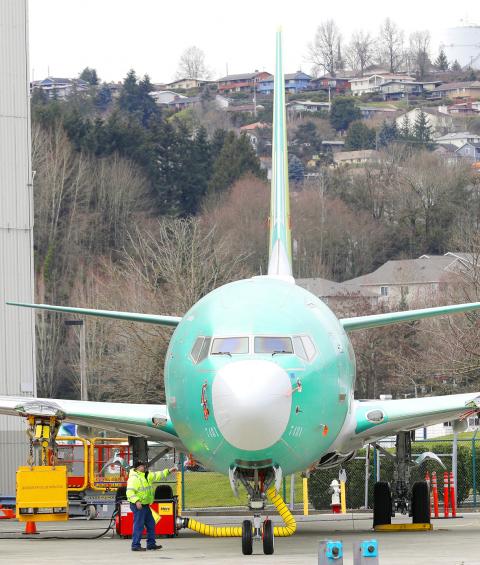
Photo: AP
Boeing shares sank 6.1 percent to US$396.62 at 3:21pm in New York after paring losses earlier in the session of as much as 13 percent.
It was the biggest intraday decline since Sept. 17, 2001, the first day of trading after the Sept. 11, 2001 attacks.
The US has only grounded an entire model of aircraft twice in the past 40 years. The most recent time was in January 2013 after two lithium-ion battery fires on Boeing’s 787 Dreamliner model. It only acted after the second such incident occurred.
Boeing has dispatched a technical team to assist the investigation into the Ethiopian Airlines plane, which was delivered new in November last year to Africa’s biggest carrier.
The US Federal Aviation Administration (FAA), which originally certified the 737 Max, and the US National Transportation Safety Board have also joined the probe.
The cloud around the Max is emerging as the biggest crisis for Boeing CEO Dennis Muilenburg, 55, who was running company’s defense business during the Dreamliner’s grounding.
Since he took the reins in July 2015, Boeing has dramatically expanded cash flow, repurchased shares and built a US$490 billion backlog of unfilled orders. The shares have tripled, boosting the company’s market value by US$140 billion and making Boeing the most valuable US industrial company. Sales last year surpassed US$100 billion for the first time.
However, since the Lion Air crash, Boeing has been hit by concerns about the 737 Max, even though its shares have rallied.
The company and the FAA have been finalizing a software fix for an obscure anti-stall measure created for the plane that came to light with the Indonesia tragedy.
The “maneuvering characteristics augmentation system,” triggered by an erroneous sensor reading, had baffled pilots by pushing the Lion Air plane downward dozens of times before it crashed.
The flight-control software is activated without pilot input when a sensor measuring the angle that a plane’s nose is flying relative to the wind indicates the aircraft might be approaching a mid-flight stall.
However, the software only operates when a plane is being flown manually with its flaps retracted, according to a memo provided to Southwest Airlines pilots dated on Nov. 10 last year following the Lion Air crash.
Flaps are typically extended to provide lift as airplanes climb after takeoff.
Boeing responded to the earlier crash by advising pilots that the Max’s so-called angle-of-attack sensor could provide false readings, causing the plane’s computers to erroneously detect a stall.
That in turn could prompt the aircraft to dive as long as 10 seconds to regain the speed the computer thinks is needs to keep flying.
Pilots could counteract the sudden downward tilt by flipping two switches and manually holding the aircraft stable, the plane maker said.
“The crash may show insufficient training for the new stall prevention systems on the 737 Max. It’s unlikely due to design flaws, and the plane is likely to stay in service,” global aviation analyst George Ferguson said.
The single-aisle 737 forms the backbone of many global airline fleets, which use the model and Airbus SE’s competing A320 line on shorter routes.
The 737 Max, which debuted in May 2017, is poised to generate about US$30 billion in annual revenue as factory output rises to a 57-jet monthly pace this year, according to Bloomberg Intelligence.
Airbus is also studying a major production boost of its upgraded A320neo.
While groundings of the Max probably would not spur mass order cancelations, “this nevertheless spurs worries that the Max is flawed and could lose share to the Neo if customers, pilots and/or passengers sour on the aircraft,” Citigroup Inc analyst Jonathan Raviv said.
“But at the end of the day, these sorts of issues are usually resolved with the fact that they’re still flying in the US, suggesting this will be the ultimate outcome,” Raviv said in a note to clients.
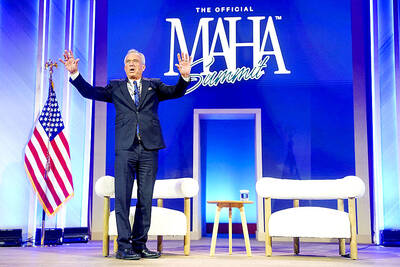
Sweeping policy changes under US Secretary of Health and Human Services Robert F. Kennedy Jr are having a chilling effect on vaccine makers as anti-vaccine rhetoric has turned into concrete changes in inoculation schedules and recommendations, investors and executives said. The administration of US President Donald Trump has in the past year upended vaccine recommendations, with the country last month ending its longstanding guidance that all children receive inoculations against flu, hepatitis A and other diseases. The unprecedented changes have led to diminished vaccine usage, hurt the investment case for some biotechs, and created a drag that would likely dent revenues and
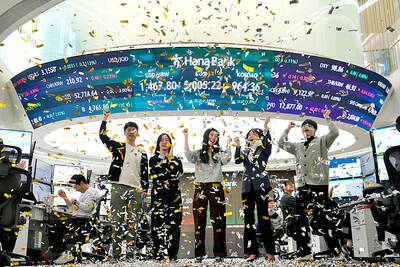
Global semiconductor stocks advanced yesterday, as comments by Nvidia Corp chief executive officer Jensen Huang (黃仁勳) at Davos, Switzerland, helped reinforce investor enthusiasm for artificial intelligence (AI). Samsung Electronics Co gained as much as 5 percent to an all-time high, helping drive South Korea’s benchmark KOSPI above 5,000 for the first time. That came after the Philadelphia Semiconductor Index rose more than 3 percent to a fresh record on Wednesday, with a boost from Nvidia. The gains came amid broad risk-on trade after US President Donald Trump withdrew his threat of tariffs on some European nations over backing for Greenland. Huang further
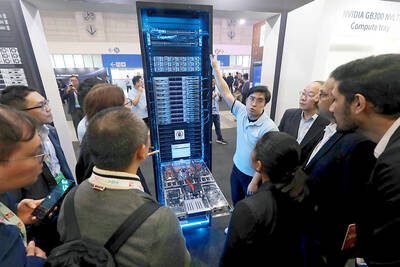
Nvidia Corp’s GB300 platform is expected to account for 70 to 80 percent of global artificial intelligence (AI) server rack shipments this year, while adoption of its next-generation Vera Rubin 200 platform is to gradually gain momentum after the third quarter of the year, TrendForce Corp (集邦科技) said. Servers based on Nvidia’s GB300 chips entered mass production last quarter and they are expected to become the mainstay models for Taiwanese server manufacturers this year, Trendforce analyst Frank Kung (龔明德) said in an interview. This year is expected to be a breakout year for AI servers based on a variety of chips, as
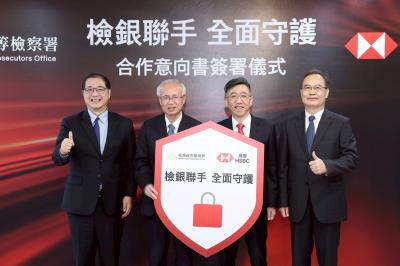
HSBC Bank Taiwan Ltd (匯豐台灣商銀) and the Taiwan High Prosecutors Office recently signed a memorandum of understanding (MOU) to enhance cooperation on the suspicious transaction analysis mechanism. This landmark agreement makes HSBC the first foreign bank in Taiwan to establish such a partnership with the High Prosecutors Office, underscoring its commitment to active anti-fraud initiatives, financial inclusion, and the “Treating Customers Fairly” principle. Through this deep public-private collaboration, both parties aim to co-create a secure financial ecosystem via early warning detection and precise fraud prevention technologies. At the signing ceremony, HSBC Taiwan CEO and head of banking Adam Chen (陳志堅)


 RSS
RSS