


Yulon Motor Co (裕隆汽車) yesterday lowered its local auto sales forecast for this year to 425,000 units as consumers are cautious on purchasing luxury goods amid growing economic uncertainty due to US-China trade tensions.
The local car market is likely to enter its first annual decline since 2015 and shrink 2.2 percent from 435,000 units last year, Yulon said.
Next year, overall car sales are to remain above 400,000 units, the company added.
“Cars are luxuries and are vulnerable to economic changes,” Yulon president Yao Chen-hsiang (姚振祥) told reporters on the sidelines of an investors’ conference in Taipei.
In addition, replacement demand is waning as most owners of older cars have already replaced their vehicles as the government’s incentive program is in its third year, Yao said.
About 30 to 40 percent of new car sales are from replacement demand, he added.
The government provides subsidies and tax credits for new car purchases to encourage replacements in a bid to curb polluting emissions. The program began in 2016 and is to end in 2020.
Local automakers are competing with global brands that are gaining advantages from a weak euro, richer product lineups and cost advantages, Yulon said.
This year, domestic automakers are to see unit sales dip to about 210,000 units after an annual decline of 3 percent over the past six or seven years, Yao said.
That might bring domestic automakers’ market share down to as low as 50 percent.
“This is a serious warning to domestic carmakers,” Yao said. “We are more cautious about rolling out new models. We will only launch models that are cost-efficient and have economic scale.”
Yulon said it expects domestic sales of its Luxgen (納智捷) brand to plummet 33.3 percent to about 10,000 units this year.
Luxgen sales are expected to rebound by 50 percent next year to about 15,000 units after a new sport utility vehicle (SUV) and some revamped models hit the market, Yulon said.
In China, Luxgen sales this year are forecast to dip 49.2 percent year-on-year to 9,500 units, the company said.
Next year, Yulon aims to boost Luxgen sales by 53.8 percent to 15,000 units, driven by new car launches, including an electric model, it said.
Dongfeng Yulon Motor Co (東風裕隆), Yulon’s joint venture with China’s Dongfeng Automobile Co (東風汽車), helps sell Luxgen cars in China.
Yulon Nissan Motor Co (裕隆日產), another subsidiary, is keeping its car sales forecast unchanged at 35,000 units next year, compared with this year.
Yulon Nissan’s new compact SUV, Kicks, has received strong orders of 2,000 vehicles since its launch last month, the firm said.
Meanwhile, Yulon said its NT$40 billion (US$1.29 billion) land development project in New Taipei City’s Sindian District (新店) would not start to contribute revenue until 2023, rather than 2022 as originally planned.
The company plans to start presales of commercial units in the project in the first quarter of 2020, while no timetable has been set for residential sales due to a gloomy property outlook.
Yulon posted a 36 percent annual decline in net profit for the first three quarters to NT$1.12 billion, compared with NT$1.74 billion in the same period last year. Earnings per share dropped to NT$1.11 from NT$1.43.

SECOND-RATE: Models distilled from US products do not perform the same as the original and undo measures that ensure the systems are neutral, the US’ cable said The US Department of State has ordered a global push to bring attention to what it said are widespread efforts by Chinese companies, including artificial intelligence (AI) start-up DeepSeek (深度求索), to steal intellectual property from US AI labs, according to a diplomatic cable. The cable, dated Friday and sent to diplomatic and consular posts around the world, instructs diplomatic staff to speak to their foreign counterparts about “concerns over adversaries’ extraction and distillation of US AI models.” Distillation is the process of training smaller AI models using output from larger, more expensive ones to lower the costs of training a powerful new
Micron Technology Inc is a driving force pushing the US Congress to pass legislation that would put new export restrictions on equipment its Chinese competitors use to make their chips, according to people familiar with the matter. A US House of Representatives panel yesterday was to vote on the “MATCH Act,” a bill designed to close gaps in restrictions on chipmaking equipment. It would also pressure foreign companies that sell equipment to Chinese chipmaking facilities to align with export curbs on US companies like Lam Research Corp and Applied Materials Inc. The bill targets facilities operated by China’s ChangXin Memory Technologies Inc

Singapore-based ride-hailing and delivery giant Grab Holdings’ planned acquisition of Foodpanda’s Taiwan operations has yet to enter the formal review stage, as regulators await supplementary documents, the Fair Trade Commission (FTC) said yesterday. Acting FTC Chairman Chen Chih-min (陳志民) told the legislature’s Economics Committee that although Grab submitted its application on March 27, the case has not been officially accepted because required materials remain incomplete. Once the filing is finalized, the FTC would launch a formal probe into the deal, focusing on issues such as cross-shareholding and potential restrictions on market competition, Chen told lawmakers. Grab last month announced that it would acquire
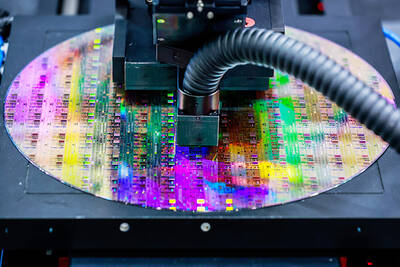
The artificial intelligence (AI) boom has triggered a seismic reshuffling of global equity markets, with Taiwan and South Korea muscling past European nations one by one. With its stock market now valued at nearly US$4.3 trillion, Taiwan surpassed the UK, Europe’s biggest market, earlier this month, data compiled by Bloomberg showed. South Korea is about US$140 billion away from doing the same. The tech-heavy Asian markets have shot past Germany and France in the past seven months. The shift is largely down to massive gains in shares of three companies that provide essential hardware for AI: Taiwan Semiconductor Manufacturing Co (TSMC, 台積電),


 RSS
RSS