


Taiwan Cement Corp (TCC, 台灣水泥) yesterday said that its board of directors has greenlit a US$1.1 billion investment in Turkey’s OYAK Cimento AS to expand the company’s presence beyond Asia as the Chinese market becomes increasingly saturated.
The Turkish firm is fully owned by Ordu Yardimlasma Kurumu (OYAK), the pension fund of the Turkish Armed Forces.
TCC said it would begin negotiating the terms of a joint venture holding company with OYAK, which would control the Turkish company’s domestic cement businesses.
The joint venture, tentatively named Dutch TCC Holdings, would be 40 percent owned by TCC, with OYAK controlling 60 percent, TCC said in a filing with the Taiwan Stock Exchange.
That would enable the Taiwanese firm to tap into OYAK’s 16 percent share of the Turkish cement market, with annual demand estimated at about 73 million tonnes, TCC senior vice president Edward Huang (黃健強) told a news conference at the exchange before the opening bell.
OYAK has 13 cement clinker production lines with annual output of 12 million tonnes, as well as 45 ready-mix concrete plants across Turkey, Huang said.
TCC hopes to leverage the Turkish company’s well-established position in Mediterranean markets to expand both firms’ global reach.
“Our companies share similar and aligned goals,” Huang said regarding OYAK’s motivation to ally with TCC.
TCC has an annual cement production capacity of 75 million tonnes, making it the sixth-largest in the Greater China region, Huang said, adding that its growth and expansion prospects are limited in its existing markets.
Apart from a rapidly saturating market in China, TCC’s expansion efforts have also been curtailed by Beijing’s calls for output cuts, as well as seasonal production shutdowns due to environmental restrictions, Huang said, adding that such measures have become a recurring factor affecting its business there.
TCC and OYAK have not yet formally sealed the deal, but Huang said that agreements such as a memorandum of understanding are better suited for acquisition of assets or corporate stakes.
“Negotiations would be focused on finalizing the joint venture’s shareholder structure,” Huang said, adding that TCC would provide updates as progress is made.
While OYAK’s business is primarily domestic, the partnership has not ruled out expanding sales to Europe and Africa, Huang said.
Following the announcement, shares in TCC rose to an intraday high of NT$34.45 before dropping 1.47 percent to close at NT$33.5 in Taipei trading, while the TAIEX dipped 0.33 percent to 9,489.18 points.
TCC earlier reported that revenue in the first nine months of the year rose 30.03 percent from the same period last year to NT$89.66 billion (US$2.89 billion) as prices were boosted by tight supply in China.
The planned investment still needs approval from various authorities, including the Investment Commission.

GROWING OWINGS: While Luxembourg and China swapped the top three spots, the US continued to be the largest exposure for Taiwan for the 41st consecutive quarter The US remained the largest debtor nation to Taiwan’s banking sector for the 41st consecutive quarter at the end of September, after local banks’ exposure to the US market rose more than 2 percent from three months earlier, the central bank said. Exposure to the US increased to US$198.896 billion, up US$4.026 billion, or 2.07 percent, from US$194.87 billion in the previous quarter, data released by the central bank showed on Friday. Of the increase, about US$1.4 billion came from banks’ investments in securitized products and interbank loans in the US, while another US$2.6 billion stemmed from trust assets, including mutual funds,
Micron Memory Taiwan Co (台灣美光), a subsidiary of US memorychip maker Micron Technology Inc, has been granted a NT$4.7 billion (US$149.5 million) subsidy under the Ministry of Economic Affairs A+ Corporate Innovation and R&D Enhancement program, the ministry said yesterday. The US memorychip maker’s program aims to back the development of high-performance and high-bandwidth memory chips with a total budget of NT$11.75 billion, the ministry said. Aside from the government funding, Micron is to inject the remaining investment of NT$7.06 billion as the company applied to participate the government’s Global Innovation Partnership Program to deepen technology cooperation, a ministry official told the
Taiwan Semiconductor Manufacturing Co (TSMC, 台積電), the world’s leading advanced chipmaker, officially began volume production of its 2-nanometer chips in the fourth quarter of this year, according to a recent update on the company’s Web site. The low-key announcement confirms that TSMC, the go-to chipmaker for artificial intelligence (AI) hardware providers Nvidia Corp and iPhone maker Apple Inc, met its original roadmap for the next-generation technology. Production is currently centered at Fab 22 in Kaohsiung, utilizing the company’s first-generation nanosheet transistor technology. The new architecture achieves “full-node strides in performance and power consumption,” TSMC said. The company described the 2nm process as
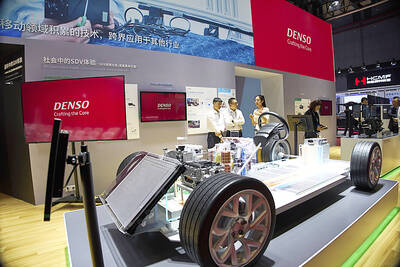
JOINT EFFORTS: MediaTek would partner with Denso to develop custom chips to support the car-part specialist company’s driver-assist systems in an expanding market MediaTek Inc (聯發科), the world’s largest mobile phone chip designer, yesterday said it is working closely with Japan’s Denso Corp to build a custom automotive system-on-chip (SoC) solution tailored for advanced driver-assistance systems and cockpit systems, adding another customer to its new application-specific IC (ASIC) business. This effort merges Denso’s automotive-grade safety expertise and deep vehicle integration with MediaTek’s technologies cultivated through the development of Media- Tek’s Dimensity AX, leveraging efficient, high-performance SoCs and artificial intelligence (AI) capabilities to offer a scalable, production-ready platform for next-generation driver assistance, the company said in a statement yesterday. “Through this collaboration, we are bringing two


 RSS
RSS