


Local textile manufacturers expect to sign US$85 million of new orders at the annual Taipei Innovative Textile Show from Oct. 16 to 18, as demand grows for higher-priced functional textiles used mostly in sports and outdoor apparel, organizers said yesterday.
That would represent about 21 percent annual growth from US$70 million in orders last year, an initial estimate by the Taiwan Textile Federation (TTF) showed.
Robust growth was already reflected in the 2 percent annual growth in textile exports to US$5.89 billion from January to July this year, and the full-year increase could be larger, as the traditional peak season falls in the second half, the federation said.
Last year, textile exports grew by an anemic 0.8 percent to US$10 billion, it said.
SMART FABRIC
“Taiwanese textile manufacturers are becoming the top choice for global [apparel and shoe] brands and retailers whenever they want to experiment with new textiles,” TTF president Justin Huang (黃偉基) told reporters on the sidelines of a news conference in Taipei. “Such new products usually carry higher price tags.”
Ruentex Industries Ltd (潤泰全球) has set an example in the smart medical textile market, Huang said.
The company earlier this year landed an order to supply 60 million units of smart medical clothes equipped with sensors that measure blood pressure and heartbeat, the federation said.
Smart medical apparel and army clothing are the two biggest markets for new functional textiles, Huang said.
Sports apparel, outdoor wear and sports shoes have been the main sources of revenue for local textile makers.
Together, Taiwanese textile manufacturers supply 40 percent of materials used in Nike Inc-branded shoes, and 20 percent of materials for Adidas AG shoes, TTF data showed.
TRADE WAR
Commenting on the consequences of the escalating US-China trade war, Huang said that local textile makers would benefit from the trade disputes in the long run as major global retailers seek to relocate their Chinese plants to Southeast Asian and African nations or India to circumvent new import tariffs imposed by US President Donald Trump.
Trump last month imposed a 10 percent tariff on US$200 billion of Chinese goods that include textiles and clothing, and the tariffs could go up to 25 percent in January next year.
“Taiwanese textile suppliers might benefit from such supply-chain shifts. They will not face a higher tax burden, as they could ship their products to the US from their factories in Vietnam or in Taiwan,” Huang said.
This year’s show at Nangang Exhibition Hall in Taipei is to see a record number of participants, he said, adding that about 456 companies are to showcase new products during the show, up from 380 last year.
Formosa Plastics Group’s (台塑集團) textile arms Formosa Chemicals & Fibre Corp (台化) and Formosa Taffeta Co (福懋興業) are to return to the show to present new products, organizers said, adding that they were absent from the show last year.
Textile makers Far Eastern New Century Corp (遠東新世紀), Eclat Textile Co (儒鴻), Lealea Enterprise Co (力麗) and Tex-ray Industrial Co Ltd (南緯實業) would also join the show, they said.
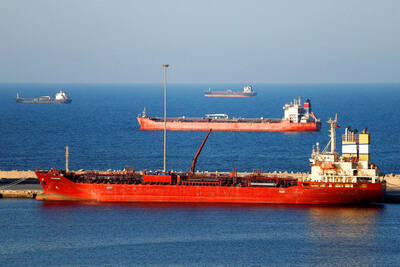
HORMUZ ISSUE: The US president said he expected crude prices to drop at the end of the war, which he called a ‘minor excursion’ that could continue ‘for a little while’ The United Arab Emirates (UAE) and Kuwait started reducing oil production, as the near-closure of the crucial Strait of Hormuz ripples through energy markets and affects global supply. Abu Dhabi National Oil Co (ADNOC) is “managing offshore production levels to address storage requirements,” the company said in a statement, without giving details. Kuwait Petroleum Corp said it was lowering production at its oil fields and refineries after “Iranian threats against safe passage of ships through the Strait of Hormuz.” The war in the Middle East has all but closed Hormuz, the narrow waterway linking the Persian Gulf to the open seas,

Apple Inc increased iPhone production in India by about 53 percent last year and now makes a quarter of its marquee devices there, reflecting the US company’s efforts to avoid tariffs on China. The company assembled about 55 million iPhones in India last year, up from 36 million a year earlier, people familiar with the matter said, asking not to be named because the numbers aren’t public. Apple makes about 220 million to 230 million iPhones a year globally, with India’s share of the total increasing rapidly. Apple has accelerated its expansion in the world’s most populous country in recent years, bolstered

RATIONING: The proposal would give the Trump administration ample leverage to negotiate investments in the US as it decides how many chips to give each country US officials are debating a new regulatory framework for exporting artificial intelligence (AI) chips and are considering requiring foreign nations to invest in US AI data centers or security guarantees as a condition for granting exports of 200,000 chips or more, according to a document seen by Reuters. The rules are not yet final and could change. They would be the first attempt to regulate the flow of AI chips to US allies and partners since US President Donald Trump’s administration said it rescinded its predecessor’s so-called AI diffusion rules. Those rules sought to keep a significant amount of AI

HEADWINDS: The company said it expects its computer business, as well as consumer electronics and communications segments to see revenue declines due to seasonality Pegatron Corp (和碩) yesterday said it aims to grow its artificial intelligence (AI) server revenue more than 10-fold this year from last year, driven by orders from neocloud solutions clients and large cloud service providers. The electronics manufacturing service provider said AI server revenue growth would be driven primarily by the Nvidia Corp GB300 server platform. Server shipments are expected to increase each quarter this year, with the second half likely to outperform the first half, it said. The AI server market is expected to broaden this year as more inference applications emerge, which would drive demand for system-on-chip, application-specific integrated circuits


 RSS
RSS