


The manufacturing purchasing managers’ index (PMI) slowed to 53.9 last month from a month earlier, as operating conditions remained fair, but momentum subsided amid US-China trade tensions, the Chung-Hua Institution for Economic Research (CIER, 中華經濟研究院) said yesterday.
The sub-index for export orders showed a bleak outlook for the next six month, as it dropped below the neutral threshold for the first time in more than two years, with manufacturers expressing concern that the tariff row between the US and China was dampening demand for technology products, as shown by lackluster smartphone sales, the Taipei-based think tank said.
“The slowdown in the latest PMI data showed that Taiwan is taking a hit from the trade conflicts,” CIER acting president Wang Jiann-chyuan (王健全) told a media briefing.
The US seems to consider China its biggest economic competitor, and seeks to persuade companies to shift manufacturing bases from China to other countries, Wang said.
The development is unfavorable to China, which is Taiwan’s largest trading partner and accounts for more than 40 percent of outbound shipments.
PMI and non-manufacturing index (NMI) readings seek to gauge the health of the nation’s manufacturing and non-manufacturing sectors, with scores above 50 indicating business expansion, while values below the benchmark suggest contraction.
Almost all sub-indices shed points with the reading on new export orders shrinking from 52.9 points to 48.7 points, while business prospects over the next six months slipped from 54.1 points to 47.6 points, the CIER survey found.
“There is no denying that major economic data at home and abroad are losing steam, although the pace is benign thus far,” Academia Sinica’s Institute of Economics director Kamhon Kan (簡錦漢) said.
Tensions might continue for a while, as there are no concrete signs of rapprochement on the horizon, Kan added.
The Nikkei PMI survey showed similar results with a score of 50.8 points, marginally above the expansion mark.
Annabel Fiddes, principle economist at IHS Markit, which compiles the Nikkei survey, said that last month’s PMI data were disappointing, as readings for production and new orders declined for the first time in more than two years.
“Companies linked the fall in new business to softer demand at home and overseas,” Fiddes said in a statement.
Export sales declined at the quickest pace since early 2016 and firms cited weaker demand across key markets such as China, Europe and the US, the Nikkei survey showed.
Input prices and inventories rose only modestly, while employment expanded at a fractional pace, suggesting that conditions might remain muted for months, Fiddes added.
The slowdown extended to non-manufacturing sectors in Taiwan with the NMI falling from 52.6 points in August to 50.8 points last month, a separate CIER report showed.
At 44.8 points, the sub-index for service-oriented sectors indicated a bleaker outlook for the next six months, the report said, while sub-indices for restaurant operators and financial firms indicated the bleakest outlook with 30 points and 37 points respectively.

SECOND-RATE: Models distilled from US products do not perform the same as the original and undo measures that ensure the systems are neutral, the US’ cable said The US Department of State has ordered a global push to bring attention to what it said are widespread efforts by Chinese companies, including artificial intelligence (AI) start-up DeepSeek (深度求索), to steal intellectual property from US AI labs, according to a diplomatic cable. The cable, dated Friday and sent to diplomatic and consular posts around the world, instructs diplomatic staff to speak to their foreign counterparts about “concerns over adversaries’ extraction and distillation of US AI models.” Distillation is the process of training smaller AI models using output from larger, more expensive ones to lower the costs of training a powerful new

Micron Technology Inc is a driving force pushing the US Congress to pass legislation that would put new export restrictions on equipment its Chinese competitors use to make their chips, according to people familiar with the matter. A US House of Representatives panel yesterday was to vote on the “MATCH Act,” a bill designed to close gaps in restrictions on chipmaking equipment. It would also pressure foreign companies that sell equipment to Chinese chipmaking facilities to align with export curbs on US companies like Lam Research Corp and Applied Materials Inc. The bill targets facilities operated by China’s ChangXin Memory Technologies Inc

Singapore-based ride-hailing and delivery giant Grab Holdings’ planned acquisition of Foodpanda’s Taiwan operations has yet to enter the formal review stage, as regulators await supplementary documents, the Fair Trade Commission (FTC) said yesterday. Acting FTC Chairman Chen Chih-min (陳志民) told the legislature’s Economics Committee that although Grab submitted its application on March 27, the case has not been officially accepted because required materials remain incomplete. Once the filing is finalized, the FTC would launch a formal probe into the deal, focusing on issues such as cross-shareholding and potential restrictions on market competition, Chen told lawmakers. Grab last month announced that it would acquire
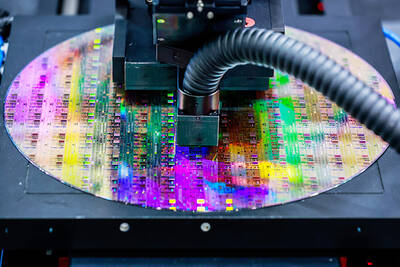
The artificial intelligence (AI) boom has triggered a seismic reshuffling of global equity markets, with Taiwan and South Korea muscling past European nations one by one. With its stock market now valued at nearly US$4.3 trillion, Taiwan surpassed the UK, Europe’s biggest market, earlier this month, data compiled by Bloomberg showed. South Korea is about US$140 billion away from doing the same. The tech-heavy Asian markets have shot past Germany and France in the past seven months. The shift is largely down to massive gains in shares of three companies that provide essential hardware for AI: Taiwan Semiconductor Manufacturing Co (TSMC, 台積電),


 RSS
RSS