


The Ministry of Economic Affairs’ Investment Commission on Friday last week approved a NT$9.35 billion (US$304.40 million) buyout of medical equipment maker Microlife Corp (百略) by an affiliate of Morgan Stanley Private Equity Asia.
Microlife in March announced that it had agreed to sell all of its shares to Midas Health Co Ltd at NT$84.74 per share, a 17.85 percent premium over the stock’s 20-day average closing price of NT$71.9.
The company is to be delisted from the local bourse next month, the commission said.
Midas Health is part of a US$1.7 billion closed-end private equity plan under Morgan Stanley.
Founded in 1981 and listed on the over-the-counter Taipei Exchange in 2001, Microlife is among Taiwan’s top contract designers and manufacturers of medical equipment for home use and has never posted an operating loss, while its annual earnings per share have consistently been more than NT$5 over the past five years.
The company’s own-brand products are sold in Europe and North America, and are distributed by major retailers including Walmart Inc.
Microlife vice chairman William Hsu (許盛信) in March said that the company was seeking a buyout to secure the funds it needed to cope with rising uncertainty in global markets.
Market analysts have said that the 17.85 percent premium was lower than expected and indicative of limited growth prospects in the market for digital thermometers and blood pressure monitoring systems.
The commission also approved an application by United Microelectronics Corp (UMC, 聯電) to purchase the remaining 84.1 percent of Mie Fujitsu Semiconductor Ltd for ¥57.63 billion (US$511.55 million) and gain full ownership of the Japanese company, which operates a 12-inch fab in Japan, it said in a statement.
Catcher Technology Co (可成), the nation’s leading supplier of light-metal casings and enclosures for mobile devices, received the commission’s nod to invest US$69.9 million in the China Renewable Energy Fund, a US$300 million fund started by Apple Inc and its suppliers in Asia.
Other Taiwanese suppliers to Apple have also invested in the fund, which aims to develop 1 gigawatt of renewable energy capacity in China, with Pegatron Corp (和碩) committing US$40 million, Quanta Computer Inc (廣達) US$28.2 million and Wistron Corp (緯創) US$26.8 million.
Eastern Media International Corp (東森國際) received the commission’s green light to acquire a 30 percent stake in Hong Kong-listed Natural Beauty Biotechnology Ltd, which markets skincare and aromatherapy products, for HK$540.57 million (US$69.22 million), the commission said.
The commission at the same time approved plans by Coretronic (Suzhou) Co Ltd (揚昕科技) to invest NT$300 million to set up a subsidiary in Taiwan.
The company, established by Taiwanese projector and LCD backlight manufacturer Coretronic Corp (中強光電) in Jiangsu in China’s Jiangsu Province, is looking to mitigate the effects of the US-China trade war by establishing an industrial plastics manufacturing unit in Taiwan, the commission said.

GROWING OWINGS: While Luxembourg and China swapped the top three spots, the US continued to be the largest exposure for Taiwan for the 41st consecutive quarter The US remained the largest debtor nation to Taiwan’s banking sector for the 41st consecutive quarter at the end of September, after local banks’ exposure to the US market rose more than 2 percent from three months earlier, the central bank said. Exposure to the US increased to US$198.896 billion, up US$4.026 billion, or 2.07 percent, from US$194.87 billion in the previous quarter, data released by the central bank showed on Friday. Of the increase, about US$1.4 billion came from banks’ investments in securitized products and interbank loans in the US, while another US$2.6 billion stemmed from trust assets, including mutual funds,
AI TALENT: No financial details were released about the deal, in which top Groq executives, including its CEO, would join Nvidia to help advance the technology Nvidia Corp has agreed to a licensing deal with artificial intelligence (AI) start-up Groq, furthering its investments in companies connected to the AI boom and gaining the right to add a new type of technology to its products. The world’s largest publicly traded company has paid for the right to use Groq’s technology and is to integrate its chip design into future products. Some of the start-up’s executives are leaving to join Nvidia to help with that effort, the companies said. Groq would continue as an independent company with a new chief executive, it said on Wednesday in a post on its Web
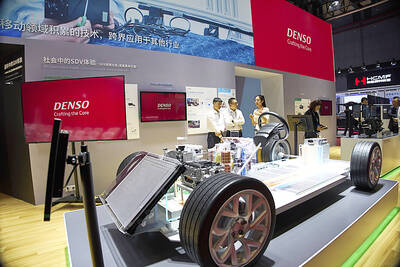
JOINT EFFORTS: MediaTek would partner with Denso to develop custom chips to support the car-part specialist company’s driver-assist systems in an expanding market MediaTek Inc (聯發科), the world’s largest mobile phone chip designer, yesterday said it is working closely with Japan’s Denso Corp to build a custom automotive system-on-chip (SoC) solution tailored for advanced driver-assistance systems and cockpit systems, adding another customer to its new application-specific IC (ASIC) business. This effort merges Denso’s automotive-grade safety expertise and deep vehicle integration with MediaTek’s technologies cultivated through the development of Media- Tek’s Dimensity AX, leveraging efficient, high-performance SoCs and artificial intelligence (AI) capabilities to offer a scalable, production-ready platform for next-generation driver assistance, the company said in a statement yesterday. “Through this collaboration, we are bringing two
Taiwan Semiconductor Manufacturing Co (TSMC, 台積電), the world’s leading advanced chipmaker, officially began volume production of its 2-nanometer chips in the fourth quarter of this year, according to a recent update on the company’s Web site. The low-key announcement confirms that TSMC, the go-to chipmaker for artificial intelligence (AI) hardware providers Nvidia Corp and iPhone maker Apple Inc, met its original roadmap for the next-generation technology. Production is currently centered at Fab 22 in Kaohsiung, utilizing the company’s first-generation nanosheet transistor technology. The new architecture achieves “full-node strides in performance and power consumption,” TSMC said. The company described the 2nm process as


 RSS
RSS