


Linde AG, the world’s largest supplier of industrial gases, plans to launch new gas separation facilities and gas distribution systems in Tainan next year to meet rising demand as semiconductor clients churn out more advanced chips from new fabs.
The new gas facilities primarily aim to supply gases to local memorychip makers and foundries, which operate cutting-edge fabs at the Southern Taiwan Science Park in Tainan. The science park is less than 10km from Tree Valley Park, where Linde’s new facilities are.
“We do see [customer] demand continuing to grow, so we also expand accordingly,” Jason Chow (周祖菴), head of Linde’s local venture, Linde LienHwa Industrial Gases Co (聯華林德), told the Taipei Times on the sidelines of the annual SEMI Taiwan trade show in Taipei on Wednesday last week.
“The latest and biggest investment is in Tainan’s Tree Valley Park, where we are building a big air separation village [facilities] and a distribution system [to deliver gas] through underground networks,” Chow said.
The facilities are to be completed next year, he said.
Chow declined to disclose the financial details of the investment in Tree Valley Park, saying Linde LienHwa has a strong commitment to continuing its investment in Taiwan to cater to customer demand.
The Linde Group has invested a combined US$1 billion in Taiwan and China over the past few years.
Linde LienHwa, a joint venture between the Munich-based group and Taiwan’s Lien Hwa Industrial Corp (聯華實業), operates four plants and an electronics research and development center at the Central Taiwan Science Park in Taichung, with about 1,600 employees in total.
The company supplies bulk gases, such as oxygen, to facilitate the operations of fabs, as well as special gases used in most chip manufacturing processes.
Linde LienHwa has built a strong customer base in Taiwan, including almost all listed chipmakers. It also helps manage on-site gas and chemical-related facilities and in-fab piping systems for clients.
As most new semiconductor investments have been in the Asia-Pacific region, the company is “shifting a lot of investment and resources to Asia, [especially to] Taiwan and China,” said Anish Tolia, Head of Global Marketing, Linde Electronics.
“Asia overall is very important to Linde. Taiwan is the biggest region for us” by revenue, Tolia said.
Linde operates several plants in Wuhan, Shanghai and other cities in China, which ranks as one of the top three markets for the group in Asia.
Overall, industrial gases is a growing market, thanks to increasing diversity of applications for semiconductors and the increasing intensity of processing and memory requirements for applications like artificial intelligence and augmented reality, Linde said in an e-mail to the Taipei Times on Friday last week.
Excluding memory chips, the world semiconductor industry is to grow at an annual pace of between 5 and 10 percent this year by revenue, Linde said in the e-mail, citing forecasts from market researchers including Gartner Inc.
More important for material and gas producers like Linde is that the number of chips produced is forecast to increase by 8 to 12 percent year-on-year this year, the company said.
The amount of chips is directly proportional to the materials and gases required to make them, it added.
Beyond that, new technologies consume more materials and more gases than previous generations, as semiconductor manufacturing process technologies become more complicated and more layers are added to make a chip, Tolia said.
Special gases, such as those used to produce advanced 3D memory chips, are to grow by a double-digit percentage this year from a year earlier, he said.

GROWING OWINGS: While Luxembourg and China swapped the top three spots, the US continued to be the largest exposure for Taiwan for the 41st consecutive quarter The US remained the largest debtor nation to Taiwan’s banking sector for the 41st consecutive quarter at the end of September, after local banks’ exposure to the US market rose more than 2 percent from three months earlier, the central bank said. Exposure to the US increased to US$198.896 billion, up US$4.026 billion, or 2.07 percent, from US$194.87 billion in the previous quarter, data released by the central bank showed on Friday. Of the increase, about US$1.4 billion came from banks’ investments in securitized products and interbank loans in the US, while another US$2.6 billion stemmed from trust assets, including mutual funds,
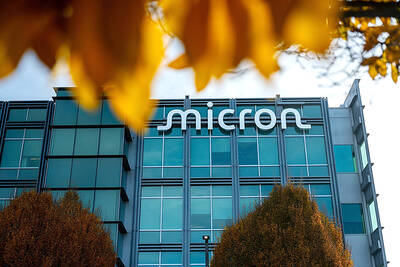
Micron Memory Taiwan Co (台灣美光), a subsidiary of US memorychip maker Micron Technology Inc, has been granted a NT$4.7 billion (US$149.5 million) subsidy under the Ministry of Economic Affairs A+ Corporate Innovation and R&D Enhancement program, the ministry said yesterday. The US memorychip maker’s program aims to back the development of high-performance and high-bandwidth memory chips with a total budget of NT$11.75 billion, the ministry said. Aside from the government funding, Micron is to inject the remaining investment of NT$7.06 billion as the company applied to participate the government’s Global Innovation Partnership Program to deepen technology cooperation, a ministry official told the
Taiwan Semiconductor Manufacturing Co (TSMC, 台積電), the world’s leading advanced chipmaker, officially began volume production of its 2-nanometer chips in the fourth quarter of this year, according to a recent update on the company’s Web site. The low-key announcement confirms that TSMC, the go-to chipmaker for artificial intelligence (AI) hardware providers Nvidia Corp and iPhone maker Apple Inc, met its original roadmap for the next-generation technology. Production is currently centered at Fab 22 in Kaohsiung, utilizing the company’s first-generation nanosheet transistor technology. The new architecture achieves “full-node strides in performance and power consumption,” TSMC said. The company described the 2nm process as
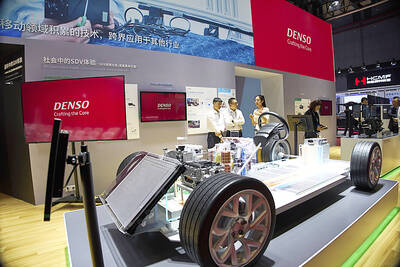
JOINT EFFORTS: MediaTek would partner with Denso to develop custom chips to support the car-part specialist company’s driver-assist systems in an expanding market MediaTek Inc (聯發科), the world’s largest mobile phone chip designer, yesterday said it is working closely with Japan’s Denso Corp to build a custom automotive system-on-chip (SoC) solution tailored for advanced driver-assistance systems and cockpit systems, adding another customer to its new application-specific IC (ASIC) business. This effort merges Denso’s automotive-grade safety expertise and deep vehicle integration with MediaTek’s technologies cultivated through the development of Media- Tek’s Dimensity AX, leveraging efficient, high-performance SoCs and artificial intelligence (AI) capabilities to offer a scalable, production-ready platform for next-generation driver assistance, the company said in a statement yesterday. “Through this collaboration, we are bringing two


 RSS
RSS