


Driven by industry innovation, global semiconductor revenue should continue to grow at an annual rate of between 5 and 6 percent in the next one to two decades, Taiwan Semiconductor Manufacturing Co (TSMC, 台積電) founder Morris Chang (張忠謀) said in Taipei yesterday.
That means the industry would continue to outpace forecast annual global GDP growth of 2.5 to 3 percent over the next 10 to 20 years, he said.
“The world semiconductor industry’s growth will be 200 to 300 basis points faster than the world GDP growth,” Chang said in a speech, entitled “A look at semiconductor companies’ rise and fall through innovations in the semiconductor industry,” at the SEMICON Taiwan Future Starts Here show, celebrating the invention of integrated circuits by Jack Kilby 60 years ago.
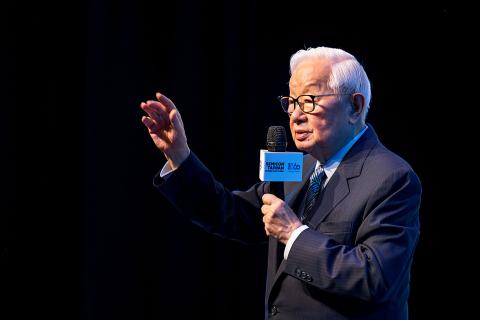
Photo: Billy H.C. Kwok, Bloomberg
Over the past 60 years, 10 major innovations have fueled the industry’s growth and benefited semiconductor companies that invested heavily in innovations, including Intel Corp and Samsung Electronics Co, Chang said.
Intel invented and invested significantly in microprocessors during the 1970s, while Samsung became an important “riser” after pouring plenty of resources into developing memory chips during the 1980s, he said.
TSMC was also one of the “risers” in the semiconductor industry over the past 30 years, aided by Chang’s development of the dedicated foundry business model in 1985 and the chipmaker’s heavy capital investments.
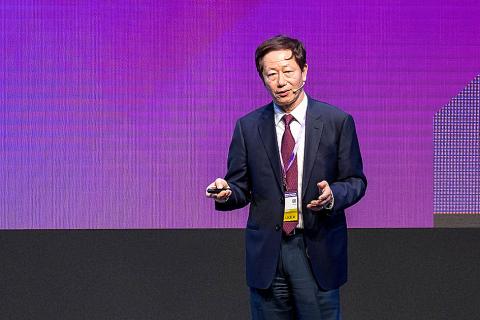
Photo: Billy H.C. Kwok, Bloomberg
Chang ranked his business model 10th on his list of 10 major innovations, which includes Moore’s law in 1965 and the invention of memory chips in 1966.
Heavy subsidies by governments, such as China and the United Arab Emirate, could be a kind of business model innovation, while artificial intelligence and machine learning chips are among innovations that are still evolving, Chang said.
As they are still evolving, it has yet to be determined which party would benefit from their progress, he added.
There “will continue to be risers and decliners in the industry. There is plenty room for more innovations,” Chang said.
In his speech in the afternoon, TSMC chairman Mark Liu (劉德音), Chang’s successor, said that innovations in the semiconductor industry are gathering pace.
It took 30 years for desktop computers to become mobile devices, but it only took 10 years to upgrade feature phones to smartphones, Liu said.
Moreover, it took only two years for autonomous cars to make the transition from desert roads to urban use, he said.
However, before self-driving cars can become a part of daily life, they would need to have 100 times more computing power than what the industry has to offer now, as well as the commercialization of 5G technology, Liu said.
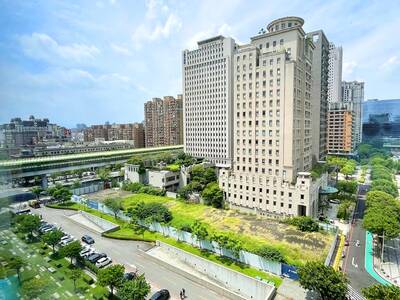
Taichung reported the steepest fall in completed home prices among the six special municipalities in the first quarter of this year, data compiled by Taiwan Realty Co (台灣房屋) showed yesterday. From January through last month, the average transaction price for completed homes in Taichung fell 8 percent from a year earlier to NT$299,000 (US$9,483) per ping (3.3m²), said Taiwan Realty, which compiled the data based on the government’s price registration platform. The decline could be attributed to many home buyers choosing relatively affordable used homes to live in themselves, instead of newly built homes in the city’s prime property market, Taiwan Realty
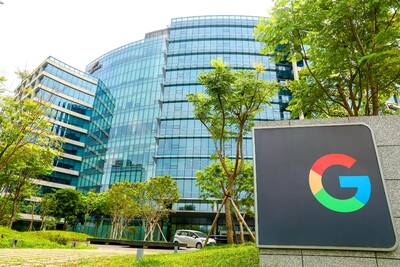
The government yesterday approved applications by Alphabet Inc’s Google to invest NT$27.08 billion (US$859.98 million) in Taiwan, the Ministry of Economic Affairs said in a statement. The Department of Investment Review approved two investments proposed by Google, with much of the funds to be used for data processing and electronic information supply services, as well as inventory procurement businesses in the semiconductor field, the ministry said. It marks the second consecutive year that Google has applied to increase its investment in Taiwan. Google plans to infuse NT$25.34 billion into Charter Investments Ltd (特許投資顧問) through its Singapore-based subsidiary Fructan Holdings Singapore Pte Ltd, and

JET JUICE: The war on Iran’s secondary effects have seen fuel prices skyrocket, knocking flight schedules down to earth in return as airlines struggle with costs Airline passengers should brace for more irritation in the next few months as carriers worldwide cancel flights and ground planes to cope with stratospheric increases in jet-fuel prices. Dutch flag carrier KLM is the latest company to cut its schedule, saying on Thursday that it would scrap 80 return flights at Amsterdam’s Schiphol Airport in the coming month. That puts it in the same league as United Airlines Holdings Inc, Deutsche Lufthansa AG and Cathay Pacific Airways Ltd, which have all pruned itineraries to mitigate costs. Global capacity for next month has been reduced by about 3 percentage points, with all
Micron Technology Inc is a driving force pushing the US Congress to pass legislation that would put new export restrictions on equipment its Chinese competitors use to make their chips, according to people familiar with the matter. A US House of Representatives panel yesterday was to vote on the “MATCH Act,” a bill designed to close gaps in restrictions on chipmaking equipment. It would also pressure foreign companies that sell equipment to Chinese chipmaking facilities to align with export curbs on US companies like Lam Research Corp and Applied Materials Inc. The bill targets facilities operated by China’s ChangXin Memory Technologies Inc


 RSS
RSS