


From iPhones to computers, the manufacturing powerhouses behind many of the world’s electronics are preparing to move chunks of production away from China and toward such far-flung locales as Eastern Europe and Southeast Asia.
Hon Hai Precision Industry Co (鴻海精密) chairman Terry Gou (郭台銘) — who became a billionaire making Apple Inc gizmos — started the ball rolling when he opened a US$10 billion display plant in the heart of the US, a move that now seems prescient.
As tensions between the world’s two largest economies escalate, a growing cohort of his Taiwanese peers have drawn up plans to shift production abroad or are devising contingencies for costly new facilities.
Taiwan’s largest corporations form a crucial link in the global tech supply chain, assembling devices from sprawling Chinese production bases that the likes of HP Inc and Dell then slap their labels on. In the past week, corporate leaders, including the chief executive officers of Pegatron Corp (和碩) and Inventec Corp (英業達), said on earnings calls that they have come up with ways to mitigate the effects of a trade war.
“We have kicked off a mechanism to reduce our current risks stemming from trade disputes,” Pegatron chief executive officer Liao Syh-jang (廖賜政) said.
In the short run, the iPhone maker might add capacity in the Czech Republic, Mexico and in Taiwan. Longer term, the company might set up shop in India or Southeast Asia, chief financial officer Charles Lin (林秋炭) added.
The impending moves by Taiwan’s six largest contract electronics makers — Compal Electronics Inc (仁寶), Hon Hai, Inventec, Pegatron, Quanta Computer Inc (廣達) and Wistron Corp (緯創) — echo a trend that has quickened in recent years. Rising labor costs have led many to consider alternatives, including setting up smaller-scale facilities elsewhere to get closer to regional markets.
Now, they can add capacity in existing non-Chinese facilities when necessary, Quanta and Compal, which make laptops for most of the world’s major brands, said.
Compal vice chairman Ray Chen (陳瑞聰) said assembling notebooks outside China could cost at least 3 percent more per unit.
However, the alternative is unsavory: The firm’s gross margin stood at slightly more than 3 percent last quarter — wafer-thin profitability that tariffs could wipe out. It is an industry-wide phenomenon: rival Quanta’s gross margin was about 4.5 percent.
“We are making dynamic adjustments so even if new tariffs on the US$200 billion Chinese exports hit, we will be able to minimize damage,” Inventec chief executive officer David Ho (何代水) told analysts on Tuesday.
Ho oversees the unit that makes AirPods and HomePods, as well as smart speakers for Sonos Inc.
To be sure, many contingency plans have not been finalized, and executives are wary about committing, given the challenges in moving production permanently, both logistical and political. Many Taiwanese firms are reluctant to provoke China, which for the most part has been a welcoming host to corporations from Taiwan.
For now, there are few signs of a full-scale exodus.
Inventec for one is adding at least one new facility in China that is to begin production next year, Ho said.
However, US President Donald Trump’s sabre-rattling is definitely making them think.
Quanta chairman Barry Lam (林百里) said his company can boost manufacturing in California and Tennessee, or Germany.
Compal could do the same for Mexico, Poland, Taiwan or Vietnam, Chen said.
“Amid the tariff rhetoric, moving investment south is a solution that makes sense for companies as Chinese incentives gradually fall, the Taiwanese government promotes its southbound investment policy and Chinese labor costs get increasingly higher,” said Angela Hsieh (謝涵涵), regional economist for Barclays Bank in Singapore.
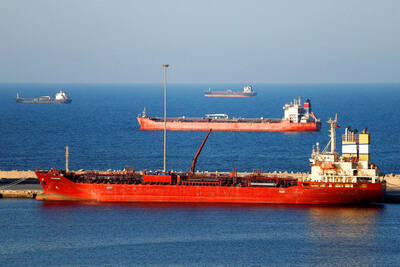
HORMUZ ISSUE: The US president said he expected crude prices to drop at the end of the war, which he called a ‘minor excursion’ that could continue ‘for a little while’ The United Arab Emirates (UAE) and Kuwait started reducing oil production, as the near-closure of the crucial Strait of Hormuz ripples through energy markets and affects global supply. Abu Dhabi National Oil Co (ADNOC) is “managing offshore production levels to address storage requirements,” the company said in a statement, without giving details. Kuwait Petroleum Corp said it was lowering production at its oil fields and refineries after “Iranian threats against safe passage of ships through the Strait of Hormuz.” The war in the Middle East has all but closed Hormuz, the narrow waterway linking the Persian Gulf to the open seas,

Taiwan has enough crude oil reserves for more than 100 days and sufficient natural gas reserves for more than 11 days, both above the regulatory safety requirement, Minister of Economic Affairs Kung Ming-hsin (龔明鑫) said yesterday, adding that the government would prioritize domestic price stability as conflicts in the Middle East continue. Overall, energy supply for this month is secure, and the government is continuing efforts to ensure sufficient supply for next month, Kung told reporters after meeting with representatives from business groups at the ministry in Taipei. The ministry has been holding daily cross-ministry meetings at the Executive Yuan to ensure
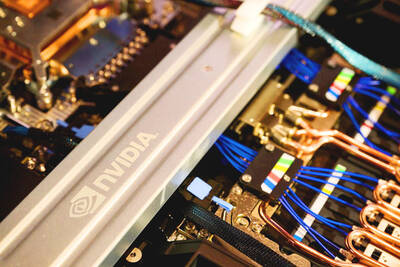
RATIONING: The proposal would give the Trump administration ample leverage to negotiate investments in the US as it decides how many chips to give each country US officials are debating a new regulatory framework for exporting artificial intelligence (AI) chips and are considering requiring foreign nations to invest in US AI data centers or security guarantees as a condition for granting exports of 200,000 chips or more, according to a document seen by Reuters. The rules are not yet final and could change. They would be the first attempt to regulate the flow of AI chips to US allies and partners since US President Donald Trump’s administration said it rescinded its predecessor’s so-called AI diffusion rules. Those rules sought to keep a significant amount of AI

A new worry has been rippling across the stock market lately: Entire businesses, not just their employees, might be thrown out of work. While most economists say fears of an artificial intelligence (AI) job apocalypse are overblown, seismic shifts have happened in the past after big tech breakthroughs. The IT revolution of the 1990s led to a surge in productivity that sped up the US economy for several years. It also rendered companies or even industries largely redundant — from travel agents and stockbrokers to classified advertising and newspapers, or video rental stores. Economists expect AI would deliver higher productivity,


 RSS
RSS