


Local shares on Friday closed little changed amid lingering geopolitical concerns after US President Donald Trump on Thursday canceled a planned summit with North Korean leader Kim Jong-un, dealers said.
While electronics heavyweights generally remained in the doldrums and petrochemical stocks were hit by a tumble in international crude oil prices, Hon Hai Precision Industry Co (鴻海精密), principal assembler of Apple Inc’s iPhones, and passive component makers attracted buying to lend support to the broader market, the dealers said.
The TAIEX on Friday ended up 5.37 points, or 0.05 percent, at 10,942.30, after moving between 10,918.12 and 10,977.81, on turnover of NT$127.9 billion (US$4.27 billion).
That was an increase of 1 percent from a close of 10,830.84 on May 18.
The market opened up 0.09 percent and moved to the day’s high on follow-through buying from a session earlier, when the weighted index closed up 0.47 percent, the dealers said.
However, with the index moving closer to the critical 11,000-point mark, the main board fell into consolidation mode as investors took cues from a fall on Wall Street, where the Dow Jones Industrial Average closed down 0.3 percent overnight due to Trump’s decision to cancel the meeting with Kim that had previously been scheduled for next month, they said.
“Few can be sure whether or when Trump and Kim will talk, and the situation remains unclear, so investors were reluctant to raise their holdings for the moment and some even disposed of liquid stocks, such as contract chipmaker Taiwan Semiconductor Manufacturing Co (TSMC, 台積電) and Formosa Plastics Corp (台灣塑膠),” KGI Securities Co (凱基證券) analyst Phil Chu (朱有志) said.
“The relatively thin turnover was also evidence of such caution amid geopolitical tension,” Chu said.
TSMC, the most heavily weighted stock on the local market, fell 0.22 percent to close at NT$228.50 after hitting NT$229.50, with 15.9 million shares changing hands, and Largan Precision Co (大立光), a smartphone camera lens supplier to Apple, ended down 0.13 percent at NT$3,995.
Among other falling large-cap stocks, Formosa Plastics shed 2.25 percent to end at NT$108.50 and Formosa Chemicals & Fibre Corp (台塑化纖) also dropped 1.71 percent to close at NT$115 after crude prices in New York fell 1.6 percent overnight.
“Fortunately, Hon Hai remained resilient and posted gains to prevent the broader market from falling into negative territory,” Chu said. “The buying in Hon Hai showed investor optimism toward a listing of subsidiary Foxconn Industrial Internet Co Ltd (富士康工業互聯網)” in Shanghai likely by the end of this month or early next month.
Hon Hai, second to TSMC in terms of market value, rose 2.85 percent to close at NT$86.50 on trading volume of 50.54 million shares.
On the back of rising passive electronics component prices, Walsin Technology Corp (華新科技) gained 8.28 percent to close at NT$340 and Holy Stone Enterprise Co (禾伸堂) added 2.11 percent to end at NT$218.
“Strong technical resistance has been in place ahead of 11,000 points,” Chu said. “I think the market needs some time to digest the pressure before having a takeoff, but an upswing trend in the longer term remains unchanged.”
Elsewhere in Asia on Friday, markets mostly fell because of the summit’s cancelation, although analysts said the losses were tempered by hopes the talks can be rekindled.
Traders had already been nervous after the US president earlier this week warned he could pull out of the June 12 meeting with the North Korean leader, while also voicing his displeasure at a deal to avert a trade war with China and threatening tariffs on car imports.
The news on Thursday took many by surprise — including North and South Korean officials — and fueled concerns about the future of a rapprochement that has had many hoping for peace on the Korean Peninsula.
In a letter released by the White House, Trump told Kim he was canceling the summit because of North Korea’s “anger” and “hostility.”
The message came after a key aide to Kim hit out at comments by US Vice President Mike Pence, saying that they were “ignorant and stupid” and warning the talks could be canceled.
However, Trump’s letter added that the talks could still go ahead “at a later date.”
For its part, Pyongyang said the decision was “unexpected” and “regrettable,” but added: “We again state to the US our willingness to sit face-to-face at any time in any form to resolve the problem.”
“It looks like we are back to ‘fire and fury’ as the modus operandi for the White House again after President Trump [threatened] a new 25 percent car import tariff and canceled the summit with North Korea,” AxiTrader chief market strategist Greg McKenna said. “Not only was the summit canceled, but it was back to threatening the DPRK [Democratic People’s Republic of Korea] with a military response.”
Asian trading was muted.
Tokyo’s Nikkei 225 on Friday edged upward 13.78 points, or 0.1 percent, to 22,450.79, but fell 2.1 percent from 22,930.36 on May 18.
Hong Kong’s Hang Seng on Friday slipped 172.37 points, or 0.6 percent, to 30,588.04, a drop of 1.5 percent from 31,047.91 a week earlier.
The Shanghai Composite on Friday slid 13.35 points, or 0.4 percent, to close at 3,141.30, falling 1.6 percent from a close of 3,193.30 on Friday last week.
Seoul’s KOSPI fell 5.21 points, or 0.2 percent, to 2,460.80, closing relatively flat from 2,460.65 on May 18.
While warning the issue remained fragile, analysts said there was still hope the meeting would go ahead.
“As we’ve seen countless times before, the president tends to walk back some of his more boisterous rhetoric time and time again,” Oanda Corp head of Asia-Pacific trading Stephen Innes said.
“While the US and their allies have offered a way to prosperity for North Korea, it was never going to come without some significant concession on the nuclear nonproliferation front,” he added.

SECOND-RATE: Models distilled from US products do not perform the same as the original and undo measures that ensure the systems are neutral, the US’ cable said The US Department of State has ordered a global push to bring attention to what it said are widespread efforts by Chinese companies, including artificial intelligence (AI) start-up DeepSeek (深度求索), to steal intellectual property from US AI labs, according to a diplomatic cable. The cable, dated Friday and sent to diplomatic and consular posts around the world, instructs diplomatic staff to speak to their foreign counterparts about “concerns over adversaries’ extraction and distillation of US AI models.” Distillation is the process of training smaller AI models using output from larger, more expensive ones to lower the costs of training a powerful new

Singapore-based ride-hailing and delivery giant Grab Holdings’ planned acquisition of Foodpanda’s Taiwan operations has yet to enter the formal review stage, as regulators await supplementary documents, the Fair Trade Commission (FTC) said yesterday. Acting FTC Chairman Chen Chih-min (陳志民) told the legislature’s Economics Committee that although Grab submitted its application on March 27, the case has not been officially accepted because required materials remain incomplete. Once the filing is finalized, the FTC would launch a formal probe into the deal, focusing on issues such as cross-shareholding and potential restrictions on market competition, Chen told lawmakers. Grab last month announced that it would acquire
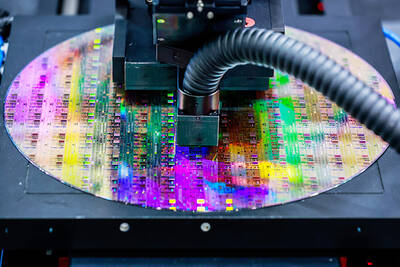
The artificial intelligence (AI) boom has triggered a seismic reshuffling of global equity markets, with Taiwan and South Korea muscling past European nations one by one. With its stock market now valued at nearly US$4.3 trillion, Taiwan surpassed the UK, Europe’s biggest market, earlier this month, data compiled by Bloomberg showed. South Korea is about US$140 billion away from doing the same. The tech-heavy Asian markets have shot past Germany and France in the past seven months. The shift is largely down to massive gains in shares of three companies that provide essential hardware for AI: Taiwan Semiconductor Manufacturing Co (TSMC, 台積電),
Shares of Taiwan Semiconductor Manufacturing Co (TSMC, 台積電) have repeatedly hit new highs, but an equity analyst said the stock’s valuation remains within a reasonable range and any pullback would likely be technical. The contract chipmaker’s historical price-to-earnings (P/E) ratio has ranged between 20 and 30, Cathay Futures Consultant Co (國泰證期) analyst Tsai Ming-han (蔡明翰) told Central News Agency. With market consensus projecting that TSMC would post earnings per share of about NT$100 (US$3.17) this year, supported by strong global demand for artificial intelligence (AI) applications, and the stock currently trading at a P/E ratio of below 25, Tsai said the valuation


 RSS
RSS