


Global index provider MSCI Inc cut Taiwan’s weighting in its Emerging Markets Index and All-Country Asia ex-Japan Index, but slightly increased the nation’s weighting in the All-Country World Index after a semi-annual review.
MSCI lowered Taiwan’s weighting in the Emerging Markets Index by 0.21 percentage points to 11.13 percent and lowered its weighting in the All-Country Asia ex-Japan Index by 0.25 percentage points to 12.84 percent.
However, it raised the nation’s weighting in the All-Country World Index by 0.02 percentage points to 1.37 percent, MSCI data showed.
Lin Liang-yi (林良一), manager of the Yuanta P-shares MSCI Taiwan ETF Fund, said the downward adjustments resulted from the inclusion of Chinese yuan-denominated A shares in the MSCI global indices.
MSCI late on Monday announced that it was adding 234 China A-shares to its global and regional indices, including the MSCI Emerging Markets Index, which is closely followed by foreign institutional investors when investing in emerging markets.
After the inclusion, China’s weighting in the MSCI Emerging Markets Index rose by 1.34 percentage points, the biggest rise among the nations in the index.
South Korea was also affected by the inclusion of Chinese A-shares in the MSCI global indices, as its weighting in the MSCI Emerging Markets Index was cut by 0.35 percentage points, the steepest decline among the nations in the index, Lin said.
Regardless, Taiwan’s economic fundamentals remain sound and should continue to attract foreign funds, Lin added.
The inclusion of Chinese A-shares in MSCI indices could lead foreign investors to pour more funds into the Chinese market in the short term, but its effects on Taiwan’s market would be limited in the longer term, Lin said.
In addition, the global index provider included Taiwan-based passive electronics component maker Walsin Technology Corp (華新科技) in the MSCI Global Standard Indices after the latest review, while removing the stock from the MSCI Global Small Cap Indices.
JPMorgan Asset Management Taiwan said the move increased Walsin Technology’s weighting in MSCI indices by 0.433 percentage points, the highest among the 20 Taiwanese stocks that benefited from a weighting increase.
Formosa Chemicals & Fibre Corp (台灣化學纖維) came in second after its weighting was raised by 0.325 percentage points, ahead of iPhone assembler Hon Hai Precision Industry (鴻海), Formosa Plastics Corp (台塑) and Nan Ya Plastics Corp (南亞塑膠), power management solution provider Delta Electronics Inc (台達電) and First Financial Holding Co (第一金控), JPMorgan said.
MSCI also lowered the weighting of 13 Taiwanese stocks, including Asia Pacific Telecom Co (亞太電信), Formosa Petrochemical Corp (台塑石化) and Standard Foods Corp (佳格食品), JPMorgan added.
Asia Pacific Telecom was removed from the MSCI Global Standard Indices, but added to the MSCI Global Small Cap Indices.
The index adjustments are scheduled to take effect after the market closes on May 31, MSCI said.

GROWING OWINGS: While Luxembourg and China swapped the top three spots, the US continued to be the largest exposure for Taiwan for the 41st consecutive quarter The US remained the largest debtor nation to Taiwan’s banking sector for the 41st consecutive quarter at the end of September, after local banks’ exposure to the US market rose more than 2 percent from three months earlier, the central bank said. Exposure to the US increased to US$198.896 billion, up US$4.026 billion, or 2.07 percent, from US$194.87 billion in the previous quarter, data released by the central bank showed on Friday. Of the increase, about US$1.4 billion came from banks’ investments in securitized products and interbank loans in the US, while another US$2.6 billion stemmed from trust assets, including mutual funds,
AI TALENT: No financial details were released about the deal, in which top Groq executives, including its CEO, would join Nvidia to help advance the technology Nvidia Corp has agreed to a licensing deal with artificial intelligence (AI) start-up Groq, furthering its investments in companies connected to the AI boom and gaining the right to add a new type of technology to its products. The world’s largest publicly traded company has paid for the right to use Groq’s technology and is to integrate its chip design into future products. Some of the start-up’s executives are leaving to join Nvidia to help with that effort, the companies said. Groq would continue as an independent company with a new chief executive, it said on Wednesday in a post on its Web
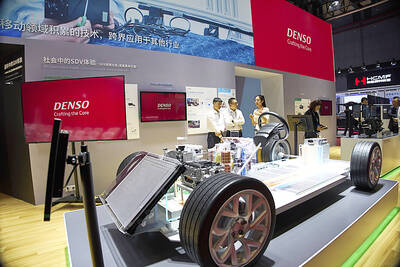
JOINT EFFORTS: MediaTek would partner with Denso to develop custom chips to support the car-part specialist company’s driver-assist systems in an expanding market MediaTek Inc (聯發科), the world’s largest mobile phone chip designer, yesterday said it is working closely with Japan’s Denso Corp to build a custom automotive system-on-chip (SoC) solution tailored for advanced driver-assistance systems and cockpit systems, adding another customer to its new application-specific IC (ASIC) business. This effort merges Denso’s automotive-grade safety expertise and deep vehicle integration with MediaTek’s technologies cultivated through the development of Media- Tek’s Dimensity AX, leveraging efficient, high-performance SoCs and artificial intelligence (AI) capabilities to offer a scalable, production-ready platform for next-generation driver assistance, the company said in a statement yesterday. “Through this collaboration, we are bringing two
Taiwan Semiconductor Manufacturing Co (TSMC, 台積電), the world’s leading advanced chipmaker, officially began volume production of its 2-nanometer chips in the fourth quarter of this year, according to a recent update on the company’s Web site. The low-key announcement confirms that TSMC, the go-to chipmaker for artificial intelligence (AI) hardware providers Nvidia Corp and iPhone maker Apple Inc, met its original roadmap for the next-generation technology. Production is currently centered at Fab 22 in Kaohsiung, utilizing the company’s first-generation nanosheet transistor technology. The new architecture achieves “full-node strides in performance and power consumption,” TSMC said. The company described the 2nm process as


 RSS
RSS